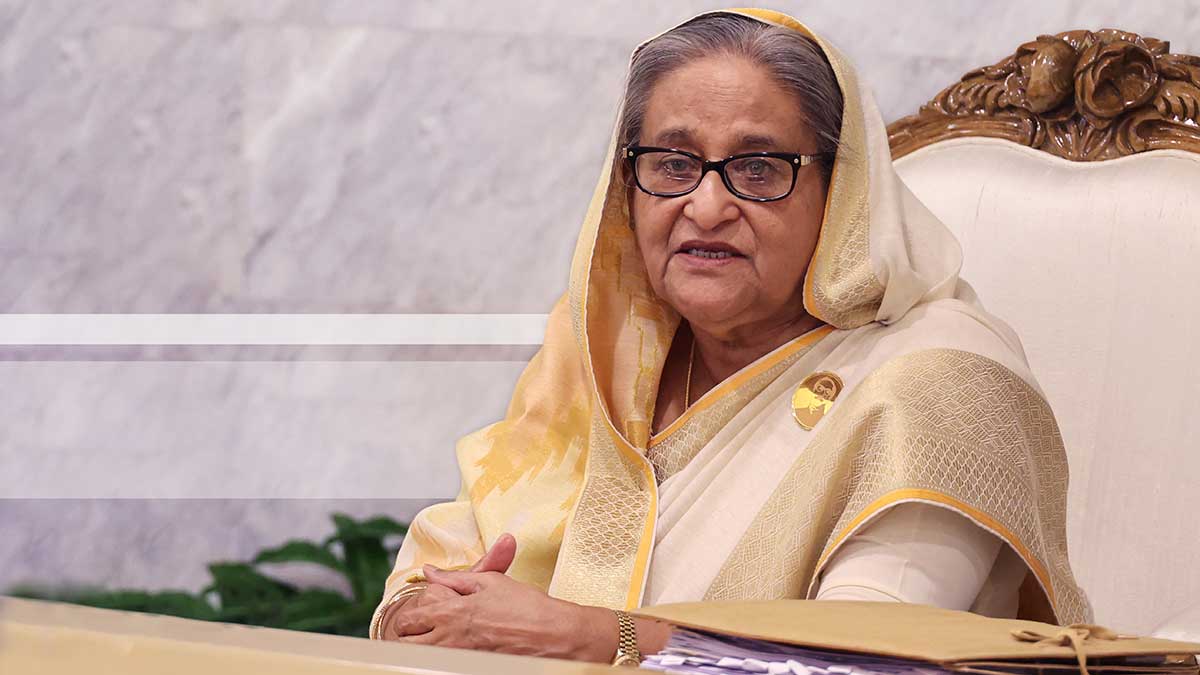
The rain over New Delhi does not care about protocols. It fell in heavy, rhythmic sheets on a Tuesday afternoon, slicking the tarmac of the technical area at the Palam Air Force Station. Down on the concrete, a door opened. A woman stepped out into the grey monsoon light, her movements measured, her face carrying the unmistakable weight of sudden, violent displacement.
Sheikh Hasina had governed Bangladesh with an iron will for fifteen years. In the span of a single afternoon, her government dissolved beneath a wave of student-led fury, leaving her fleeing across an international border with little more than the clothes on her back and forty-five minutes to pack.
India did not hesitate. Or rather, India could not afford to.
To understand why a regional superpower instantly opened its airspace, its tarmac, and its security apparatus to a deposed autocrat, you have to look beyond the cold calculus of geopolitics. You have to look at a map, and then you have to look at human nature.
Borders are lines drawn on paper by men who thought they could contain geography. But geography has a stubborn memory.
Consider a hypothetical village in West Bengal, sitting so close to the international boundary that a stray cricket ball can land in a different country. For generations, the people on both sides of that invisible line have shared dialects, wedding invitations, and grief. When the streets of Dhaka erupted into smoke and fire in the summer of 2024, the shockwaves did not stop at the checkpoints. They rattled windows across the border. Families separated by partition watched television screens in horror as police vans burned and monuments to a shared liberation history were smashed to pieces.
When a neighbor’s house catches fire, you do not check their political registration before handing them a bucket of water.
That was the core defense offered by New Delhi’s Ministry of External Affairs, albeit translated into the careful, bloodless syntax of diplomacy. It was our duty as a neighbor, officials murmured behind closed doors. But beneath the diplomatic prose lies a harsher, more fragile reality.
Power in South Asia is a delicate, web-spun glass. Pull one thread too hard, and the entire room vibrates.
For New Delhi, Hasina’s departure presented an immediate, agonizing dilemma. She was a reliable partner who had systematically dismantled anti-India insurgent camps operating along her country's eastern flank. Under her watch, trade corridors opened, security cooperation reached unprecedented levels, and the northeastern states of India enjoyed a rare, fragile peace. Her sudden fall meant the collapse of a predictable status quo.
Yet, sheltering her carried immense domestic and international peril. Millions of citizens across the border watched her leave with unmitigated joy, celebrating the end of a regime marked by authoritarian crackdowns, suppressed journalism, and disputed elections. By offering her safe haven, New Delhi risked alienating the millions of ordinary citizens now shaping Bangladesh's volatile new interim administration.
Why take that risk? Because in the high-stakes game of statecraft, the devil you know is infinitely preferable to the chaotic vacuum of the unknown.
History teaches us that nations do not have permanent friends or permanent enemies, only permanent interests. But they also have neighbors. And neighbors must live with each other long after the news cycle moves on.
Imagine standing on the balcony of a high-rise apartment, watching a storm roll in over the horizon. You can feel the pressure drop in your ears before the first flash of lightning splits the sky. That is what foreign policy feels like in the subcontinent. Events do not happen in isolation. A riot in Dhaka becomes a security crisis in Tripura. A shift in leadership in Bengal translates to altered trade routes in the Bay of Bengal.
When Hasina’s transport aircraft touched down under heavy military escort, it was an acknowledgment of this interconnected fate. India could not turn away a leader who had stood as its anchor in the east for over a decade. To do so would send a chilling signal to every regional ally: when the tide turns against you, you stand entirely alone.
And so, the diplomatic machinery swung into gear. Safe houses were secured. Communications were monitored. A delicate dance of non-interference and quiet hospitality began.
The streets of Dhaka are quieter now, though the peace remains uneasy. The interim government navigates the arduous task of rebuilding institutions from the ground up, while citizens grapple with the ghosts of a turbulent transition. Meanwhile, miles away in a secure, nondescript location guarded by elite forces, a former prime minister watches the news loop of her former life burning on television screens.
We often look at international relations as a chessboard where pieces are moved by cold logic. We forget that the board is made of wood, and the pieces are made of flesh and blood.
The border remains long. The rivers continue to flow across international lines without asking for a passport. And when the next storm breaks over the delta, the people on both sides will still look across the fence, waiting to see who is left standing in the rain.

