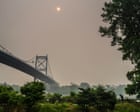
The taste of zinc sits on the back of the tongue long before the horizon turns the color of a bruised peach. In the high-altitude quiet of northern Ontario, a stand of black spruce does not explode; it sighs. A low, continuous hiss escapes the moisture-starved needles as the heat builds underneath, a subterranean furnace chewing through centuries of peat.
Consider Sarah, a hypothetical wildlife technician working the ridges near Thunder Bay. She knows the arithmetic of a drying continent by the crackle under her boots. When the canopy catches, the sound shifts from a hiss to the roar of a jet engine. The air becomes an enemy. She watches the column lift, a mile-high pillar of carbon, ash, and vaporized soil, caught by the prevailing westerlies and dragged south. Air does not acknowledge a border. It does not carry a passport. It possesses no loyalty to the mapmakers of Ottawa or Washington.
But three hundred miles away, the wind turns this ecological emergency into a political theater of the absurd.
The Air Quality of Anger
In Cleveland, Detroit, and New York, the sun is a dull orange dime hanging in a milky sky. The Air Quality Index hits 212 in Washington. Red alerts mean children stay indoors. It is an exhausting, throat-scratching reality that millions of Americans have endured for three consecutive summers. The frustration is real. The chest tightness is real.
Yet, the legislative response emerging from Capitol Hill feels detached from the friction of the earth. Ohio Senator Bernie Moreno announced the introduction of the CANADA FIRE Act, a piece of legislation designed to treat drifting particulate matter as a hostile foreign entity. The bill aims to declare a national emergency, strip Canadian diplomats of immunity by labeling them persona non grata, and halt visas for environmental officials until the northern neighbor tames its vast, wild interior.
The rhetoric escalated rapidly from policy disagreement to sovereign threat. Michigan Representative John James issued what he termed a "final warning" to Canada, remarking online that the air outside smelled like Baghdad. Other lawmakers floated the theoretical notion of annexing the northern forests entirely, or deploying American agencies to unilaterally manage the brush across the border. Donald Trump added weight to the firestorm, using his platform to accuse Canada of "willful negligence" and threatening to penalize the country through increased trade tariffs.
The political logic is simple: when the sky turns foul, find a manager to blame.
The Myth of the Controlled Wilderness
The argument rests on a comfortable illusion—the idea that the boreal forest is a manicured park waiting for a larger maintenance budget. Proponents of the sanctions argue that Canada has failed to invest in forest thinning, fuel reduction, and prescribed burns. They speak of the wilderness as if it were a suburban backyard overgrown with weeds, a crisis born entirely of bureaucratic inertia.
The reality on the ground is far more stubborn.
Canada’s boreal forest spans over one billion acres. It is a vast, roadless expanse of spruce, pine, and muskeg, much of it completely inaccessible by vehicle. To thin these forests or carry out controlled burns across even a fraction of this terrain would require an army and a budget that defies national math. More importantly, fire is not a system failure in these northern ecosystems; it is the engine of regeneration. Jack pines require the intense heat of a blaze to melt their resin-sealed cones and release their seeds. The forest has been burning and rebirthing itself since long before human boundaries cut the continent in two.
What has changed is not Canada’s management style, but the baseline temperature of the planet.
The northern woods are drying out faster than the local crews can adapt. Lightning strikes hit tinder-box soils that haven't seen a normal winter snowpack in years. When the Namaygoosisagagun First Nation north of Thunder Bay was reduced to ash this week, the residents didn't wait for a government truck. They fled in small motorboats across the water, watching their lives incinerate behind them. They were their own heroes because the scale of the fires routinely outstrips the physical capacity of any modern firefighting force.
A Shared Atmosphere
The tension highlights a deeper, more uncomfortable truth about the modern world. We are trying to solve borderless, ecological crises using the rigid tools of nineteenth-century nationalism.
The irony of threatening economic sanctions over smoke is thick. An attribution study examining decades of wildfire losses in western North America revealed that nearly forty percent of the forest area burned could be linked directly to emissions from the world's largest carbon polluters—many of whom are based in the United States, or funded by American capital. The smoke drifting into Ohio is a feedback loop, a return investment on a global economy that has treated the atmosphere as an infinite dump for two centuries.
Canadian Prime Minister Mark Carney deflected the finger-pointing during a press conference in Ontario, noting quietly that climate change is everyone’s responsibility, including the United States. It was a diplomatic reminder that nature does not negotiate with treasury departments.
A policy of isolation or economic punishment will not alter the trajectory of the jet stream. Tariffs cannot extinguish a peat fire burning three feet underground in the subarctic. If Washington chooses to restrict visas for the very Canadian land managers tasked with coordinating cross-border fire responses, it complicates the only mechanism that actually works: shared logistics and joint initial attack crews.
Consider what happens next if this precedent stands. If a nation can be sanctioned for the airborne migration of its ecological disasters, the global courtroom will quickly fill up. Should the American Southwest be penalized when its dust storms choke northern Mexican cities? Will Europe sue North Africa for the Saharan dust that shuts down Mediterranean airports?
The sky cannot be partitioned. The air we breathe is a single, recirculating sheet that binds the continent together in a contract we never signed but cannot cancel. Blaming Canada for the wind is an easy way to score a headline, but it offers no protection for the lungs of the people living below the border. The orange haze over the Capitol isn't an invasion. It is a mirror.