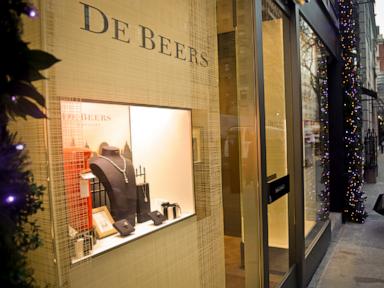
Botswana is moving to double its ownership stake in De Beers from 15 percent to 30 percent under a proposed restructuring and sale by majority owner Anglo American. On paper, Gaborone is seizing sovereign control over the crown jewel of its economy at a bargain price. In reality, the southern African nation is taking on massive financial exposure in a diamond market undergoing permanent structural decay.
The move follows Anglo American’s decision to offload its 85 percent holding in De Beers as part of a broader corporate retreat triggered by BHP’s unsuccessful takeover bid in 2024. While private equity groups, sovereign wealth funds, and luxury conglomerates have circled the world’s most famous diamond miner with hesitation, Botswana stepped forward to assert pre-emptive rights and negotiate a larger slice of the parent company. For decades, Botswana has been the quiet engine behind De Beers, supplying roughly 70 percent of the company’s rough diamond production through their 50-50 joint venture, Debswana. Moving from a 15 percent minority shareholder in the parent group to a 30 percent bloc fundamentally alters who calls the shots in Gaborone and London.
The Anatomy of a Forced Divestment
Anglo American did not put De Beers on the block because it wanted to. It did so because Wall Street and London institutional investors demanded simplification. When BHP made its multi-billion-dollar play for Anglo American, the mining giant defended itself by promising to break up its sprawling conglomerate structure, shedding coal, platinum, and diamonds to focus on copper and iron ore. De Beers became an unwanted complication.
Valuing De Beers in the current climate has proven to be a nightmare for investment bankers. Anglo American carried De Beers on its books at roughly $7 billion before writing down its value repeatedly as rough diamond prices cratered. By late 2024 and into 2025, analysts were slashing valuations to below $4 billion, with some bearish estimates dipping even lower. Finding a clean buyer at that price is difficult when the single most important asset in the portfolio—the Jwaneng and Orapa mines in Botswana—is tied up in complex, politically sensitive agreements with the host government.
Botswana’s leadership, first under former President Mokgweetsi Masisi and subsequently navigated by the administration of President Duma Boko following the historic 2024 election upset, recognized an opening. No outside buyer would pay top dollar for De Beers without Gaborone’s blessing. By positioning itself to absorb another 15 percent of the company, Botswana effectively turned a corporate fire sale into a nationalization-lite strategy.
How the Debswana Leverage Works
To understand why Botswana holds all the cards, you have to look at the mechanics of Debswana. While Botswana holds 15 percent of De Beers Group at the corporate parent level, it already owns 50 percent of Debswana, the operating company that actually pulls the stones out of the Kalahari Desert. Furthermore, under the sales agreement renegotiated in 2023, Botswana’s state-owned Okavango Diamond Company (ODC) secured the right to market 30 percent of Debswana’s output independently, with a pathway to reach 50 percent over the coming decade.
This creates an unusual corporate structure. Botswana extracts revenue at three distinct levels:
- Royalties and Taxes paid directly to the treasury on every carat mined.
- Direct Dividends from its 50 percent equity in Debswana.
- Parent-Level Returns from its stake in De Beers Group, which captures downstream margins from trading, sightholder allocations, and retail brands like Forevermark.
Increasing that parent-level stake to 30 percent gives Botswana veto power over major strategic decisions at De Beers Group. It prevents a foreign private equity buyer from stripping assets, slashing capital expenditure on underground expansions at Jwaneng, or shifting sorting and aggregation operations away from Gaborone. In 2013, Botswana fought hard to force De Beers to move its rough diamond sorting and global sales operations—the famous Sights—from London to Gaborone. Doubling the parent stake locks those jobs and that prestige inside the country permanently.
The Elephant in the Vault
Yet celebrating this as an unalloyed triumph ignores the brutal math of the global diamond trade. Botswana is buying a larger share of a shrinking pie.
For more than a century, De Beers maintained an iron grip on global diamond supply, throttling output during downturns to keep prices rising steadily. That monopoly died in the early 2000s with the rise of Russian producer Alrosa and Canadian mines. Today, an even bigger threat has broken the pricing model entirely: lab-grown diamonds.
Synthetic stones, chemically and optically identical to mined diamonds, have collapsed in production cost. A two-carat lab-grown diamond that sold for $8,000 five years ago can now be picked up at retail for under $1,000. In the United States—the world’s largest bridal jewelry market—lab-grown stones have captured roughly half of all engagement ring center-stone sales by volume.
De Beers tried to fight this fire with fire when it launched Lightbox in 2018, selling synthetic fashion jewelry at $800 per carat to deliberately tank the perceived luxury value of lab-grown stones. The strategy backfired. Instead of quarantining synthetics into a cheap fashion tier, consumers embraced the lower prices for engagement rings, dragging down the price of natural melee and mid-tier commercial goods right along with them. De Beers eventually retreated from synthetic jewelry production to refocus solely on natural stones, admitting tacitly that it could not control the narrative.
At the same time, China—once touted as the second engine of global diamond demand—has suffered a prolonged real estate and consumer confidence slump. Chinese middle-class buyers have pivoted aggressively toward 24-karat gold, which retains transparent resale value, abandoning natural diamonds that lose half their retail price the moment they leave the jeweler's counter.
What a 30 Percent Stake Actually Costs Botswana
Acquiring an additional 15 percent of De Beers does not happen through magic. Even at a depressed valuation of $4 billion to $5 billion, a 15 percent tranche represents an outlay of $600 million to $750 million. For a nation of 2.6 million people whose economy is overwhelmingly reliant on a single commodity, that is a staggering sum.
Diamond revenues account for roughly 80 percent of Botswana’s foreign exchange earnings and around a third of total government revenue. When rough diamond sales stalled in 2024 and 2025, De Beers was forced to slash production targets and stockpile millions of carats in Gaborone vaults rather than dump them onto an illiquid market. The immediate result in Botswana was a sharp contraction in GDP growth, widening fiscal deficits, and delayed infrastructure spending.
Consider a hypothetical scenario to see how this plays out on the national balance sheet. Suppose Botswana finances its increased stake using a mix of sovereign wealth reserves from the Pula Fund and syndicated bank debt backed by future diamond off-take. If rough diamond prices recover by 15 percent over the next three years, the dividend stream from a 30 percent parent stake plus 50 percent of Debswana easily services the debt and refills the treasury. If, however, natural diamond prices stagnate or fall another 10 percent due to synthetic competition, Botswana finds itself paying interest on borrowed money to own a larger share of an asset whose cash flows are drying up.
Economic concentration is the exact trap Botswana has spent forty years trying to escape. Every national development plan since the 1980s has preached diversification into tourism, financial services, beef exports, and solar energy. Doubling down on De Beers does the exact opposite. It increases Botswana’s beta—its sensitivity—to a single luxury commodity at the exact moment younger consumers are questioning whether natural diamonds are worth the premium.
Why No One Else Wanted the Whole Thing
The absence of a bidding war from major mining houses tells you everything you need to know about the risk profile of this deal. Rio Tinto, which closed its famous Argyle pink diamond mine in Australia in 2020, has shown zero appetite to return to diamonds. Glencore prefers battery metals and coal. Even LVMH, the French luxury titan that owns Tiffany & Co. and Bulgari, has kept its distance from upstream mining, recognizing that owning mines exposes luxury brands to environmental scrutiny, capital intensity, and geopolitical headaches without improving retail margins.
Upstream mining is a capital-heavy business. Open-pit mining at Jwaneng—widely considered the richest diamond mine in the world by value—is reaching depths where open-pit economics no longer work. Transitioning Jwaneng to an underground block-caving operation requires billions of dollars in upfront capital expenditure over the next decade.
Under the old structure, Anglo American shouldered the heavy lifting on corporate balance-sheet guarantees and technical engineering oversight for these megaprojects. With Anglo exiting, and Botswana rising to 30 percent alongside a fragmented group of minority financial investors or sovereign partners, the burden of funding those underground expansions falls much more heavily on cash flows generated inside Botswana. If De Beers cannot generate enough internal cash to fund Jwaneng’s underground buildout, shareholders will have to inject fresh equity or take on corporate debt.
The Geopolitical Counterweight
Still, writing off Botswana’s move as pure economic folly misses the geopolitical reality on the ground in southern Africa. For Gaborone, letting De Beers fall into the hands of an aggressive private equity consortium or an opaque foreign state-backed entity posed an existential threat.
A private equity buyer operates on a five-to-seven-year exit timeline. Their playbook is predictable: cut exploration budgets, squeeze supplier margins, load the balance sheet with debt, extract special dividends, and flip the business via an IPO. Applied to De Beers, that playbook would gut the long-term viability of Botswana’s mines and undermine the Natural Diamond Council marketing budgets needed to defend the category against synthetics.
By stepping up to 30 percent, Botswana ensures that the single largest bloc of voting power belongs to an owner with a multi-generational time horizon. Botswana cannot pack up its mines and move to another jurisdiction. Its destiny is fused to the Kalahari kimberlite pipes.
Furthermore, a larger stake gives Gaborone greater control over beneficiation—the cutting, polishing, and jewelry manufacturing sector inside Botswana. For years, rough stones were dug out of Botswana, shipped to Antwerp, cut in Surat, India, and sold on Fifth Avenue in New York, leaving Botswana with only the raw extraction value. Through the Diamond Trading Company Botswana (DTCB), the government has forced international sightholders to set up local cutting factories in Gaborone. A 30 percent seat at the parent boardroom table guarantees that local beneficiation quotas remain non-negotiable, regardless of who buys the remaining shares from Anglo American.
The Marketing Burden Ahead
Owning more of De Beers means owning more of its biggest unsolved problem: convincing Generation Z and Millennials to care about natural diamonds.
For decades, the famous "A Diamond is Forever" campaign—created by N.W. Ayer in 1947—was the most successful piece of demand engineering in modern capitalism. De Beers spent hundreds of millions of dollars annually policing the cultural expectation that a man should spend two months' salary on a natural diamond engagement ring. When De Beers lost its monopoly in the early 2000s, it stopped funding generic category marketing because it refused to pay for advertising that helped Russian and Canadian competitors sell stones.
That decision left an ideological vacuum. When lab-grown diamonds arrived, there was no unified industry voice defending the rarity, geological age, or emotional permanence of natural stones. De Beers has recently resumed generic marketing campaigns in partnership with major retailers like Signet Jewelers, attempting to draw a bright line between "real" billion-year-old stones and factory-made equivalents.
Yet marketing campaigns cost hundreds of millions of dollars upfront with uncertain payoffs. Under the new ownership structure, Botswana’s government will effectively be subsidizing global luxury advertising in New York, Shanghai, and Mumbai at a time when domestic voters in Gaborone are demanding jobs, healthcare, and economic relief. Explaining to unemployed university graduates why state capital is tied up in global diamond marketing and corporate restructuring is a delicate political tightrope for President Boko’s administration.
The Bottom Line for Investors and Observers
The restructuring of De Beers marks the end of an era that began when Cecil Rhodes founded the company in 1888. The colonial-era corporate model—where a London-listed mining conglomerate extracted wealth from southern Africa and controlled global supply from a vaulted building on Charterhouse Street—is officially dead.
In its place stands a hybrid sovereign-commercial enterprise where the host nation holds decisive sway. Botswana has won the battle for sovereignty, securing a 30 percent stake in the parent company alongside its 50 percent grip on Debswana and expanding direct sales channels through ODC. Nobody can accuse Gaborone of letting foreign miners dictate its national future.
Yet sovereignty does not guarantee profitability. By tying its treasury, its sovereign reserves, and its political capital even tighter to De Beers, Botswana has made a massive, leveraged wager that natural diamonds will survive the synthetic onslaught and reclaim their luxury aura. If the bet pays off, Botswana will cement its status as the undisputed master of the global diamond trade. If natural diamond demand continues its slow structural slide, Gaborone will discover that owning 30 percent of a fading monopoly is far more expensive than owning 15 percent.