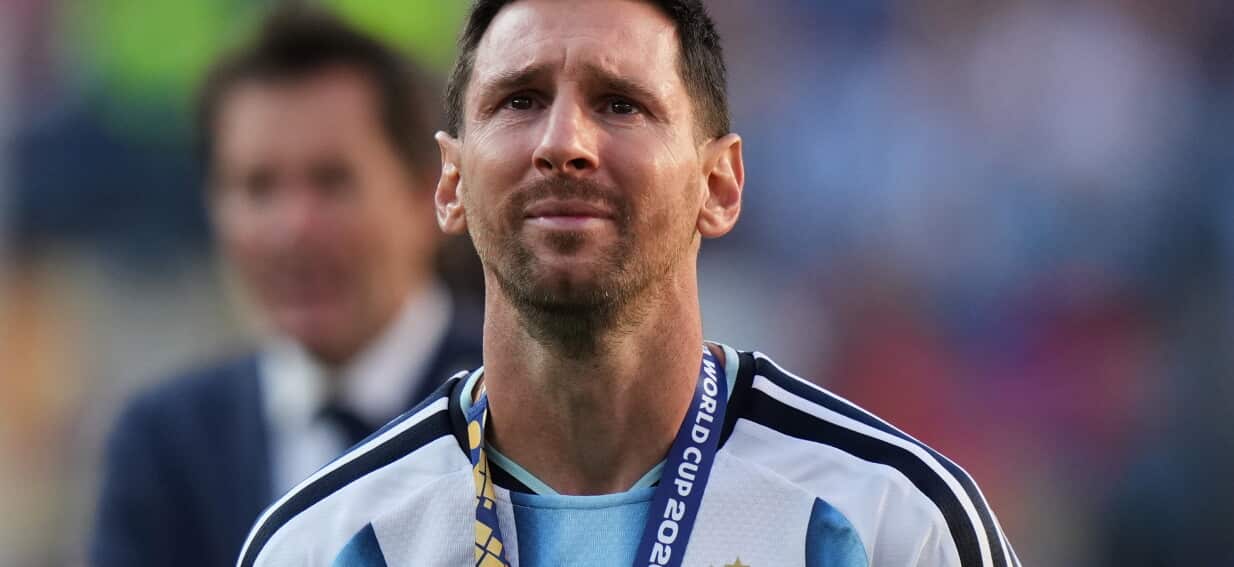
We forget that heroes are made of flesh, not marble.
On a gravel pitch in Rosario, decades ago, a small boy chased a white sphere that seemed perpetually glued to his left foot. He was too short. The doctors said so. The hormone injections were real, a daily ritual of tiny needles pressed into tired skin, paid for by a family that measured survival in pesos. But when he ran, the world stopped moving. Gravity bent to accommodate his stride.
That boy grew into a man who held the entire weight of a football-obsessed nation on his shoulders, hoisting trophies in Madrid, Paris, Miami, and finally, under the golden desert night of Qatar. He gave us magic. He gave us nineteen years of breathless commentary, eight Ballon d'Or trophies, and a World Cup final that nearly stopped time itself.
Now, the silence has arrived.
Lionel Messi has announced his retirement.
The cold dispatch from sports networks will list the numbers. The goals. The assists. The records shattered and rewritten. But numbers are an inadequate cage for a ghost. They do not capture the sound of a hundred thousand voices roaring a single surname until the stadium lights vibrate. They do not measure the quiet dignity of a man who walked away from the field with his head bowed, not in defeat, but in the heavy, beautiful exhaustion of a task finally, impossibly completed.
Consider what happens next: the cleats are hung up. The grass grows over the footprints.
For two decades, our Sundays were anchored by his rhythm. We watched him drop deep into midfield, scanning the pitch with a hunter's cold calculus before erupting into a sudden, devastating sprint. Defenders knew it was coming. They knew the left foot would shift. They knew the ball would vanish and reappear in a pocket of space that mathematically should not have existed. Yet, knowledge offered no shelter.
I remember standing in a packed pub in Buenos Aires when he missed the penalty in the 2016 Copa América final, followed by his abrupt, heartbroken international retirement. Grown men wept into their Quilmes beers. The street outside went dead silent, save for the hum of idling buses. It felt like a national bereavement. We took it personally because he was not just representing us; he was us. Flawed, doubted, burdened by history, yet refusing to break until the job was done.
When he returned, it wasn't for glory. It was for redemption.
The narrative arc of his career is not a straight line of triumphs. It is a tragedy in three acts that somehow morphed into a fairy tale. The early genius in Barcelona, wrapped in the protective embrace of Ronaldinho and Xavi. The agonizing years of near-misses with the Argentine national team, where critics sharpened their knives and whispered that he was only a club player, a mercenary of European turf who didn't bleed light blue and white.
Those whispers were scars. They burned deep.
(As a hypothetical exercise, imagine standing in the tunnel of the Maracanã in 2014, looking up at the World Cup trophy just feet away, knowing you are ninety minutes from immortality or a lifetime of bitter what-ifs. That is the invisible pressure chamber where legends are forged or crushed.)
He stayed in the chamber. He absorbed the heat.
And then came December 18, 2022. Lusail Stadium.
If you closed your eyes that night, you could hear the heartbeat of forty million people echoing across the pampas. When the final penalty hit the back of the net, Messi did not run toward the cameras. He dropped to his knees, his hands covering his face as the accumulated weight of a decades-long crusade slid off his shoulders all at once. The boy from Rosario had climbed the mountain.
That was the true ending. Everything since has been an encore, a victory lap under the neon lights of Major League Soccer, a chance to kick a ball with a smile, free from the crushing tyranny of expectation.
Now the encore is over.
We enter an uncharted epoch. Football without Messi is like a grand cathedral with a missing stained-glass window; the light still filters through, but the colors are never quite the same. Younger phenoms will rise, sprinting faster, jumping higher, powered by modern sports science and genetic lottery tickets. They will break his records. Time demands it.
Yet, numbers are easily broken. Magic is not.
You cannot replicate the way he walked across a pitch, head tilted downward, seemingly detached from the chaos around him, only to detonate into a run that left entire defensive lines grasping at thin air. You cannot coach the geometry of his vision.
The cleats are in the locker. The silence is real.
Somewhere in Rosario tonight, a small boy is kicking a worn-out football against a concrete wall, listening to the hollow thud echo into the dark, dreaming impossible dreams because a quiet man showed him they could come true.