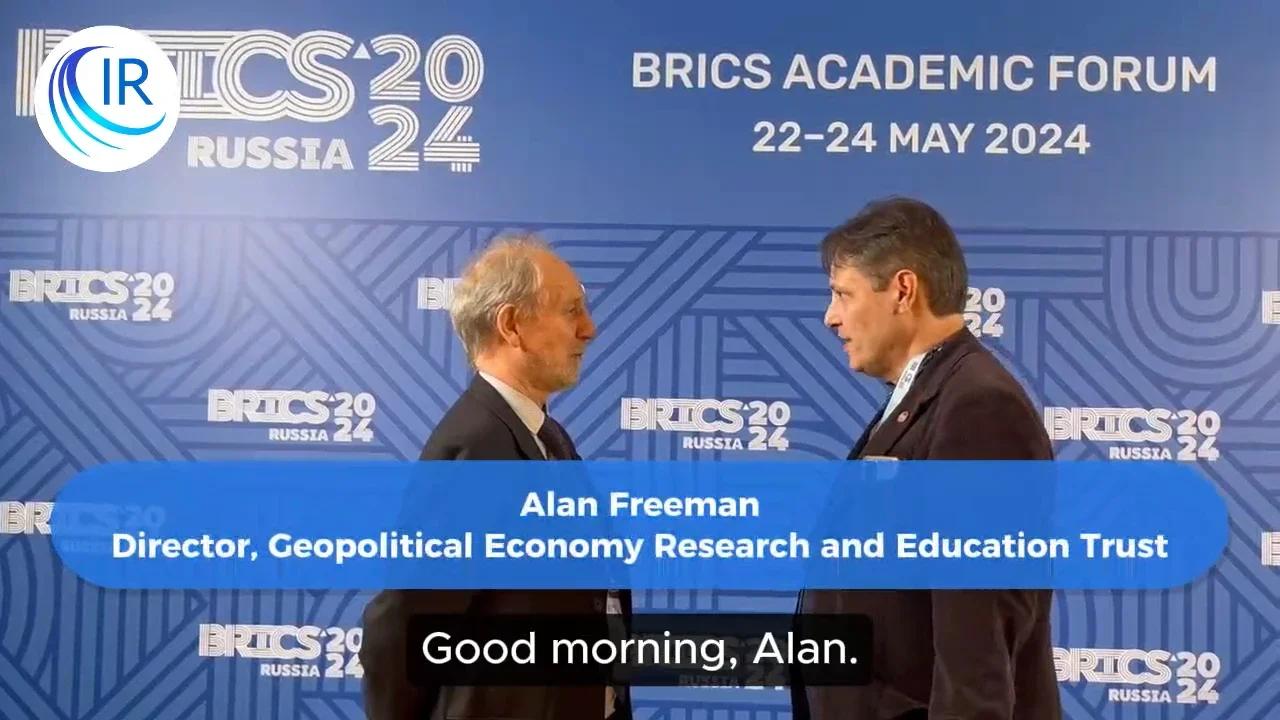
The establishment of the inaugural BRICS Academic Forum by the Observer Research Foundation (ORF) and the Russian Institute for Strategic Studies (RIS) marks a transition from informal diplomatic dialogue to a structured institutionalization of non-Western intellectual capital. This move is not merely a diplomatic gesture; it is a strategic effort to build an alternative knowledge infrastructure that challenges the current monopoly of G7-aligned think tanks on global policy norms. By formalizing this academic track, BRICS nations are attempting to solve the "legitimacy gap" in their collective influence by creating a rigorous internal logic for multipolarity that can be translated into actionable state policy.
The effectiveness of this forum depends on its ability to synchronize disparate national interests into a coherent economic and security framework. To understand the gravity of this development, one must deconstruct the functional mechanics of how track-two diplomacy—academic and intellectual exchange—influences track-one state decisions.
The Tri-Pillar Architecture of BRICS Intellectual Integration
The forum operates through three distinct functional layers that aim to reorganize how emerging economies interact with global governance systems.
1. Normative Standard-Setting and Knowledge Sovereignty
For decades, global benchmarks for "development," "sustainability," and "financial stability" have been defined by Bretton Woods institutions. The BRICS Academic Forum serves as an incubator for alternative metrics. This involves redefining what constitutes a "stable" currency or a "fair" credit rating. The objective is to move beyond the Western-centric "universal" values and toward a "plurality of modernities." This intellectual sovereignty is the prerequisite for any functional de-dollarization or the creation of an independent BRICS payment system. Without a shared academic foundation, technical integration remains impossible.
2. Technical Interoperability and Policy Harmonization
Beyond abstract theory, the forum addresses the friction points in intra-BRICS trade and technology transfer. This includes:
- Regulatory Alignment: Creating shared standards for digital trade and AI governance to bypass the "Brussels Effect" of EU-led regulations.
- Resource Management: Coordinating the "Critical Minerals Club" logic, where academic research informs how BRICS+ members (like Iran, UAE, and Ethiopia) manage the supply chains of the energy transition.
- Infrastructure Financing: Developing the risk-assessment models used by the New Development Bank (NDB) to ensure they are more receptive to Global South realities than the IMF or World Bank.
3. The Geopolitical Buffer Mechanism
Academic forums provide a "low-stakes" environment for adversarial or competing members—specifically India and China—to engage in technical cooperation without the political optics of high-level summits. This creates a stabilizing layer of "deep-state" intellectual continuity that persists even when bilateral relations fluctuate. The ORF and RIS partnership specifically bridges the gap between New Delhi's "Multi-alignment" strategy and Moscow's "Greater Eurasia" vision.
The Logic of Strategic Autonomy and the Bottleneck of Diversity
The core hypothesis of the BRICS Academic Forum is that collective bargaining power can be synthesized through shared research. However, this logic faces a significant structural bottleneck: the radical heterogeneity of the member states' political and economic systems.
The "Cost Function" of BRICS integration is high. Unlike the G7, which shares a common baseline of liberal democracy and market capitalism, BRICS includes a diverse array of governance models, ranging from China’s centralized state-led economy to India’s noisy democracy and Russia’s wartime economic mobilization.
The forum must resolve the tension between these conflicting domestic imperatives to produce a unified global stance. For example, while Russia and Iran may prioritize an aggressive dismantling of the SWIFT-based financial order, India and the UAE are more inclined toward a "hedging" strategy that utilizes BRICS to gain leverage within existing Western systems. The Academic Forum’s primary task is to calculate the "Minimum Viable Cooperation" (MVC) point—the specific areas where interests overlap enough to warrant institutional investment.
Quantifying the Shift in Global Intellectual Labor
The partnership between ORF and RIS indicates a shift in the global "brain trust." Data regarding global research output shows a steady migration of high-impact engineering, AI research, and macroeconomic modeling from the North Atlantic to the BRICS+ corridor.
The Forum acts as the "Central Processing Unit" for this data. By pooling the intellectual resources of these nations, they are attempting to solve the problem of "information asymmetry." Historically, developing nations have relied on Western data sets to make decisions about their own economies. By building an internal BRICS data architecture, these states can model the impact of sanctions, trade tariffs, and climate policies using variables that are specific to their demographic and geographic realities.
The Strategic Deficit: Where Academic Forums Fail
While the establishment of the forum is a significant milestone, it faces three critical risks that could render it a "talking shop" rather than a policy engine.
The Implementation Gap
There is no formal mechanism that mandates BRICS governments to adopt the recommendations of the Academic Forum. Unlike the European Commission, which has a direct pipeline from research to regulation, the BRICS forum relies on the voluntary uptake of its findings by national leaders. This creates a risk where the forum produces high-quality analysis that never penetrates the bureaucratic layers of its member states.
Funding and Institutional Bias
If the forum is disproportionately funded or hosted by a single member—such as China or Russia—its outputs risk being perceived as instruments of that nation’s specific foreign policy rather than a collective BRICS consensus. To maintain credibility, the ORF and RIS must ensure a rotational leadership structure that prevents the "capture" of the intellectual agenda by any one superpower.
The Competency Trap
The forum may focus too heavily on "anti-Western" rhetoric at the expense of "pro-active" technical solutions. Strategic autonomy is not achieved by criticizing the current order; it is achieved by building a more efficient one. If the forum prioritizes political signaling over the hard work of building cross-border legal frameworks and financial protocols, it will fail to attract the global institutional investors and private sector actors necessary for its success.
Reconfiguring the Global Power Grid
The BRICS Academic Forum is the first step in a long-term play to build a "Parallel Governance Stack." This stack consists of:
- Hardware: The physical trade routes, fiber optic cables, and energy pipelines (e.g., the International North-South Transport Corridor).
- Software: The digital payment systems and legal contracts that govern these physical assets.
- Firmware: The intellectual and academic frameworks—provided by this forum—that dictate the logic of the entire system.
The "Firmware" layer is the most important. If BRICS can convince the rest of the Global South that their model of "Sovereign Development" is more stable and less intrusive than the "Washington Consensus," the geopolitical gravity of the world will shift permanently.
This is not a zero-sum game, but a competition for the "operating system" of the 21st century. The ORF and RIS initiative is the signal that BRICS is no longer content to be a passenger in the global order; it is now writing the code for its own destination.
To effectively navigate this shift, global enterprises and policymakers must stop viewing BRICS as a mere trade bloc and start viewing it as a competing regulatory and intellectual ecosystem. The immediate strategic priority for any entity operating across these borders is to establish a presence within these academic and track-two dialogues. Monitoring the outputs of the BRICS Academic Forum will provide a 24-to-36-month lead time on the regulatory shifts and trade barriers that will eventually become state law across nearly half the world’s population. The "New Global Norms" are not being written in Davos or DC; they are being drafted in the working papers of this forum.