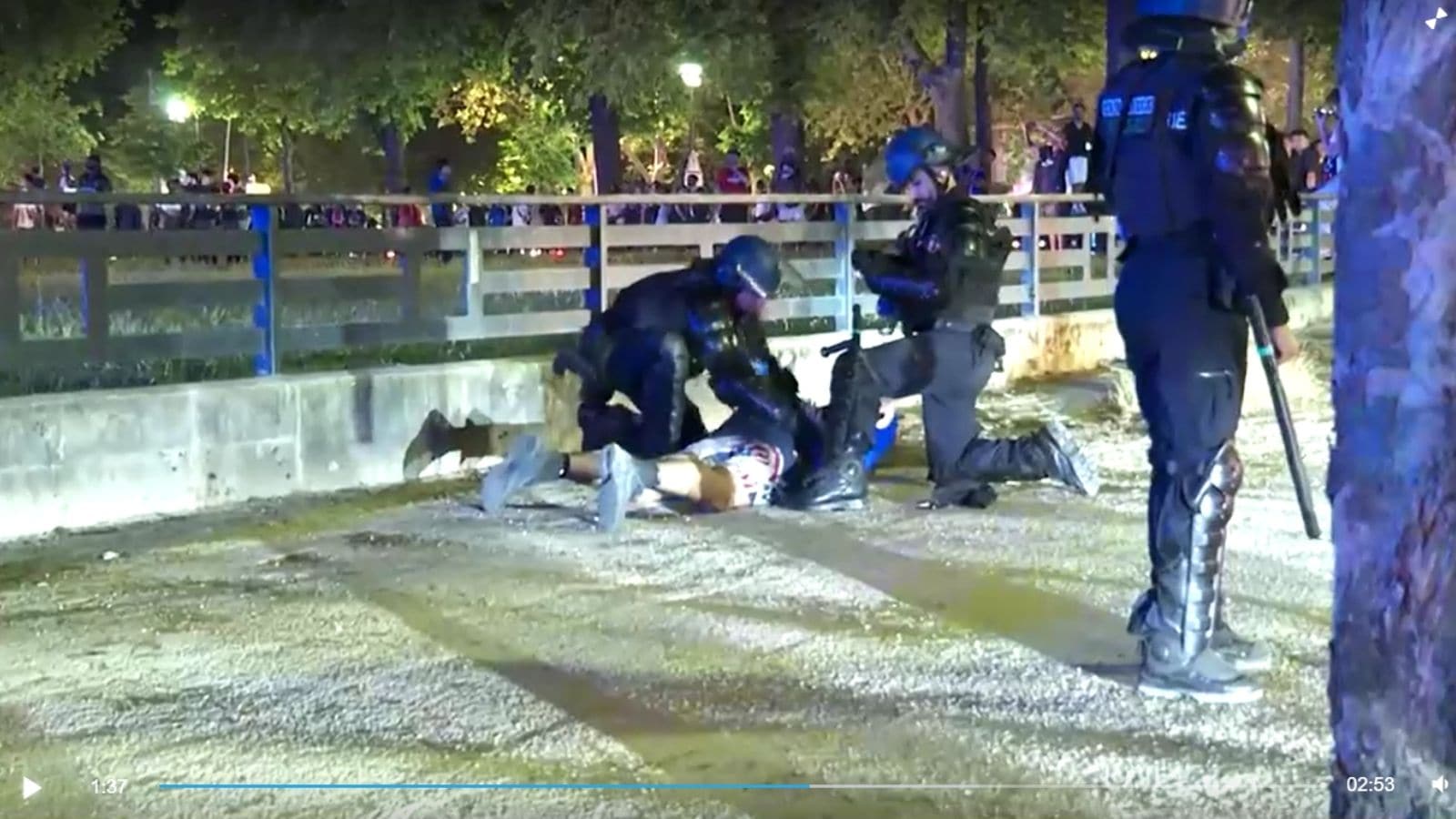
French authorities detained more than 400 people overnight as Paris Saint-Germain’s second consecutive Champions League triumph devolved into widespread urban unrest. While the club secured its European dominance on the pitch in Budapest, the aftermath on the streets of Paris exposed a deep, systemic friction between celebratory public gatherings and militarized urban policing. The sheer scale of the deployment—8,000 officers in the capital alone and 22,000 nationwide—failed to prevent skirmishes, arson, and property damage across multiple districts, proving that the city's approach to managing mass sporting triumphs remains fundamentally fractured.
This is no longer an isolated subculture issue. It is a recurring crisis of public order.
The Geography of Discontent
The violence that erupted following PSG’s penalty shootout victory over Arsenal was not a centralized riot. It was a fragmented series of confrontations spread across distinct strategic nodes of the capital. While 20,000 fans converged on the Champs-Élysées to light flares and block traffic, more volatile flashpoints emerged in the outer arrondissements.
Near the Parc des Princes in the 16th Arrondissement, a crowd of roughly 1,000 supporters clashed directly with law enforcement. A group of approximately 150 individuals attempted to force entry through the stadium gates, meeting a immediate wall of riot police. When fans began constructing barricades using municipal rental bicycles and launching commercial-grade fireworks at police lines, the response was swift and heavy: salvos of tear gas that blanketed the residential neighborhood.
Concurrently, a highly aggressive splinter group in the affluent 8th Arrondissement attempted to storm a local police station. This specific escalation points to a reality that superficial sports reporting consistently overlooks: for a volatile minority, football victories are not the cause of the chaos, but a convenient, highly combustible shield for anti-state agitation.
The Institutional Failure of Containment
Interior Minister Laurent Nuñez pointed to the nationwide tally of 416 arrests as evidence of a responsive security apparatus. However, looking at the data reveals a more troubling pattern of escalation.
| Metric | May 2025 (First Title) | May 2026 (Second Title) |
|---|---|---|
| Paris Police Deployment | 8,000 | 8,000 |
| Nationwide Arrests | 500+ | 416 |
| Key Incidents | Widespread commercial looting | Police station targeted, ring road blockaded |
Despite extensive preemptive measures—including boarding up luxury storefronts along the Champs-Élysées and preemptively shutting down vital metro stations, tram lines, and bus routes—the city was effectively paralyzed. By cutting off public transit, the municipality did not disperse the crowds; it trapped them in the streets, forcing thousands of pedestrian celebrants to mix with highly organized groups of disruptors.
The strategy relies heavily on containment and overwhelming force rather than crowd management and de-escalation. When the périphérique—the critical ring road encircling Paris—was briefly blockaded by fans setting off flares, the police responded with immediate dispersal tactics. While effective at clearing tarmac, these maneuvers simply push the volatility into adjacent commercial streets, resulting in the vandalizing of local bakeries, restaurants, and bus shelters.
The Subtext of Modern Football Celebrations
To understand why a sporting victory regularly triggers urban warfare in France, one must look beyond the pitch. The relationship between PSG's ultra fan base, the club's corporate identity, and the French state is intensely strained. For decades, the stands of the Parc des Princes have served as a socio-political microcosm of the city's deep class divisions.
When the club wins, the celebration serves as a reclamation of space. The elite corridors of the city, from the Champs-Élysées to the 8th Arrondissement, become the stage. For the vast majority, this means singing and waving flags. For a cynical contingent, it represents an opportunity to challenge authority on prime real estate.
Political figures have wasted no time weaponizing the fallout. Far-right leader Marine Le Pen quickly localized the issue, claiming that "only in France does a football club's victory spark riots." This rhetoric deliberately ignores the global history of football hooliganism, yet it strikes a nerve with a public weary of seeing their neighborhoods transformed into tactical conflict zones every May.
The Limits of Tear Gas Diplomacy
The structural issue facing Parisian authorities is the predictability of the response. The state deploys thousands of heavily armed Compagnies Républicaines de Sécurité (CRS) officers, shuts down transit, and waits for the inevitable spark. This creates a self-fulfilling dynamic where the presence of riot gear acts as a catalyst rather than a deterrent.
Alternative models of crowd management used elsewhere in Europe emphasize communication, fan zones managed by supporters' groups, and targeted interventions rather than blanket tear gas use. In Paris, political friction between the police prefecture and City Hall has historically stalled these initiatives, leaving the city stuck in a cycle of containment and cleanup.
With a massive victory parade scheduled around the Eiffel Tower and a formal reception hosted by President Emmanuel Macron at the Élysée Palace, the city faces an immediate logistical headache. The fans will return to the streets, the boarded-up windows will remain in place, and the underlying social tensions that transform a sporting triumph into an urban battlefield will remain completely unaddressed.


