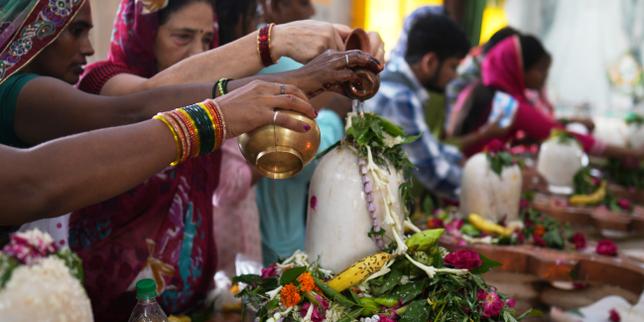
The death of seven individuals at the Ashok Dham temple in Bihar this week is not merely a tragic accident. It is the latest indicator of a recurring systemic failure in India, where massive religious fervor regularly outpaces the infrastructure designed to contain it. While authorities scramble to manage the aftermath, the reality remains that for millions of pilgrims traveling to honor the god Shiva during the sacred month of Shravan, the spiritual journey often carries a lethal risk of crowd collapse.
When the news cycle focuses on the immediate toll—seven dead, nineteen injured—it frequently ignores the anatomy of such disasters. These events are rarely the result of a single failure. They are the product of decades-old logistical gaps, crumbling infrastructure, and a lack of standardized safety protocols at sites that have not been engineered for the modern scale of human migration.
The Anatomy of a Crowd Crush
Modern crowd dynamics are a science, yet religious sites across India often operate on antiquated methods of containment. At the Ashok Dham temple, reports suggest the chaos was triggered by a rumor regarding a fallen electrical pole. In a space already packed to its structural limit, a rumor acts as a match in a room filled with gasoline. Panic propagates faster than any security force can react.
Human stampedes, or more accurately, crowd crushes, occur when the physical pressure of people exceeds the structural capacity of the environment. Once a person loses their footing in a density of six or more people per square meter, they effectively vanish beneath a tide of moving bodies. Physics takes over. The pressure is fluid, moving like a wave that can break concrete barriers and crush chests long before any official intervention can occur.
In this instance, the proximity to the festival of Shravan magnified the risk. Millions of devotees navigate narrow corridors and aged temple architecture that was never intended for such volume. When the infrastructure fails to channel this energy, the result is predictable, cyclical violence.
Beyond the Rumor
Critics and local observers often point to administrative incompetence, and they are not entirely wrong. Rahul Gandhi, a prominent voice in the opposition, recently criticized the "mismanagement" of large-scale events, noting a tendency to prioritize VIP movement over the safety of the general public. This reflects a broader truth: the hierarchy of access in India often dictates where resources are allocated.
However, blaming management alone obscures the deeper issue of neglected architecture. Many of these temples are historic sites that have seen little in the way of safety retrofitting. We are seeing a collision between ancient devotional practices and the realities of a nation with a ballooning population. The state provides reactive aid—monetary compensation for grieving families—but rarely proactive engineering.
We must ask why, despite repeated warnings from previous disasters, the structural integrity of these high-traffic zones remains largely unaddressed. Why do we see the same narratives of "panicked crowds" and "fallen barriers" repeat every few years, from the major Kumbh Mela gatherings to remote village shrines?
The Illusion of Control
Authorities often claim that the situation is under control immediately after an event, as they did this week in Bihar. But "control" is a fragile concept in a landscape where security personnel are vastly outnumbered by devotees. Effective crowd management requires more than boots on the ground; it requires intelligent spatial design. It requires wide-exit architecture, clear visual signaling, and, most importantly, the willingness to cap attendance—a move that is politically and culturally fraught in a country where religious rites are central to public life.
To suggest that these tragedies are inevitable is a failure of imagination. There are methods to mitigate these risks: managed entry points, one-way flow systems, and real-time electronic monitoring of crowd density. Yet, these measures require investment, planning, and a shift in how the state views the duty of care in sacred spaces.
The current approach is a bandage on a chronic condition. Until the conversation shifts from blaming rumors and managing the aftermath to fundamentally redesigning how millions of people access these sites, the cycle will continue. The next event is already in the making, hidden behind the next festival date on the calendar, waiting for a spark—a rumor, a trip, or a broken wire—to turn devotion into a site of mourning.
The weight of this tragedy sits not just with the administrators of the temple, but with a system that refuses to reconcile its ancient faith with the modern reality of the masses.
https://www.youtube.com/watch?v=x_o2cCE2s8M
This video provides a look at the intensity and scale of the crowds during Indian religious festivals, illustrating the extreme pressure that leads to the types of tragic stampedes discussed in this report.