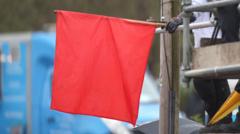
The silence that follows a red flag at the North West 200 is unlike any other in motor racing. It is a heavy, suffocating quiet that rolls over the nine-mile "Triangle" connecting Portstewart, Coleraine, and Portrush. On a circuit where Superbikes regularly clock speeds north of 200mph on public roads lined with stone walls and telegraph poles, the margin for error does not exist. The recent death of a competitor during the Superbike sessions has once again forced a grim reckoning for a sport that operates on the razor's edge of social and legal acceptability. This was not a mechanical anomaly or a freak occurrence of nature. It was the predictable, if tragic, byproduct of pushing modern 220-horsepower machinery to its absolute limit on a course designed for horse-drawn carriages.
While the immediate aftermath focuses on the mourning of a fallen rider, the broader industry must confront a harder truth. Road racing is currently trapped in a cycle of escalating velocity that has outpaced the safety infrastructure of the Northern Irish countryside. We are no longer watching bikes that belong on these roads. We are watching missiles with tires, guided by men who have accepted a statistical probability of disaster that would be grounds for a permanent shutdown in any other professional sporting arena.
The Velocity Trap
Modern Superbikes have become too fast for the Triangle. Ten years ago, hitting 200mph on the Causeway Coast was a milestone celebrated in hushed tones. Today, it is the entry fee for the front row. The technical evolution of electronics, aerodynamic winglets, and tire compound technology has allowed riders to carry immense speed through sections like Station Corner and University, areas where the run-off is measured in inches rather than yards.
The problem is physics. Kinetic energy increases with the square of velocity. When a rider loses the front end at 180mph compared to 150mph, the force of the impact isn't just slightly higher; it is devastatingly different. The human body has not evolved at the same rate as the Ducati Panigale or the BMW M1000RR. We are putting 2026 technology onto 1950s geography, and the result is a recurring funeral procession that the sport’s governing bodies struggle to justify to a skeptical public.
Road Racing’s Insurance Stranglehold
Behind the scenes, the North West 200 is fighting a war on two fronts. The first is the physical danger on the track. The second is the fiscal reality of keeping the event alive. Last year, the event nearly collapsed under the weight of astronomical insurance premiums. The risk profile of road racing has become so toxic that many underwriters simply refuse to touch it.
Those who do provide coverage demand eye-watering sums that eat into the prize money and infrastructure budget. This creates a dangerous paradox. To pay for the insurance, organizers need massive crowds and high-profile factory entries. To get those entries, the course must be fast and "spectacular." But the faster and more spectacular the racing becomes, the higher the risk, and the higher the insurance premiums climb.
Critics argue that the sport is cannibalizing itself. If the North West 200 cannot find a way to significantly reduce the frequency of serious incidents, the insurance industry will eventually do what the protesters couldn't—it will kill the event by making it financially impossible to flag off.
The Myth of the Controlled Environment
Event organizers often point to the "controlled environment" of the race weekend, citing the thousands of hay bales, foam protectors, and specialized air-fence modules deployed along the 8.9-mile circuit. This is a comforting narrative, but it is largely a performance for the cameras.
You cannot "safe" a stone wall at 190mph. You cannot "buffer" a telephone pole with enough foam to make an impact survivable at triple-digit speeds. The safety measures at the North West 200 are designed to mitigate low-speed slides and provide a psychological safety net for the fans. In a high-speed high-side or a multi-bike collision on the approach to Magherabuoy, these measures are effectively decorative.
The Moral Weight of the Spectacle
There is a voyeuristic element to the North West 200 that the industry rarely discusses in public. Thousands of fans line the hedges, many of them hoping to see the limit reached, knowing full well what happens when that limit is exceeded. The economic impact on the North West region is undeniable—millions of pounds flow into local hotels, pubs, and shops—but this revenue is increasingly stained by the recurring loss of life.
We have to ask if the local economy is worth the blood of a rider every few years. For the die-hard "pure" road racing fans, the answer is a resolute yes. They view the danger as the very soul of the sport. To them, short-circuit racing (on purpose-built tracks) is sterile and cowardly. They believe the riders are modern gladiators who choose this path with full knowledge of the stakes.
However, this "freedom of choice" argument is becoming harder to maintain as the bikes become more difficult to control. When a rider suffers a mechanical failure at top speed, choice is removed from the equation. They are merely passengers in a high-velocity disintegration.
Redefining the Superbike Class
One potential solution being whispered in the paddocks involves the total removal of the 1000cc Superbike class from road racing. The logic is simple: move the premier class to the 600cc Supersport or the burgeoning "Super-Twin" categories.
- Supersport bikes are slower, lighter, and more manageable.
- Super-Twins offer technical intrigue without the terrifying top-end speeds.
- Reduced mass equals less kinetic energy during a crash.
The pushback against this is purely commercial. Manufacturers want to sell their flagship liter-bikes. Fans want to hear the scream of a four-cylinder 1000cc engine at full chat. But if the choice is between racing smaller bikes or not racing at all, the decision seems obvious. The sport survived the transition away from lethal two-stroke 500s; it can survive the transition away from overpowered Superbikes.
Accountability and the Future
Investigation into these incidents often results in a "racing accident" verdict. This is a convenient shorthand that absolves everyone of responsibility. It suggests that the death was an act of God, an unavoidable glitch in the matrix of speed.
It wasn't. It was the result of a specific set of variables: a specific speed, on a specific corner, on a bike with specific power delivery. If the sport refuses to change those variables, it must accept that it is no longer a sport in the traditional sense, but a high-stakes gamble where the house eventually wins.
The riders who line up at the North West 200 are some of the most talented athletes on the planet. Their bravery is beyond question. But bravery should not be a substitute for a viable safety strategy. The organizers have a responsibility to look beyond the next race weekend and consider the decades to come. If they don't, the next red flag might be the last one the Triangle ever sees.
The sport doesn't need more tributes or moments of silence. It needs a radical, unsentimental overhaul of its technical regulations before the next stone wall claims another name.
Stop pretending the hay bales are enough.