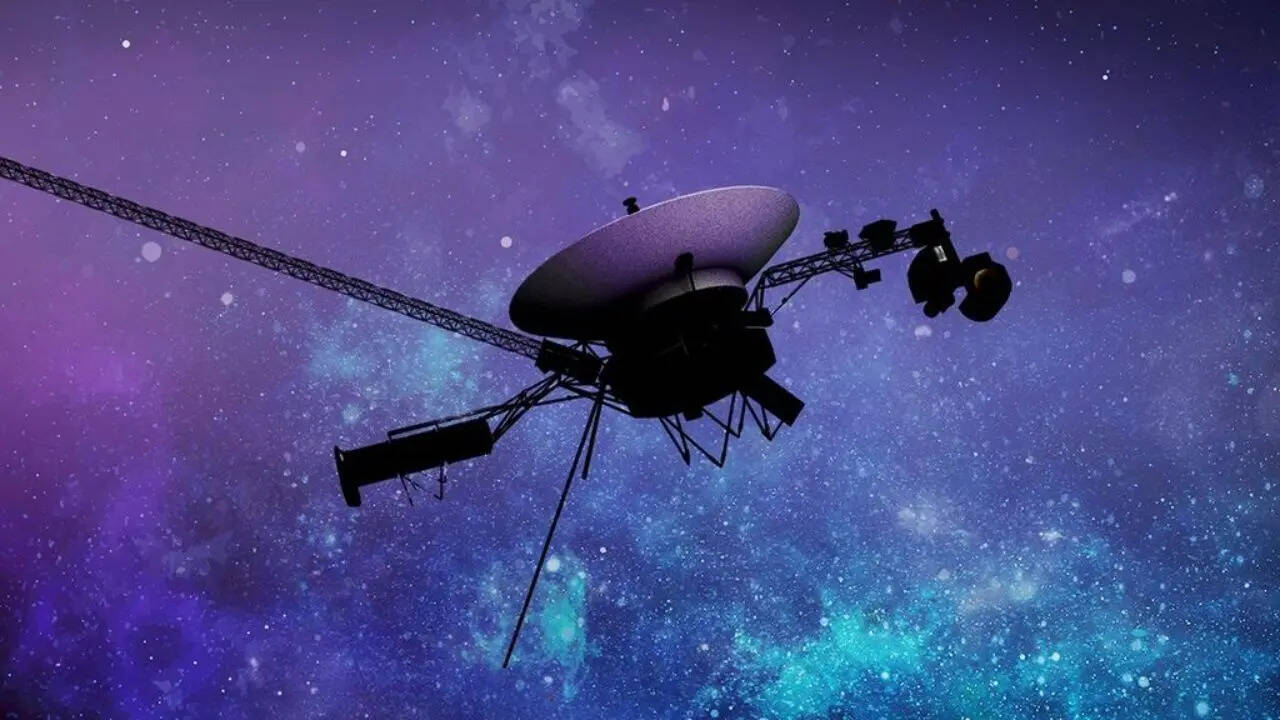
When NASA's Voyager 1 re-established a coherent signal across more than 16 billion miles of interstellar space, the triumph had nothing to do with modern computing miracles and everything to do with brute-force analog resilience. Following months of transmitting garbled binary gibberish due to a corrupted memory chip in its Flight Data Subsystem, engineers at the Jet Propulsion Laboratory successfully bypassed the dead hardware by relocating critical code to other sections of the spacecraft's 1970s-era memory banks, proving that a 48-year-old machine running on less memory than a modern key fob can still outsmart deep-space decay.
The headlines made it sound effortless. A cheerful wave from the edge of the solar system, a nostalgic nod to Carl Sagan, and a feel-good victory lap for space exploration. That narrative misses the actual story. What happened 16 billion miles away was not a gentle check-in; it was a high-stakes, blindfolded neurosurgery performed across a 45-hour round-trip communications delay on hardware that predates the commercial internet, the microprocessor revolution, and half the engineering team currently keeping it alive.
The Myth of Immortal Hardware
Space journalism loves a romantic metaphor. Reporters routinely describe Voyager 1 as a lone wanderer sailing serenely through the cosmic ocean, effortlessly sending postcards back to Earth. In reality, the spacecraft is a dying, radiation-battered relic surviving on thermal fumes and patched-together workarounds.
Launched in 1977 with a primary mission lifespan of just four years to study Jupiter and Saturn, Voyager 1 was never designed for interstellar longevity. Its computers possess roughly 69.63 kilobytes of total memory across three redundant dual-processor systems. To put that in perspective, a single high-resolution smartphone photograph contains roughly fifty times more data than the entire computational capacity of humanity's farthest-flung emissary.
The recent communications crisis exposed just how fragile this architecture has become. For months, the spacecraft's telemetry modulation unit transmitted a repeating, nonsensical pattern of ones and zeros. The carrier signal was there, meaning the antenna was still pointed toward Earth and the transmitters still had power, yet the data inside the stream was completely unreadable.
Anatomy of a 16-Billion-Mile Blind Spot
Diagnosing a hardware failure on a terrestrial server takes minutes. Diagnosing a failure on Voyager 1 requires forensic deduction across an incomprehensible void. At a distance exceeding 16 billion miles—roughly 170 times the distance between the Earth and the Sun—radio signals traveling at the speed of light take more than 22.5 hours to reach the spacecraft, and another 22.5 hours to return.
Engineers cannot simply run a diagnostic script and watch the output in real time. Every command sent from NASA's Deep Space Network is a blind bet. You transmit a sequence of instructions on Monday morning, wait nearly two full days, and hope the telemetry trickle captured by massive 70-meter dish antennas in California, Spain, or Australia on Wednesday morning confirms your hypothesis.
The culprit turned out to be a single malfunctioning chip responsible for storing a portion of the Flight Data Subsystem (FDS) memory. The FDS is the spacecraft's brain for packaging scientific measurements and engineering health data before handing them off to the telemetry unit for broadcast. When that specific slice of memory degraded—likely due to decades of cumulative cosmic ray bombardment or simple age-induced component fatigue—the software routines stored there became corrupted. The FDS got stuck in an infinite loop, spitting out gibberish instead of science.
Why Modern Spacecraft Would Have Died Years Ago
If a modern commercial satellite or flagship deep-space probe suffered a comparable memory corruption event nearly five decades after launch, the mission would likely be declared a total loss within weeks. Modern aerospace engineering prioritizes miniaturization, high-density silicon, and complex autonomous operating systems. Those advancements come with a hidden vulnerability: extreme sensitivity to radiation and cascading software failures.
Voyager 1 survives precisely because its architecture is primitive by contemporary standards.
- Physical Component Spacing: Built with discrete transistors and early integrated circuits rather than nanometer-scale modern microchips, the hardware can absorb high-energy cosmic particles without suffering instantaneous, catastrophic latch-ups across millions of adjacent gates.
- Hardwired Simplicity: The spacecraft lacks a modern operating system. Its code is written in a custom assembly language tailored directly to the hardware, eliminating background processes, bloated software layers, and unexpected memory leaks.
- True Redundancy: Unlike modern systems that often share power buses or memory controllers to save weight, Voyager's core subsystems were built with isolated, physical backups—though after nearly half a century, most of those backups have already been depleted or disabled to conserve power.
When the JPL team realized the damaged FDS chip could not be repaired or rebooted back to health, they faced a brutal constraint. No single remaining block of intact memory within the FDS was large enough to hold the entire section of code that had been lost.
The solution required surgical precision. Engineers had to dissect the affected software, break it into smaller, modular chunks, and scatter those fragments across different unused pockets of the remaining FDS memory. Then, they had to manually rewrite every internal pointer and memory address across the rest of the spacecraft's software so the computer knew where to find the relocated pieces without crashing the system.
One misplaced bit in the patch could have permanently severed communications. In April 2024, the team transmitted the first batch of relocated code to restore engineering telemetry. Forty-five hours later, the spacecraft answered with clean, readable health data for the first time in five months. Weeks later, a second patch restored the flow of scientific data from its remaining active instruments.
The Power Crisis Nobody Talks About
Restoring Voyager 1's voice is an extraordinary engineering feat, yet it does not change the fundamental math governing the spacecraft's survival. Every celebratory headline glosses over the ticking clock inside Voyager's Radioisotope Thermoelectric Generators (RTGs).
Voyager 1 does not use solar panels; at 16 billion miles from the Sun, sunlight is roughly 29,000 times dimmer than it is on Earth. Instead, the probe draws electrical power from three RTGs packed with plutonium-238. As the plutonium naturally decays, it generates heat, which thermocouples convert into electricity.
At launch in 1977, those generators produced approximately 470 watts of electrical power. Because plutonium-238 has a half-life of 87.7 years, and because the thermocouples themselves degrade over time, Voyager 1 loses roughly 4 watts of electrical output every single year. Today, the spacecraft operates on less than half its original power budget—roughly the energy required to run a couple of standard household incandescent light bulbs.
The Slow Amputation of a Legend
To keep the main transmitter warm and functional, mission managers have spent the last two decades systematically executing a slow, agonizing amputation of the spacecraft's capabilities.
- Instrument Shutdowns: The iconic cameras that captured the "Pale Blue Dot" photograph were turned off in 1990 to save power and memory, as there was nothing left to photograph in the dark void ahead.
- Heater Sacrifices: Engineers have switched off heaters for the remaining instruments, including the cosmic ray subsystem and the low-energy charged particle detector. Remarkably, these instruments continue to operate at temperatures far below anything they were ever tested to survive on Earth.
- Thruster Workarounds: In 2017, when Voyager 1's primary attitude-control thrusters degraded to the point where they could no longer keep the high-gain antenna pointed accurately at Earth, engineers fired up a set of trajectory-correction thrusters that had sat dormant in freezing space for 37 years. Even those backup thrusters have recently required careful fuel-line management to prevent residue buildup from clogging the tiny propellant tubes.
Every watt matters. If the spacecraft's internal temperatures drop too low, the hydrazine propellant will freeze in its lines, turning a functioning interstellar observatory into an inert block of aluminum and gold-plated copper hurtling silently through the dark.
The Deep Space Network Bottleneck
Even when Voyager 1 successfully transmits a coherent signal across 16 billion miles, catching that whisper on Earth is a logistical battle. The spacecraft broadcasts with a transmitter power of roughly 23 watts—about the same wattage as a refrigerator light bulb. By the time that radio wave expands across the solar system and reaches Earth, its signal strength has diluted to approximately a billionth of a billionth of a watt.
Only NASA's Deep Space Network (DSN) can hear it, and the DSN is currently stretched to its absolute breaking point.
The network consists of three ground complexes spaced roughly 120 degrees apart around the globe in Goldstone, California; Madrid, Spain; and Canberra, Australia. This positioning ensures that as the Earth rotates, at least one station always has a direct line of sight to deep space. However, to capture Voyager 1's faint signal, the network cannot rely on its standard 34-meter dishes. It must dedicate its massive 70-meter antennas—or link multiple 34-meter dishes together in an array—for hours at a time.
"Listening to Voyager 1 requires sacrificing tracking time for dozens of active Mars orbiters, lunar missions, and deep-space telescopes currently fighting for bandwidth on the same aging ground infrastructure."
The competition for DSN time is fierce. With the Artemis lunar program, active Mars rovers, the James Webb Space Telescope, and dozens of commercial and international deep-space probes all demanding downlink windows, allocating an entire 70-meter dish to a 48-year-old probe is an expensive operational trade-off. Furthermore, because Voyager 1 travels southward relative to the ecliptic plane, only the Canberra complex in Australia has the optimal geographic view to communicate with it consistently, creating a single-point geographic bottleneck in the Southern Hemisphere.
What Voyager 1 Actually Sees Out There
Why spend millions of dollars and precious antenna hours keeping a dying 1970s probe alive? Because Voyager 1 is the only functioning sensor humanity has ever placed inside the interstellar medium—the vast, turbulent region between the stars completely outside the protective magnetic bubble of our Sun.
Everything we previously knew about interstellar space was inferred from telescopic observations and theoretical models. Voyager 1 provides direct, in-situ physical measurements of an environment no other human-made object has ever touched.
Before Voyager 1 crossed the heliopause in August 2012, astrophysicists assumed the boundary where the solar wind gives way to interstellar winds would be a relatively smooth, predictable transition. Voyager's instruments proved those models wrong. Instead of a clean border, the spacecraft encountered a chaotic magnetic highway where solar magnetic field lines twist and connect directly with interstellar magnetic fields, allowing high-energy cosmic rays to stream inward while solar particles leak outward.
More recently, Voyager 1's plasma wave instrument detected a persistent, faint hum in the interstellar gas—a steady background vibration caused by plasma oscillations independent of occasional solar outbursts. This discovery allows scientists to continuously map the density of interstellar space even when the Sun is quiet, revealing how shockwaves from distant supernovae ripple through the galaxy and compress the vacuum between stars.
The Inevitable Silence
No amount of clever assembly-language patching can outrun thermodynamics. Within the next few years—likely between 2027 and 2030—Voyager 1's plutonium power supply will drop below the minimum threshold required to run even a single scientific instrument alongside the main radio transmitter.
When that day arrives, engineers will shut down the final science sensors, leaving only a bare engineering carrier signal to ping Earth until the power drops so low that the computer can no longer maintain antenna lock. Once the high-gain antenna drifts off-axis by even a fraction of a degree, the 23-watt signal will miss Earth entirely.
Voyager 1 will not crash or burn up. Moving at roughly 38,000 miles per hour relative to the Sun, it will continue coasting through the Milky Way for hundreds of millions of years, carrying its gold-plated phonograph record long after Earth's oceans have boiled away. The recent phone call from 16 billion miles out was not a sign of eternal life, but rather the final, hard-won proof of what human ingenuity can extract from aging steel and silicon right before the lights go out for good.