The era of the heroic soldier is fading into a storm of cheap plastic and high-frequency radio waves. In the mud of Eastern Europe, the theoretical debates about "killer robots" have been silenced by the scream of first-person view (FPV) drones and the silent prowl of ground-based crawlers. This isn't a glimpse into the future. It is a fundamental breakage of how humans have conducted organized violence for five thousand years.
For decades, military theorists imagined high-tech warfare as a theater of billion-dollar stealth jets and satellite-guided precision. Instead, the battlefield has become a laboratory for the democratization of mass-produced slaughter. War has moved from the era of the sniper to the era of the swarm. While the world watches high-altitude footage, the real shift is happening at the grassroots level, where $500 hobbyist drones are stripping away the very concept of "cover." If a sensor can see you, it can kill you, and in 2026, sensors are everywhere.
The Death of Sanctuary
Historically, the infantryman found safety in the "dead space"—behind a ridge, inside a trench, or under the canopy of a forest. Modern autonomy has erased these zones. Small, agile drones now navigate inside buildings and hunt individual soldiers through zigzagging trenches with a level of persistence a human could never match.
This isn't just about efficiency; it is about the psychological collapse of the combatant. When an enemy is a person, there is a chance for error, fatigue, or mercy. When the enemy is an algorithmic loop running on a circuit board, the pressure is constant. We are seeing the total transparency of the battlefield. The moment a unit moves, it is spotted by a thermal lens. Seconds later, a loitering munition is dispatched. The time between detection and impact has shrunk from minutes to mere seconds, leaving no room for tactical adjustment.
The Electronic Shield is Failing
Electronic Warfare (EW) was supposed to be the hard counter to this robotic surge. The logic was simple: if you jam the signal, the robot falls. But the arms race has already pivoted. We are now seeing the rapid deployment of "terminal autonomy."
In this setup, a pilot flies the drone toward a general target area. Once the onboard AI identifies a tank or a group of soldiers, it "locks on." Even if the radio link is severed by heavy jamming, the drone’s onboard processor continues the flight path using visual recognition. It doesn't need a human to hold its hand anymore. The "man-in-the-loop" is becoming a "man-on-the-loop," merely supervising a machine that makes its own final ballistic decisions. This bypasses the most sophisticated jamming suites currently in production, rendering billions of dollars in EW investment effectively obsolete.
The Logistics of Attrition
We have entered the age of "industrialized insurgency." In previous conflicts, losing a tank was a strategic blow. Today, a $5 million Main Battle Tank is regularly disabled by a swarm of drones costing less than a used sedan. The math of war has turned upside down.
The defense industry remains addicted to "exquisite" platforms—hugely expensive, multi-role machines that take years to build. But the front lines demand "attritable" systems. You don't need a drone to last ten years; you need it to last ten minutes. If you can produce 10,000 cheap robots for the price of one advanced fighter jet, you can overwhelm any defense through pure volume.
The Ground Robot Revolution
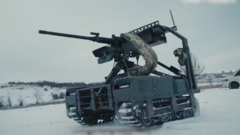
While aerial drones get the headlines, the ground is being ceded to Unmanned Ground Vehicles (UGVs). These aren't the clunky, remote-controlled cars of a decade ago. They are becoming multi-purpose mules, mine-layers, and mobile gun platforms.
- Evacuation: UGVs are now pulling wounded soldiers out of "hot zones" where a human medic would be a certain casualty.
- Logistics: Small, silent electric crawlers are ferrying ammunition to forward positions under the cover of night, moving through terrain too dangerous for trucks.
- Direct Combat: Automated turrets mounted on tracks are being used to "test" enemy positions, forcing the opponent to reveal their location by firing on a machine rather than a person.
The result is a thinning of the human presence. Commanders are realizing that putting a human in a forward observation post is a waste of a life when a $2,000 sensor pod can do the job better and transmit the data to a bunker miles away.
Software as the Supreme Weapon
The most critical component of the modern battlefield isn't the explosive charge; it’s the code. We are seeing the rise of "battlefield management systems" that function like a real-time strategy game. Data from thousands of drones, satellites, and intercepted radio signals are fed into a central AI that identifies patterns the human eye misses.
This creates a terrifying speed of command. If an AI detects a specific thermal signature associated with a command vehicle, it can automatically task the nearest available loitering munition to strike. The human commander simply hits "approve." This reduces the "kill chain" to a length that makes traditional military bureaucracy look like it’s moving through molasses.
The Problem of False Positives
The danger in this automated speed is the erosion of judgment. Algorithms are trained on datasets that may not account for the chaos of a civilian environment. A heat signature from a farm tractor can look remarkably like a mobile artillery piece under the right conditions. As the pace of war accelerates to machine speeds, the window for a human to intervene and say "stop" is closing. We are delegating the moral weight of killing to lines of Python code because, on the modern battlefield, being slow means being dead.
The Myth of the Silver Bullet
Military contractors love to promise a single system that will win the war. They are wrong. Success in this new environment isn't about one "killer app"; it is about the integration of thousands of disparate, cheap systems. The winner is the side that can update its software fastest.
If the enemy develops a new frequency for their drones on Tuesday, you need a software patch pushed to your jamming units by Wednesday. This is a "DevOps" war. The traditional multi-year procurement cycle of the Pentagon or the UK Ministry of Defence is a death sentence in this environment. The front line is now a software development sprint.
The Ghost Front
We are moving toward a reality where the "front line" is an empty space. It will be a gray zone populated by machines hunting other machines, while humans hide in deep, reinforced bunkers, attempting to manage the chaos through screens.
The physical bravery of the individual soldier is being replaced by the technical proficiency of the operator and the ingenuity of the programmer. This changes the very nature of military recruitment and training. We don't just need athletes; we need gamers who can handle the cognitive load of controlling multiple assets at once, and engineers who can repair a circuit board in a muddy trench.
The Erosion of Sovereignty
This shift also lowers the barrier to entry for war. When you don't have to send thousands of your citizens home in body bags, the political cost of starting a conflict drops significantly. State-sponsored "robotic incursions" can be conducted with a level of deniability and low risk that makes conventional diplomacy even more fragile. If a swarm of unidentified drones takes out a power grid, who do you retaliate against?
The proliferation of this technology means that non-state actors—terrorist groups, cartels, and private militias—now have access to "air forces" that can challenge sovereign nations. The monopoly on high-end violence has been shattered.
The Irony of Automation
There is a profound irony in the automation of the battlefield. The more we remove the human from the direct line of fire to save lives, the more we expand the scope of the killing. Machines don't get tired. They don't have a "breaking point." They can continue a war of attrition long after the human spirit would have surrendered.
We are building a world where war is a constant, low-level background noise—an automated exchange of hardware that grinds on indefinitely because the political cost of stopping is higher than the economic cost of replacing cheap robots.
The transition is already complete. The question is no longer when the robots are coming, but how many are already hovering above your head, waiting for the algorithm to click "yes."