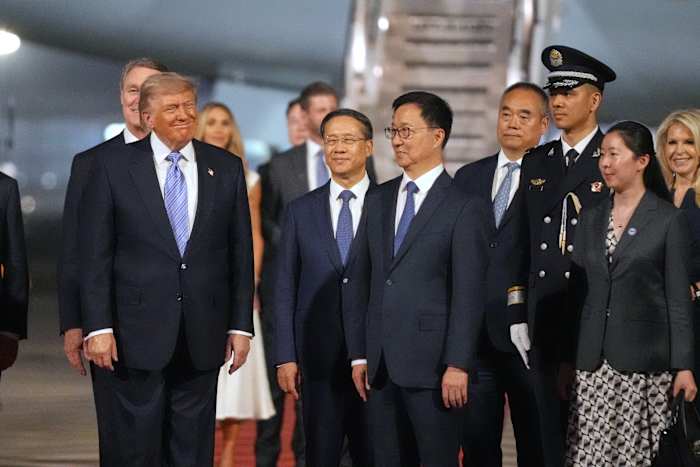
The cameras captured a carefully choreographed display of diplomatic theater as Presidents Donald Trump and Xi Jinping met in Beijing to reset the most consequential relationship on the planet. While the official press releases focused on "mutual respect" and "stability," the actual mechanics of this summit are driven by a desperate need to prevent a total decoupling of the world’s two largest economies. This is not a friendly reunion. It is a high-stakes negotiation where the primary goal is to establish a new set of rules for a global trade system that has effectively broken down.
The meeting marks a critical juncture in a decade-long friction point. For the United States, the objective is a hard-line correction of trade imbalances and the protection of intellectual property. For China, the priority is maintaining domestic growth while resisting what it perceives as an American containment strategy. The friction is no longer just about soybeans or steel; it has moved into the realm of advanced semiconductors, artificial intelligence, and the very infrastructure of the future global economy.
The Mirage of De-Escalation
To understand the Beijing summit, one must look past the handshakes and focus on the fundamental structural differences between the two nations. The rhetoric suggests a "thaw" in relations, but the reality is a tactical pause. Both leaders are facing immense domestic pressures that make a true compromise nearly impossible.
In Washington, there is a rare bipartisan consensus that China represents the single greatest threat to American economic dominance. Trump’s return to the negotiating table is underpinned by a mandate to bring manufacturing back to the U.S. heartland, a promise that requires aggressive tariffs and strict enforcement mechanisms. Conversely, Xi Jinping is navigating a slowing Chinese economy, a cooling real estate market, and a demographic shift that threatens the long-term viability of the "Chinese Dream."
Neither side can afford to look weak. This creates a paradox where every concession must be framed as a victory, and every agreement is viewed with extreme skepticism by the markets. We are seeing a shift from "globalization" to "localization," where the flow of capital and technology is being rerouted through geopolitical filters rather than market efficiencies.
The Tech Wall and the Battle for Supremacy
The most contentious issue on the Beijing agenda is not the trade deficit, but the control of high-end technology. The U.S. has increasingly used export controls to starve Chinese firms of the advanced chips necessary for modern computing. This "tech wall" is the modern equivalent of a naval blockade, and it is the primary reason the Chinese delegation is pushing for a rollback of sanctions.
From a veteran analyst's perspective, this is where the summit likely hits a dead end. The U.S. views technology transfer as a national security issue, while China views it as a sovereign right to development.
- Export Restrictions: The U.S. continues to expand the list of restricted entities, citing the dual-use nature of AI and quantum computing.
- Supply Chain Resilience: Companies are being pressured to adopt "China Plus One" strategies, moving production to Vietnam, India, or Mexico to avoid the crossfire.
- Domestic Subsidies: Both nations are pouring hundreds of billions into domestic chip manufacturing, creating a massive, inefficient redundancy in the global supply chain.
This competition is not a race to the top; it is a race for control. When two giants compete to set the standards for the next century of innovation, the result is often a fragmented world where devices and software do not talk to each other across borders.
Currency Maneuvers and the Ghost of the Plaza Accord
Behind the scenes, the value of the Yuan and the Dollar is a constant source of friction. The U.S. Treasury has long kept a watchful eye on Beijing's management of its currency, often accusing it of keeping the Yuan artificially low to boost exports. In the current environment, the stakes are even higher.
If the U.S. implements its proposed blanket tariffs, the inflationary pressure back home could be significant. To offset this, the Trump administration wants a stronger Yuan. However, the Chinese central bank is hesitant to let the currency rise too sharply, fearing it would kill off the very exports keeping their factories running.
This tension mirrors the 1985 Plaza Accord, where major economies forced Japan to appreciate the Yen. The result for Japan was a lost decade of stagnation. Beijing has studied that history carefully. They will not sign any agreement that dictates their monetary policy, regardless of the trade incentives offered. The negotiation is less about a deal and more about managing the inevitable divergence.
The Corporate Exodus and the Cost of Uncertainty
While the politicians talk, the private sector is voting with its feet. For decades, the American corporate world viewed China as an inexorable growth engine. That certainty has vanished. The summit in Beijing is, in many ways, an attempt to provide some semblance of predictability to a business community that is currently paralyzed by risk.
The cost of doing business in China has skyrocketed, not just because of labor rates, but because of the regulatory minefield. New anti-espionage laws and data security regulations have made it difficult for foreign firms to operate with the transparency they require.
Consider the hypothetical example of a mid-sized automotive parts manufacturer based in Ohio. Ten years ago, they would have looked to Shenzhen for a manufacturing partner without a second thought. Today, that same company is looking at the legal fees of compliance, the risk of intellectual property theft, and the possibility of their shipments being caught in a sudden tariff hike. They are choosing to pay 20% more to produce the parts in Monterrey or Nashville just for the peace of mind.
This "uncertainty tax" is dragging down global GDP. The summit may produce a few high-profile purchase agreements—perhaps for Boeing planes or American LNG—but those are band-aids on a systemic wound.
Geopolitical Leverage and the Third-Party Factor
The summit does not happen in a vacuum. Both leaders are acutely aware of how their relationship affects, and is affected by, the rest of the world. For Trump, the goal is to peel China away from its deepening "no-limits" partnership with Russia. For Xi, the goal is to maintain access to European and American markets while building a secondary trade bloc through the BRICS+ framework.
There is a growing sense that the rest of the world is tired of being forced to choose sides. Countries in Southeast Asia and the Middle East are increasingly playing both sides, taking American security guarantees while accepting Chinese infrastructure investment. This multi-polar reality makes it harder for Washington or Beijing to exert the kind of unilateral pressure they once did.
The Beijing summit is therefore an exercise in optics for the global audience. It is an attempt by both powers to signal that they are the "responsible" party, while the other is the aggressor.
The Tariff Trap and Consumer Fallout
We must address the elephant in the room: the American consumer. The primary weapon in the U.S. arsenal is the tariff. While branded as a tax on China, tariffs are essentially a sales tax paid by the people importing the goods.
If the summit fails to produce a meaningful reduction in trade barriers, the next wave of tariffs will hit everyday items that were previously spared. We are talking about laptops, smartphones, and apparel. The economic theory is that these costs will force production back to the U.S., but the reality is that domestic manufacturing capacity cannot be rebuilt overnight.
This creates a dangerous political window. If the administration pushes too hard, they risk a spike in inflation that could sour the public on the very trade policies they initially supported. If they don't push hard enough, they look like they’ve been outmaneuvered by Beijing. It is a razor-thin margin for error.
The Strategy of Managed Decline
We are no longer in an era of "constructive engagement." That ship sailed a decade ago. What we are witnessing in Beijing is the beginning of an era of managed decline in the bilateral relationship. The goal is no longer to be partners; the goal is to be competitors who don't go to war.
This requires a different kind of diplomacy. It requires "guardrails"—a term often used by the State Department to describe communication channels meant to prevent a misunderstanding from escalating into a military conflict in the Taiwan Strait or the South China Sea.
The summit is the highest level of these guardrails. By meeting face-to-face, the two leaders are attempting to humanize a relationship that has become increasingly abstract and hostile. But humanizing the opponent doesn't change the underlying math. The math says that two superpowers cannot occupy the same space in a global hierarchy without significant friction.
Why This Time is Different
Skeptics will say we have seen this movie before. We’ve had the Mar-a-Lago summit, the Buenos Aires dinner, and the San Francisco meeting. Each time, there was a temporary "truce" followed by further escalation.
However, the 2026 landscape is different because the levers of power have changed. China is no longer the "factory of the world" in the way it once was; it is a peer competitor in technology and finance. The U.S. is no longer the undisputed hegemon; it is a nation focused on internal renewal and protectionism.
The Beijing meeting is the first time these two versions of the nations have met. The old scripts don't work. The old concessions aren't enough. Every word spoken in those private rooms is filtered through the lens of a new Cold War that is already well underway.
The Infrastructure of the Split
One of the most overlooked factors in these talks is the diverging financial infrastructure. China has been aggressively promoting the use of the Yuan in international settlements, specifically to bypass the SWIFT system and the dominance of the Dollar. This is a direct challenge to the "exorbitant privilege" the U.S. has enjoyed since World War II.
When the U.S. uses the Dollar as a tool of foreign policy—through sanctions—it incentivizes other countries to find an alternative. The summit is a venue where the U.S. can try to reassert the Dollar's role, but for Beijing, the drive for financial autonomy is non-negotiable. They saw what happened to Russia's central bank reserves and decided they would never let themselves be that vulnerable.
This creates two parallel worlds. One world runs on Western standards, the Dollar, and American-made software. The other runs on Chinese hardware, the Yuan, and a highly controlled internet. The Beijing summit is the last-ditch effort to keep a bridge between these two worlds from collapsing entirely.
The outcome of these talks will not be a grand treaty. There will be no "Mission Accomplished" moment. Instead, there will be a series of small, technical agreements that serve as a temporary ceiling on the hostility. The real story is the silent acknowledgment that the world as we knew it—a single, integrated global market—is dead.
The future is one of silos, blocks, and managed competition. The leaders in Beijing aren't there to save the old world; they are there to negotiate the terms of the divorce. Every handshake, every dinner menu, and every joint statement is a piece of evidence in a much larger trial. The jury, consisting of global markets and smaller nations, is still out on whether this transition can be managed without a catastrophic rupture.
The high-profile summit in Beijing is the start of a long, painful adjustment. Both nations are realizing that the cost of total conflict is too high, but the price of genuine cooperation is one they are no longer willing to pay. This leaves us in a permanent state of tension, where the only thing more dangerous than the talks failing is the delusion that they have actually succeeded.
Stop looking for a breakthrough. Start looking for the exit strategies. The real work is happening in the supply chain offices and the central banks, far away from the cameras and the red carpets. The Beijing summit is the beginning of the end of the global era.