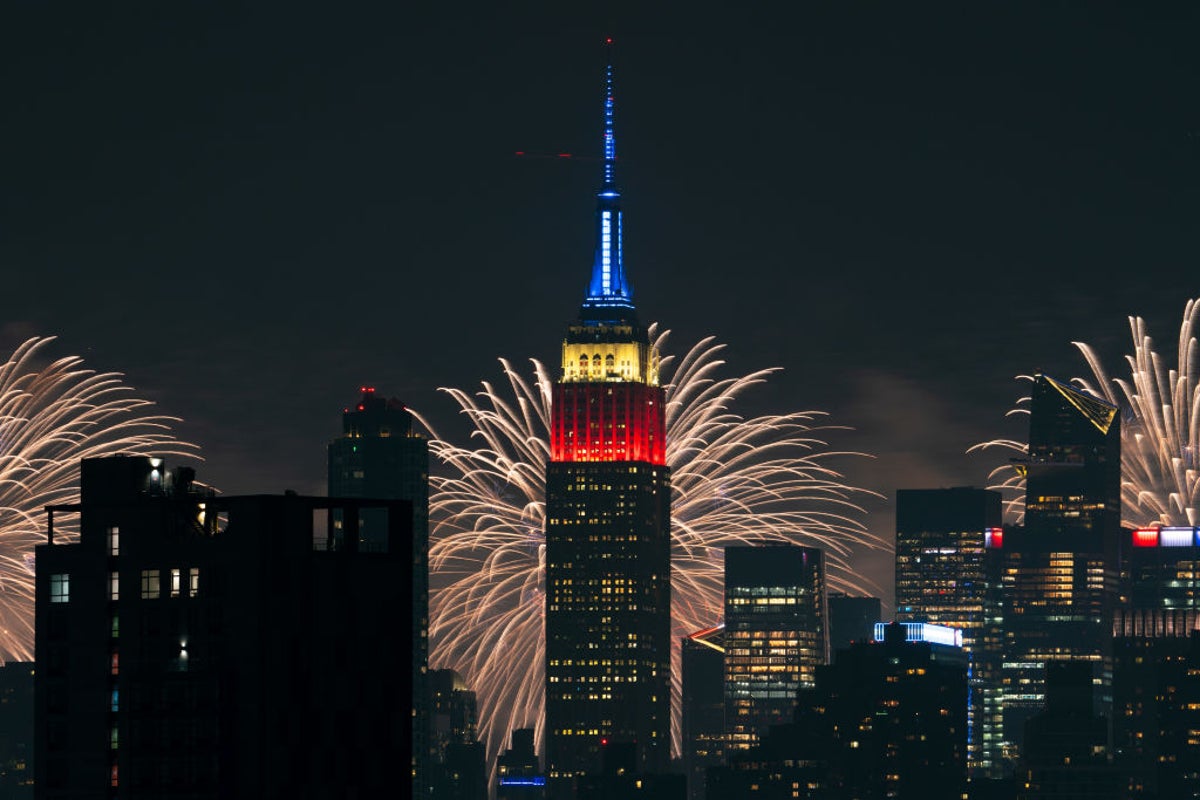
America celebrated its 250th anniversary amidst record-breaking heatwaves and standard-issue backyard barbecues, but the actual headline of the day was written in smoke over the East River. The Brooklyn Bridge caught fire during the national celebrations. While early reports treated the blaze as a bizarre, isolated mishap caused by stray fireworks, the reality is much more damning. The fire was the predictable result of a systemic collision between extreme climate realities and an antiquated, overburdened national infrastructure that is completely unprepared for the next century.
Urban centers across the nation faced rolling grid pressures and melting transit components during the July 4th weekend, proving that the incident in New York was not an anomaly. It was a warning shot.
The Chemistry of a High-Wire Crisis
To understand how a historic suspension bridge catches fire, you have to look past the spectacular visuals of the fireworks display and examine the physical state of urban engineering. The Brooklyn Bridge utilizes a complex hybrid system of cable-stayed and suspension designs. The timber decking, pedestrian walkways, and protective coatings on the structural steel are subjected to intense environmental stress long before a single spark is introduced.
When ambient temperatures hover above 100 degrees Fahrenheit for consecutive days, structural materials undergo thermal expansion. Protective sealants degrade. Dust, microplastics, and oily residues from decades of commuter traffic settle into the microscopic fissures of the bridge’s upper frameworks.
During the anniversary events, pyrotechnic debris landed directly in these hyper-heated, debris-choked crevices. The combination of sustained thermal elevation and highly combustible chemical compounds from the fireworks created a flashpoint.
This was not a failure of event security. It was a failure of materials science management under extreme duress.
The Cost of Decorative Maintenance
Municipal budgets routinely prioritize aesthetic upgrades over deep structural reinforcement. It looks good on television to illuminate a historic monument in red, white, and blue, but the electrical conduits and structural elements supporting those displays are frequently decades old.
Consider a hypothetical city that spends ten million dollars upgrading the exterior lighting of a historic transit hub but allocates less than two million to inspect the internal wiring conduits hidden behind the masonry. When an unseasonal heatwave hits, the cooling systems fail, the wires melt, and the entire system grinds to a halt.
This hypothetical scenario plays out in real time across major American cities every single summer. The American Society of Civil Engineers consistently gives the nation's infrastructure mediocre grades, pointing out a trillion-dollar investment gap. We are choosing to dress up aging infrastructure for holidays rather than rebuilding its core capacity to withstand modern environmental volatility.
Why Current Emergency Frameworks Are Obsolete
The response to the Brooklyn Bridge incident highlighted another critical flaw in our civic planning, specifically the reliance on reactive emergency protocols rather than predictive mitigation.
Fire departments and emergency management agencies are trained to suppress active threats. They arrive after the smoke appears. However, modern urban environments require real-time sensor networks that monitor structural temperature, material stress, and atmospheric particulate accumulation before a fire ever starts.
- Sensor Deficits: Most historic bridges lack continuous fiber-optic temperature monitoring along their upper cable spans.
- Predictive Failure: Without localized data, engineers cannot predict which section of a structure will fail first under extreme heat.
- Resource Misallocation: Emergency crews are deployed uniformly rather than being concentrated at high-risk thermal zones.
Relying on human observation to spot structural fires in the middle of a massive public gathering is an obsolete strategy. The smoke is often noticed only when the damage is already severe.
The Energy Grid Parallel
The vulnerability of our monuments mirrors the precarious state of the national energy grid during major holidays. Independence Day celebrations drastically spike energy consumption. Air conditioning units run at maximum capacity across entire time zones while municipal entertainment systems draw massive amounts of power simultaneously.
This simultaneous demand creates severe electrical distribution bottlenecks. Transformers overheat. Transmission lines sag under the thermal load, sometimes coming into contact with overgrown vegetation and sparking secondary blazes far away from major cities.
We are asking a mid-20th-century grid to manage 21st-century climate extremes and population densities. The system cannot sustain this trajectory without widespread, systemic overhauls that move beyond mere patch-and-repair maintenance.
The True Path to Resiliency
Fixing this vulnerability requires an immediate shift in how public works projects are funded and executed. True resiliency means designing structures that actively adapt to their environments.
This involves implementing self-cooling materials, advanced fire-retardant coatings that do not degrade under intense ultraviolet radiation, and integrated drone inspection fleets capable of monitoring structural integrity without disrupting public use.
Furthermore, civic celebrations must be reimagined to reduce physical risks to historic architecture. Drone light shows, which eliminate chemical debris and fire hazards entirely, are replacing traditional pyrotechnics in forward-thinking municipalities. Continuing to detonate tons of explosives over fragile, overheating infrastructure is a tradition that has outlived its safety margins.
Cities must face the stark reality that our historic structures are breaking down under the weight of climate shifts and systemic neglect. The fire on the Brooklyn Bridge was a spectacular display of vulnerability, proving that patriotism cannot substitute for structural integrity.