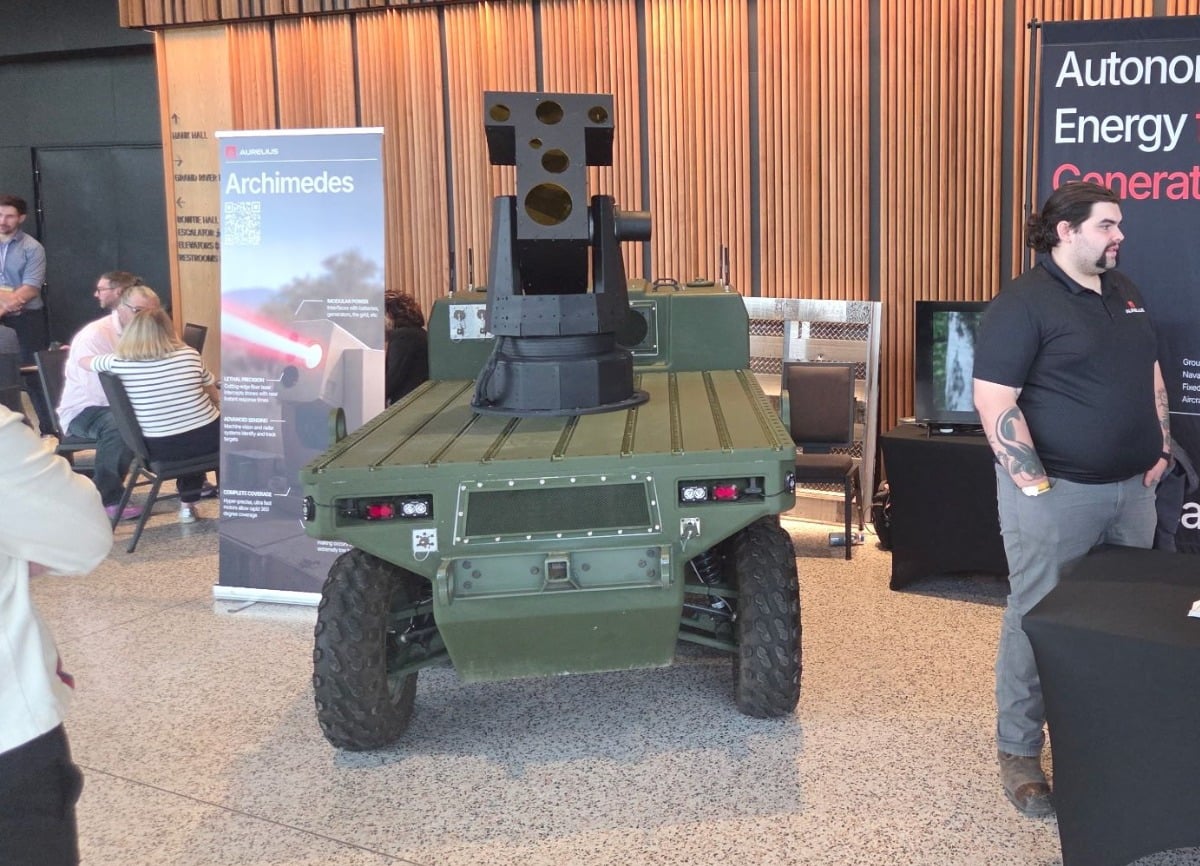
The defense industry wants you to believe that cheap, swarming quadcopters can be easily erased by a single burst of concentrated light. At a recent defense exhibition in Detroit, contractors proudly unveiled their latest creation, a mobile laser drone-killer robot designed to burn incoming threats out of the sky in seconds. It looks spectacular on a showroom floor, gleamic under stadium lighting with its motorized optics tracking imaginary targets. The sales pitch is seductive because it promises a clean, high-tech remedy to the terrifying reality of modern mechanized infantry warfare.
But showroom demonstrations are not the muddy, chaotic realities of an actual battlefield.
While a laser drone-killer robot offers a theoretical solution to the severe cost imbalance of using million-dollar missiles against five-hundred-dollar quadcopters, the underlying physics and engineering limitations present major hurdles that defense contractors routinely downplay. This system is not a magic shield. It is a highly sensitive, power-hungry optical laboratory bolted onto a combat chassis, trying to function in an environment defined by dirt, smoke, and unpredictable weather.
The Financial Math Driving the Laser Push
Modern warfare has an asymmetry problem that is bankrupting traditional air defense strategies. When a swarm of cheap commercial quadcopters carrying modified explosives can disable an advanced main battle tank, the economic calculus flips on its head.
Traditional air defense rely on kinetic interceptors. Firing a conventional surface-to-air missile costs hundreds of thousands of dollars per shot. In some cases, that number climbs past a million. Forcing an army to deplete its limited inventory of sophisticated missiles against a wave of disposable plastic targets is a highly effective attrition strategy.
Directed-energy weapons fundamentally alter this equation. A laser weapon requires no physical ammunition storage, instead drawing power directly from an onboard generator or battery bank. The marginal cost per shot drops down to the price of the fuel needed to run the engine for a few seconds. This is often estimated at less than ten dollars per engagement.
This financial incentive explains why the Pentagon and global defense firms are pouring billions into these programs. The Detroit exhibition highlighted a machine built precisely for this role, featuring rapid-targeting software and a solid-state fiber laser designed to disable a drone's plastic rotors or ignite its onboard lithium-polymer batteries.
The Unforgiving Physics of Atmospheric Degradation
The primary enemy of any laser weapon system is not the target itself. It is the air between the weapon and the target. On a clean test range or inside an exhibition hall, a laser beam travels undisturbed, delivering maximum thermal energy to a precise spot.
Real battlefields are messy. High-energy laser beams suffer from an effect known as atmospheric attenuation, where dust, water vapor, smoke, and battlefield debris scatter and absorb the light particles. Every millimeter of airborne particulate matter robs the beam of its destructive potential.
Consider these common battlefield conditions and their direct impact on laser efficacy
- Heavy fog or rain drops the effective range of a solid-state laser precipitously as water droplets diffuse the concentrated beam across a wider area.
- Battlefield smoke screens act as an immediate physical shield, dropping the thermal energy absorption at the target down to near-zero levels.
- Thermal blooming occurs when the laser beam heats the air it passes through, creating a lens effect that defocuses the beam and prevents it from melting the target.
To burn through a drone's casing, the laser must dwell on the exact same square centimeter of a moving target for several seconds. If the beam is diffused by dust or deflected by atmospheric turbulence, it merely warms the plastic rather than destroying it. The drone keeps flying.
The Mobile Power Dilemma
A laser drone-killer robot requires an immense amount of instantaneous electrical power to function. Generating a 30-kilowatt to 50-kilowatt beam requires a power plant that is both massive and heavy, transforming the vehicle into a prominent logistical target.
Cooling these systems presents an even greater engineering headache. Solid-state lasers generate enormous amounts of waste heat during operation. If the system cannot dissipate this heat immediately, the optical components warp, degrading accuracy or causing a catastrophic internal system failure.
This reality creates a major design contradiction. To protect the delicate lasers and cooling loops, engineers must add heavy armor plating. However, adding armor increases the overall weight of the vehicle, reducing its cross-country mobility and increasing its fuel consumption. The resulting machine is often too heavy for soft terrain, yet too fragile to be placed directly on the front line where the drone threat is most acute.
Countermeasures Are Already Cheaper Than the Fix
Military technology exists in a constant state of measure and countermeasure. The moment a weapon system becomes prevalent, an inexpensive method to bypass it emerges.
Protecting a cheap quadcopter from a laser system does not require advanced alien technology. A simple layer of highly reflective material or a specialized ablative coating can scatter or absorb enough thermal energy to double or triple the required dwell time of a laser beam. If a laser needs ten seconds of continuous contact to destroy a drone instead of two seconds, the system's ability to handle multiple simultaneous targets evaporates.
Furthermore, autonomous navigation algorithms are evolving away from constant radio communication. Modern drones can utilize onboard computer vision to navigate toward a target even when their GPS signals are completely jammed. A coordinated, multi-directional swarm can easily overwhelm a single laser turret, which can only engage one target at a time. While the laser is busy burning down one drone on the left, three more can slip through from the right.
The machine displayed in Detroit represents a necessary step forward in the evolution of tactical air defense, but it is far from an immediate solution to the drone problem. It is a niche tool that must be carefully integrated into a wider, multi-layered defense network alongside rapid-fire conventional guns, electronic jamming arrays, and physical net catchers. Relying on a laser robot alone to secure the airspace is a gamble that ignores both basic physics and historical precedent.