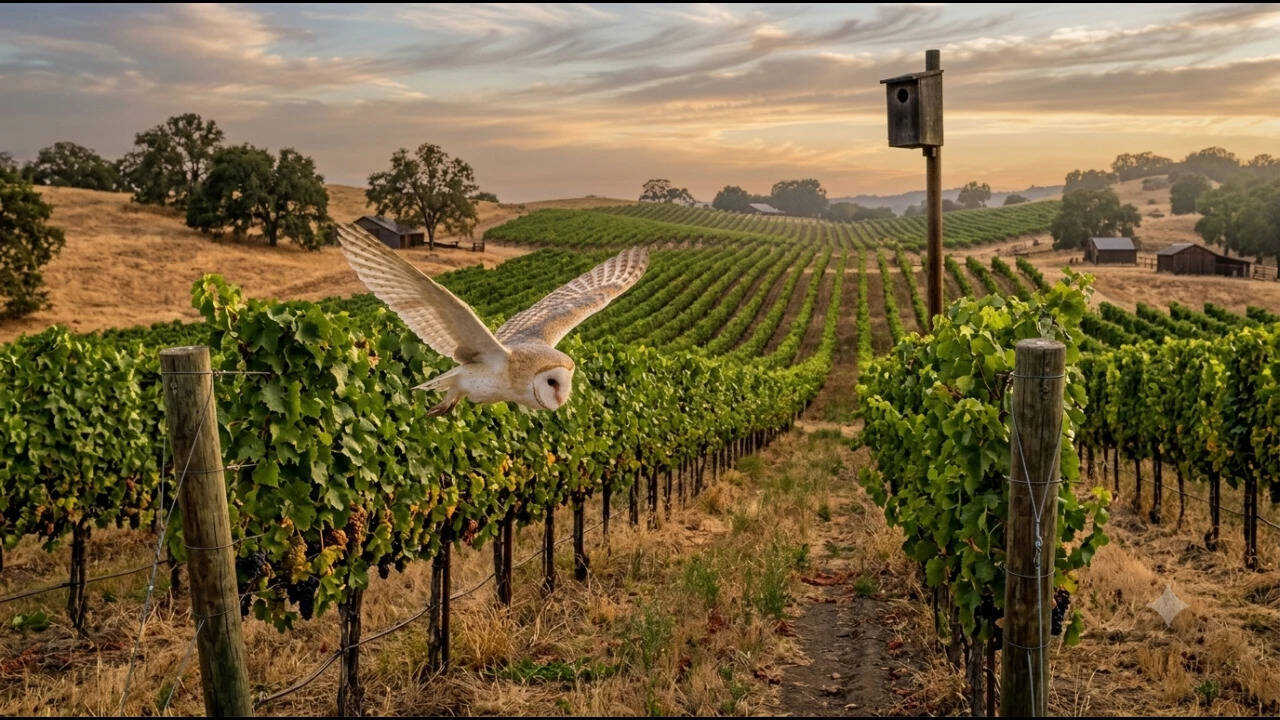
If you walk through a North Coast vineyard at dusk, you won't just smell damp earth and aging oak. You might hear a harsh, hissing shriek cutting through the evening air. That is the sound of a barn owl going to work. For decades, agricultural producers relied on chemical rodenticides to keep pocket gophers and voles from chewing through vine roots. That strategy backfired. It poisoned local raptors, polluted the soil, and created a dependent loop that cost growers a fortune.
Smart vineyard owners changed tactics. They built wooden boxes on tall poles, invited wild barn owls to move in, and watched nature handle the pest control. The results stunned skeptics. Studies tracking California vineyards using owl boxes found that these silent hunters can reduce rodent populations by up to 52 percent. Pest control isn't about chemical warfare anymore. It is about biology.
The Rodent Problem Beneath the Vines
Underneath those neat rows of Pinot Noir and Chardonnay lies an underground highway system. Pocket gophers, voles, and ground squirrels treat vine root systems like an endless buffet. A single gopher can girdle a young vine, killing it in days. When you scale that across a fifty-acre estate, the financial damage adds up fast.
Growers used to panic. They dropped toxic bait pellets into burrows or sprayed broad-spectrum poisons. Then the secondary poisoning started. A hawk or a bobcat would eat a dying mouse, ingest the poison, and die on the property. Suddenly, the vineyard lost its natural predators, and the rodent problem bounced back twice as hard. It was a vicious cycle.
Barn owls offer a clean break from that cycle. They don't dig up the soil. They don't introduce chemical runoff into the local watershed. They just sit quietly during the day, fly out at night, and sweep the vineyard floor clean of anything with whiskers and a tail.
Why Barn Owls Outperform Every Alternative
You can buy mechanical traps. You can hire pest control crews. None of them compare to a breeding pair of barn owls during peak hunting season.
A single barn owl family consumes hundreds of rodents a year. When nesting parents have four or five hungry chicks to feed, the hunting frequency spikes dramatically. They scour the vineyard rows from dusk until dawn. Their flight is entirely silent, thanks to specialized wing feathers that muffle the sound of rushing air. Rodents never hear them coming.
Compare that to human intervention. A trap requires manual resetting, bait replacement, and constant monitoring. Poisons require regulatory compliance and carry severe environmental liabilities. Barn boxes require an initial installation cost, an annual cleaning in the off-season, and basically zero maintenance after that.
The economics speak for themselves. Building and mounting a sturdy wooden owl box costs roughly one hundred dollars in materials. Compare that to thousands of dollars spent annually on rodenticide applications and vine replacements. It is one of the few sustainable farming practices that actually saves money right out of the gate.
Setting Up Your Own Vineyard Owl Program
You cannot just nail a plywood box to a tree and expect results. Barn owls have specific real estate preferences. If you ignore their rules, they will ignore your vineyard.
Height matters. Boxes should stand twelve to fifteen feet off the ground, mounted on smooth metal poles to keep predators like raccoons and cats from raiding the nest. Face the entrance holes away from prevailing winter winds and harsh afternoon sun. East-facing or south-facing orientations usually work best in California's climate.
Spacing is another critical factor. Putting ten boxes in a single acre won't work because territorial breeding pairs will fight or drive each other away. Space them out roughly one box per ten to twenty acres to give each family enough hunting territory to thrive.
Clean them out once a year. Late autumn, right before the breeding season kicks off, is the ideal window. Clear out old pellets, feathers, and debris so the incoming pair has a fresh space to raise their clutch.
The Broader Ecological Shift
This isn't just about saving grapes. It is about redesigning agricultural landscapes to work with native species instead of fighting them. When you stop poisoning the local food web, other beneficial predators return. Foxes, hawks, and snakes show up naturally to share the workload.
Consumers care about this stuff. People buying a bottle of wine want to know the land was treated with respect. Marketing a wine as bird-friendly or rodent-controlled via raptors carries genuine weight in a crowded tasting room.
You don't need a degree in ornithology to make this work. You just need patience, a few well-built wooden boxes, and the willingness to let nature take the wheel. Stop buying synthetic poisons. Put up a pole, screw together a box, and let the owls do what they do best.