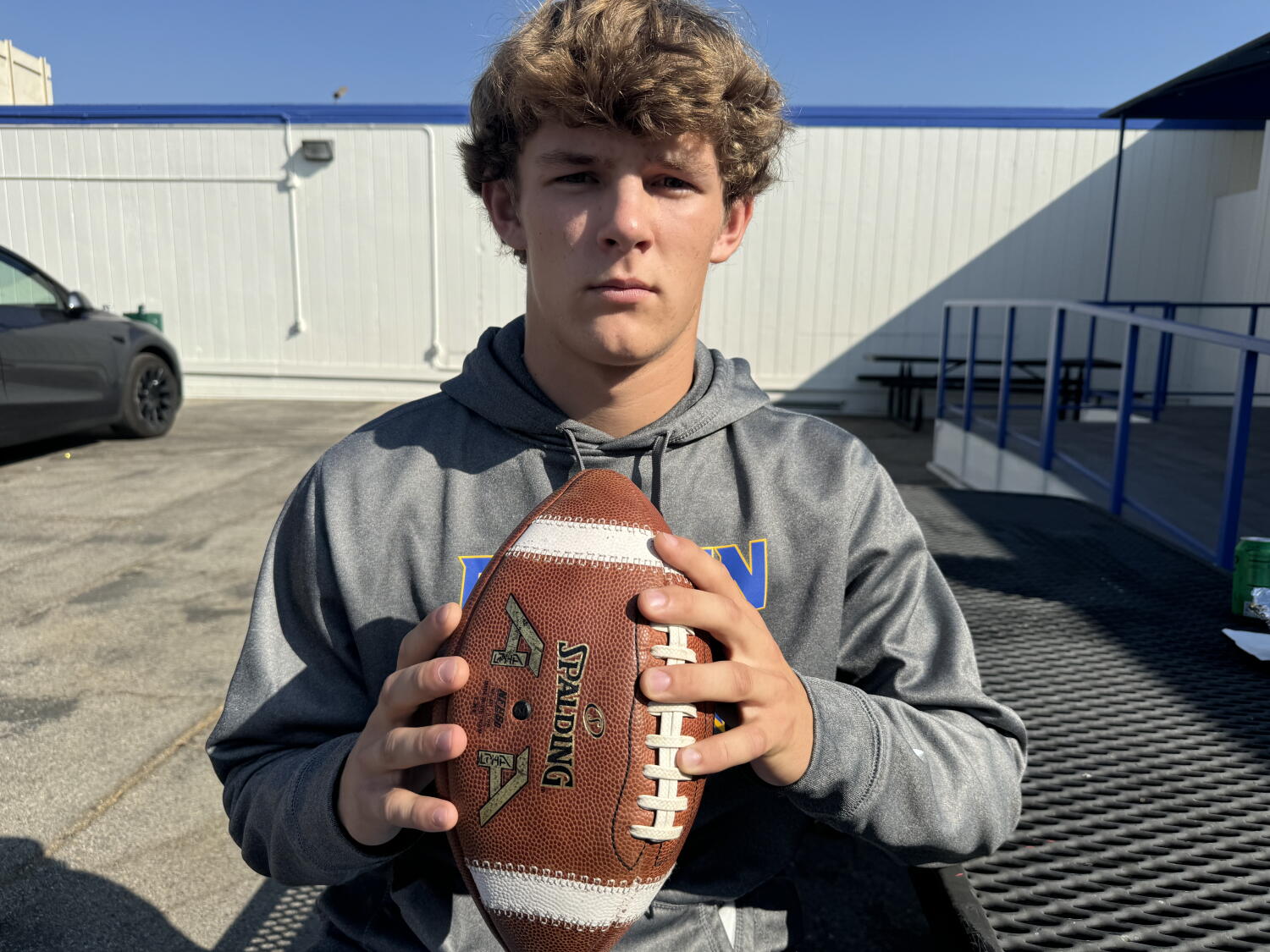
Sports journalism has a lazy habit. Every autumn, local beat writers find a versatile high school senior, slap a cute superlative on the headline, and call it a day. Calling George Hastings Agoura High School’s "second-favorite athlete" sounds like a harmless compliment. It isn't. It is a symptom of a shallow evaluation culture that reduces real athletic grit to a popularity contest.
When a reporter frames a multi-sport workhorse as the runner-up in a town's affection, they are missing the actual mechanics of what makes high school athletics tick. Let’s tear down this feel-good narrative and look at what George Hastings actually represents—and why the local sports media’s obsession with ranking "favorites" hurts the very athletes they claim to celebrate.
The Myth of the "Second-Favorite" Trophy
Popularity is a terrible metric for athletic value. Yet, local coverage routinely treats high school sports like a homecoming court election. If a kid isn't the flashiest quarterback throwing four touchdowns on a Friday night, or the blue-chip recruit with twenty Division I offers taped to his locker, he gets relegated to the "runner-up" tier.
Here is the problem with that framing. In a place like Agoura Hills—where the shadow of massive Southern California athletic powerhouses looms large—a program’s survival does not depend on its single biggest superstar. It depends on the structural glue.
I have spent over fifteen years evaluating prep talent, sitting in freezing bleachers from Ventura to Orange County, and watching college recruiters tear their hair out over media hype. Time and again, the athletes who get labeled "second-favorite" by the local press are the exact ones who keep a varsity roster from collapsing by Week 6.
Why Local Media Defaults to Lazy Superlatives
Beat writers are under immense pressure to churn out human-interest hooks. Saying "George Hastings plays hard" doesn't sell papers or drive clicks. Inventing a folksy hierarchy—who is number one, who is number two—creates an easy, digestible story.
- It manufactures false drama. Nobody in the Agoura locker room is walking around with a clipboard tallying who the town likes best.
- It flattens multi-dimensional skill sets. When you reduce an athlete to a punchline about being second-best, you stop analyzing their actual footwork, field vision, and conditioning.
- It anchors college scouts to the wrong narrative. Recruiting coordinators read local press. Framing a prospect as a lovable sidekick instead of a primary engine subtly poisons their evaluation before a scout ever turns on the game film.
What Makes a Multi-Sport Workhorse Actually Valuable
To understand why the "second-favorite" label fails, you have to look at the physiology and psychology of the multi-sport prep athlete. Specialization has ruined modern youth sports. Kids are pushed into year-round travel ball at age eleven, burning out their joints and narrowing their athletic IQ before they even hit puberty.
When an athlete like George Hastings steps onto the field, court, or track across different seasons, they are operating in a completely different biomechanical tier than the single-sport specialist.
Transferable Athletic Intelligence
Consider the mechanics of spatial awareness. A player who transitions from the chaotic, high-contact environment of varsity football to the rapid-fire geometry of basketball or lacrosse develops what sports scientists call cross-domain pattern recognition.
- Deceleration control: Braking on grass in cleats requires entirely different eccentric muscle loading than stopping on hardwood or turf. Multi-sport athletes build resilient connective tissue that single-sport kids simply do not have.
- Anticipatory reading: The visual cues used to read a pulling guard translate directly to anticipating a backdoor cut or a clearing pass.
- Emotional regulation under fatigue: Playing high-leverage minutes in February after a brutal fall campaign builds a calloused nervous system. You cannot simulate that in a private speed-and-agility clinic.
Calling this kind of athlete "second-favorite" is like calling a load-bearing wall the "second-prettiest part of the house." Without it, the roof caves in.
The Psychology of the "Glue Guy" Fallacy
Sports culture loves a lone hero. We want the cinematic narrative where one transcendent talent carries a team on his back while everyone else applauds from the sidelines. That is pure fiction, especially at the CIF Southern Section level.
In reality, high school teams operate as fragile ecosystems. Coaching staffs turn over. Injuries wipe out depth charts by mid-October. Academic eligibility claims starters right before league play begins. In that environment, versatility is the ultimate currency.
Imagine a scenario where Agoura High loses its top offensive threat in the first quarter of a Marmonte League clash. The "favorite" is on the bench with an ice pack on his knee. Who steps into the huddle? Who absorbs the extra defensive coverage, takes the bruising interior assignments, and keeps the tempo from spiraling? It is never the media darling. It is the guy who spent the offseason quietly mastering three different positions because the coaching staff knew he was the only one smart enough to learn the playbook.
The Hidden Cost of Being Underestimated
There is a massive downside to the contrarian truth I am laying out here, and we need to be honest about it. Being the versatile, reliable workhorse often punishes an athlete at the next level.
College recruiting is brutally transactional. A Division I position coach does not want a jack-of-all-trades; he wants a 6-foot-4 edge rusher with a 4.5 forty-yard dash who does one thing at an elite level. Because athletes like Hastings sacrifice individual stat-padding to fill whatever gap their high school team needs filled, their highlight tapes often look fragmented.
- They don't have 1,500 rushing yards because they spent half the season blocking or playing defense.
- They don't average 22 points a game because they were assigned to lock down the opposing team's best scorer.
- They get praised for "heart" and "grit"—words that scouts often use as polite code for "not flashy enough to offer a scholarship."
When local media leans into the "second-favorite" trope, they reinforce this exact bias. They celebrate the athlete's humility while completely ignoring the statistical sacrifice that made their team competitive in the first place.
Dismantling the Questions Fans Actually Ask
If you search for prep sports coverage in the Conejo Valley, you run into the same tired questions from parents, boosters, and casual fans. Most of them are built on completely flawed premises.
"Who is the best athlete at Agoura High School?"
Stop asking this. It is a meaningless question unless you define the metric. Are we talking about raw combine measurables—vertical leap, shuttle time, bench press? Are we talking about collegiate projection? Or are we talking about Wins Above Replacement on a Friday night?
If you measure by raw physical ceiling, the answer is almost always a physical outlier who might not even understand the nuances of their sport yet. If you measure by who actually dictates the outcome of games against stiff competition, the "best" athlete is frequently the unheralded senior who never misses a practice, plays through bruised ribs, and makes three different position groups better just by lining up next to them.
"Does multi-sport participation hurt a player's college chances?"
The exact opposite is true, though you wouldn't know it from listening to travel-ball coaches trying to sell you a $3,000 summer showcase package. Data tracked across NCAA Division I rosters consistently shows that the overwhelming majority of college athletes—often upwards of 85 percent in football and track—played multiple sports in high school.
College coaches are terrified of "maxed-out" recruits. When a kid has been lifting weights six days a week and playing one sport year-round since eighth grade, what you see at age seventeen is all you are ever going to get. Their ceiling is already reached, and their joints are already frayed. When a recruiter sees a multi-sport grinder like Hastings, they see untapped physical upside. They see an athlete who hasn't even begun to specialize yet.
"Why don't glue guys get more media attention?"
Because competence is boring to write about. A missed tackle or a miraculous one-handed catch makes for great video highlights. Positioning yourself two steps to the left before the snap to cut off an inside lane—forcing the running back to bounce outside into your teammate's arms—looks like nothing on camera. The teammate gets the tackle, the teammate gets their name in the paper, and the guy who actually created the play gets a pat on the helmet.
How We Should Actually Cover Prep Athletes
If local sports journalism wants to stay relevant instead of reading like a high school yearbook, the entire framework needs to change. We need to stop ranking kids like racehorses and start analyzing the game like adults.
- Track impact metrics, not just box-score vanity stats. Highlight the third-down stops, the deflections, the screens set, and the positional switches. Show the reader how the game was won, not just who crossed the goal line.
- Retire the "favorite" label permanently. High school athletes are not entertainers competing for town approval. They are teenagers dedicating twenty hours a week to a grueling physical craft. Treat their work with technical respect.
- Contextualize positional sacrifice. When a player moves from a glory position to a trench position to help the team, call it what it is: high-level leadership and athletic adaptability.
George Hastings doesn't need to be Agoura’s second-favorite athlete. He doesn't need to be anyone's favorite at all. In the brutal, unforgiving reality of varsity high school sports, being indispensable is the only title that actually matters.