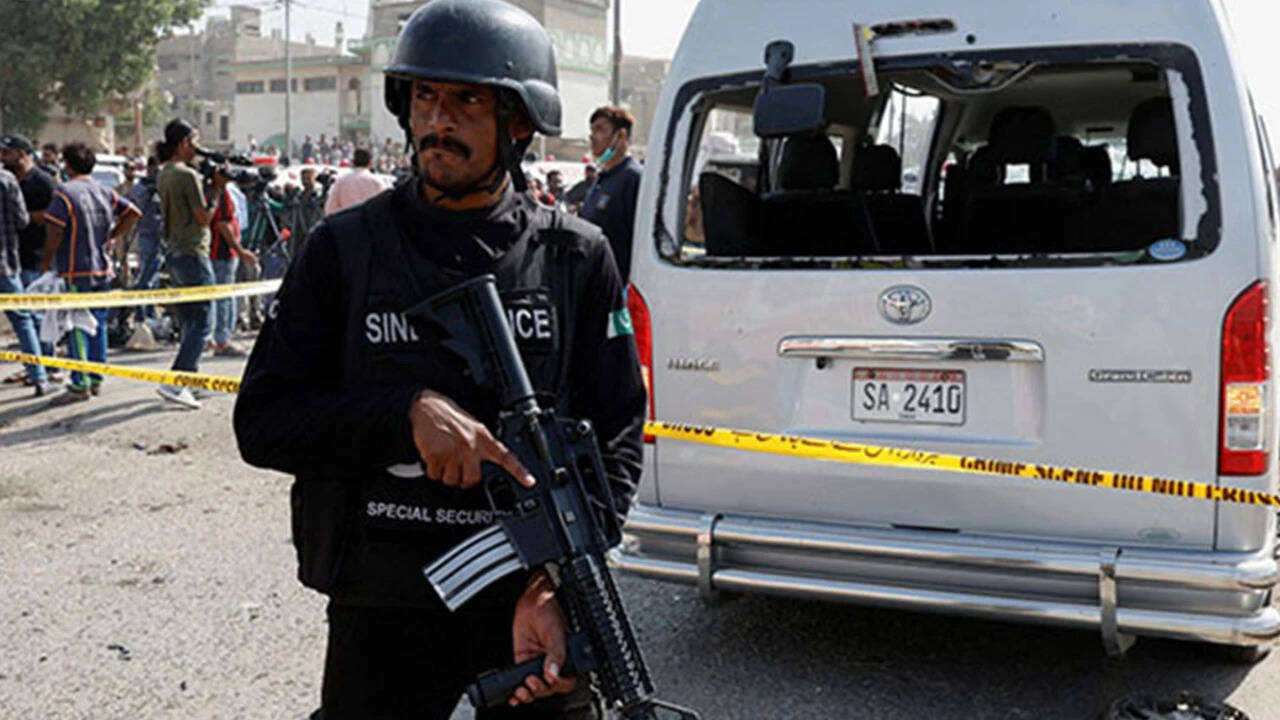
Ten policemen dead in Kohat. A gunbattle echoing across Khyber Pakhtunkhwa. Within minutes of the first shots, the standard media playbook kicks into gear.
Wire services push out breaking alerts counting the bodies. Pundits dust off the same tired scripts about "resurgent militancy," "border insecurity," and "kinetic operations." Officials issue copy-pasted statements condemning the "cowardly act" and promising that the sacrifices of the martyrs will not go in vain.
Stop buying this narrative.
Treating the Kohat ambush as merely another episodic spike in terrorism is the laziest consensus in South Asian security analysis. It reduces a systemic collapse of state governance and policing doctrine into a simple body count. When you frame every attack in Khyber Pakhtunkhwa as an isolated tactical clash between good guys in uniform and bad guys with rifles, you completely miss why the men in uniform keep dying in the exact same way, in the exact same districts, year after year.
The uncomfortable truth is that the Khyber Pakhtunkhwa Police are not just fighting an insurgency. They are fighting a war with a doctrine designed for traffic stops, deployed as cheap infantry on the front lines of a geopolitical failure they did not create.
The Myth of the Tactical Failure
Whenever a police station or convoy gets hit in districts like Kohat, Bannu, Lakki Marwat, or Dera Ismail Khan, the immediate post-mortem focuses on tactical gaps. Critics ask why the armored personnel carriers were not deployed, why night-vision gear was missing, or why intelligence failed to intercept the chatter.
Those questions are valid, yet they miss the forest for the trees. You cannot solve a political and strategic vacuum with better Kevlar.
Look at the geography and history of Kohat. Sitting at the gateway to the former Federally Administered Tribal Areas (FATA), specifically bordering Orakzai and Kurram, Kohat is not some remote outpost. It is a major garrison city. It houses vital military infrastructure, key transit arteries, and the headquarters of the Kohat Division. If militants can mass enough firepower to kill ten police officers and sustain a protracted gunbattle right here, the problem is not a lack of checkpoints.
I have spent years tracking counterinsurgency metrics across the Durand Line, and the pattern is painfully consistent. Every time Islamabad relies on a "clear and hold" strategy where the military clears an area and hands the "hold" phase over to an under-resourced civilian police force, the police become sitting ducks.
The Policing Paradox
Policing and counterinsurgency are fundamentally incompatible missions.
- Policing requires visibility, accessibility, community integration, and minimal use of force. A good beat cop sits in an open station, talks to locals, and operates within strict legal frameworks.
- Counterinsurgency requires fortified positions, heavy weaponry, offensive patrols, and intelligence networks capable of penetrating clandestine cells.
In Khyber Pakhtunkhwa, the state merged the tribal areas into the province in 2018 through the 25th Constitutional Amendment without building the institutional spine required to govern them. Suddenly, regular civilian police were expected to enforce writ in territories where tribal elders and Frontier Crimes Regulations had ruled for a century. They were given old rifles, brick-and-mortar stations with low perimeter walls, and told to hold the line against battle-hardened fighters equipped with leftover NATO weaponry and thermal scopes.
Calling the Kohat ambush a "police security lapse" is like blaming a lifeguard for failing to stop a tsunami.
Dismantling the Lazy Consensus on Border Security
If you ask the average security analyst what is driving the bloodshed in Kohat and southern KP, you will hear one overwhelming answer: Afghanistan.
The standard argument goes like this: the return of the Taliban in Kabul gave Tehreek-e-Taliban Pakistan (TTP) strategic depth, sanctuary, and modern weapons. Therefore, until Kabul reins in the TTP, Kohat will bleed.
Is cross-border sanctuary a massive factor? Obviously. Denying the operational breathing room the TTP enjoys across the border would be dishonest. Organizations like the Pakistan Institute for Peace Studies (PIPS) and the Center for Research and Security Studies (CRSS) have documented the steep upward trajectory in militant attacks since late 2021. The correlation is undeniable.
However, blaming everything on Kabul is the ultimate political get-out-of-jail-free card for domestic policymakers.
What the Border Narrative Hides
- The Negotiations Blunder: Between 2021 and 2022, Islamabad pursued an opaque appeasement policy, releasing hundreds of hardened TTP militants and allowing thousands to return and resettle in KP under the guise of peace talks. Those talks predictably collapsed, leaving intact militant networks embedded directly inside districts like Swat, Bannu, and Kohat. They did not all just walk across the border yesterday; many were invited back in.
- The Intelligence Breakdown: Militants do not materialize out of thin air to ambush ten officers. Executing a coordinated assault and sustaining a gunbattle requires local logistics—safe houses, spotters, fuel, ammunition caches, and medical support. That infrastructure exists because local populations are either intimidated into silence or deeply alienated by heavy-handed state responses, prolonged curfews, and economic neglect.
- The Resource Mismatch: While billions are poured into mega-projects and elite security protocols in major urban centers, the rank-and-file constable in Kohat often lacks basic mine-resistant vehicles (MRAPs) and modern communications gear.
Imagine a scenario where the border with Afghanistan were sealed tomorrow with a hundred-foot concrete wall. Would the attacks in Kohat stop? No. The networks are already localized, self-funding through extortion and kidnapping, and deeply entrenched in the socio-economic cracks of southern KP.
Why "More Operations" Is the Wrong Answer
When news breaks of ten dead policemen, the public demands vengeance, and the state obliges with promises of sweeping kinetic operations. This brings us to the biggest misconception in counter-terrorism: the belief that killing more militants equals winning the war.
In asymmetric warfare, attrition favors the insurgent.
Militant groups like the TTP or regional splinter factions do not need to hold territory permanently to win. They only need to prove that the state cannot protect its own enforcers. Every time a police mobile is blown up or a checkpoint is overrun, the psychological impact ripples through the entire civil administration. Judges become hesitant to convict. Local administrators stay behind blast walls. Informants dry up because they see that the state cannot even keep its own cops alive.
The Trap of Kinetic Addiction
Military theorists from David Galula to David Kilcullen have hammered home the same principle for decades: counterinsurgency is 80 percent political and 20 percent military. Yet, policy in KP remains inverted—80 percent kinetic and 20 percent political, if that.
When an operation is launched after an attack like Kohat:
- Roads are blocked, crippling local trade and daily wage earners.
- Mass arrests and cordon-and-search sweeps sweep up innocent civilians alongside suspects.
- Collective punishment breeds resentment among Pashtun communities who already feel marginalized.
- Militants simply melt into the rugged terrain or urban sprawl, wait for the operation to wind down, and strike the next vulnerable police patrol.
This is not a strategy. It is a hamster wheel soaked in blood.
Answering the Questions Nobody Wants to Ask
When readers search for news about the Kohat attack, they usually look for simple answers: Who did it? How many died? Is the area safe now? Those are the wrong questions. If we want to understand what is actually happening in Pakistan's northwest, we need to ask—and brutally answer—the questions that get buried beneath official press releases.
Is the KP Police force collapsing?
No, and that is actually the most astonishing part of this entire tragedy. Despite abysmal casualty rates, inferior gear, and relentless targeting, the KP Police continue to show up for duty. Their resilience is extraordinary. However, resilience is not a sustainable security policy. Morale is a finite resource. When rank-and-file officers watch senior leadership fail to secure basic protective equipment while politicians bicker over federal funds, silent attrition sets in. Officers stop patrolling aggressively. They hunker down inside fortified stations at night, ceding the streets to the insurgents after sundown. You do not need a formal surrender to lose control of a district; you just need the police to stop leaving the barracks.
Why are police targeted more than the military?
It is simple target economics. Attacking a fortified military cantonment requires massive resources, complex planning, and carries a high probability of total annihilation for the attackers. Police stations, roadside pickets, and routine patrol vans are soft targets. They are dispersed across civilian areas, predictable in their routines, and lightly armored. By bleeding the police, militants achieve maximum media headlines and maximum disruption of daily governance at minimal operational cost.
Does throwing more money at the police solve this?
Only if the money goes to the right places—and historically, it does not. Throwing funds at a broken structure just buys more expensive targets. Buying new pickup trucks without armor plating simply gives militants newer vehicles to shoot at. Increasing recruitment without overhauling counter-terror training simply puts more young men in harm's way faster.
What Actually Works (And Why Leaders Hate It)
If the status quo is a slow-motion disaster, what is the alternative? Fixing the security architecture in Kohat and across Khyber Pakhtunkhwa requires abandoning performative toughness in favor of structural, unglamorous reforms.
1. Stop Using Beat Cops as Counterinsurgency Cannon Fodder
There must be an immediate doctrinal separation between civilian policing and counter-terrorism. Regular district police should not be manning isolated rural checkpoints in high-threat zones. Either deploy dedicated, heavily armed paramilitary units (like the Frontier Constabulary) to hold perimeter zones, or fully convert threatened police posts into hardened, mutually supporting strongpoints with overhead cover, thermal surveillance, and rapid-reaction air or drone support. If you cannot defend a post, close it. Unprotected posts are just weapon-supply depots waiting to be raided.
2. Fix the National Finance Commission (NFC) Award Bottleneck
Since the 2018 merger of FATA into KP, the provincial government has repeatedly pointed out that the federal government and other provinces have failed to transfer the promised share of NFC funds meant for the newly merged districts. You cannot integrate millions of people and secure thousands of square kilometers of rugged borderland on a shoestring budget. The financial starvation of KP's security apparatus is a direct policy choice made in Islamabad and provincial capitals.
3. Rebuild Grassroots Intelligence Through Local Empowerment
Human intelligence (HUMINT) does not come from satellites or checkpoints; it comes from trust. You get trust when local elders, elected municipal representatives, and community leaders have genuine authority and economic stakes in peace. Empowering local governments in KP—rather than sidelining them in favor of bureaucratic commissioners—creates a natural buffer against militant infiltration.
4. Enforce Unified Command and Accountability
Right now, counter-terrorism in Pakistan suffers from fractured ownership. Civilian governments blame the military establishment; the military blames civilian governance failures; provincial authorities blame federal inaction. There needs to be a single, transparent chain of accountability. When ten officers die in Kohat, someone at the policy level—not just a local Station House Officer—must answer for why those men were left exposed.
The Uncomfortable Downside of Real Reform
Let us be completely honest about the trade-offs here. Adopting a hardened, intelligence-led, structurally separated policing model is not a magic wand.
First, fortifying police infrastructure and pulling cops back from vulnerable rural pickets means conceding physical presence in remote areas in the short term. Critics will scream that the state is retreating. Second, shifting from massive kinetic sweeps to slow, surgical, intelligence-driven operations means there will be no immediate, flashy body counts to satisfy an angry public demanding instant retribution after an ambush. Politicians hate policies that take three years to show results when the news cycle demands vengeance by tonight.
Third, empowering local political structures in KP means accepting messy democratic friction and sharing power with local leaders who might criticize the state. For a security establishment accustomed to top-down control, letting go of the reins is terrifying.
Yet, the alternative is already playing out on our screens. Every few weeks, another district name enters the headlines. Another ten coffins are draped in flags. Another round of empty condemnations echoes through the halls of power.
Until Pakistan stops treating the slaughter of its police officers as a routine weather report and starts dismantling the broken governance model that leaves them exposed, Kohat will not be an exception. It will be the schedule.


