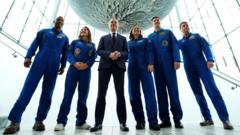
Mark Carney spent years managing the global financial system, but his most high-stakes conversation this year happened with four people suspended 400,000 kilometers above the planet. When the Prime Minister spoke with the Artemis II crew—including Canadian astronaut Jeremy Hansen—during their historic lunar flyby in April, the exchange was framed as a victory lap for national ingenuity. Now, as the crew concludes a multi-city homecoming tour across Ottawa and Montreal this May, the celebratory atmosphere masks a complex web of industrial debt and geopolitical maneuvering. Canada has secured its seat at the lunar table, but the price of admission involves more than just a talented pilot and a handful of commemorative coins.
The mission, which saw the Orion capsule Integrity shatter the distance record set by Apollo 13, represents the first time a non-American has ventured toward the moon. For Carney, the political optics are undeniable. Bringing the crew to the National Arts Centre and the Canadian Space Agency headquarters serves a specific domestic purpose: validating a multi-billion-dollar bet on space robotics and international partnerships at a time when the Canadian economy is searching for its next industrial anchor.
The Canadarm Debt
Canada didn't get Jeremy Hansen onto Artemis II through goodwill alone. The seat was the direct result of the Gateway Treaty, a massive commitment to provide the "Canadarm3" for NASA’s future Lunar Gateway station. This is a classic industrial quid pro quo. By providing the essential nervous system for a permanent lunar outpost, Canada ensures its astronauts stay in the flight rotation.
The risk, however, is that this strategy ties the Canadian space sector entirely to the whims of NASA’s budget and shifting American political winds. While Carney praised the "teamwork" and "human ingenuity" of the crew, industry insiders are looking at the balance sheet. Developing the next generation of space robotics is a decade-long capital intensive process. If the Artemis program faces delays or budget cuts in Washington, Canada’s massive investment in "smart" robotics could become a high-tech anchor rather than a sail.
Geopolitical Friction Above the Atmosphere
During the mission, a subtle but telling moment occurred when Carney referenced his discussions with U.S. President Donald Trump regarding the mission’s success. The two leaders have famously clashed on trade and climate policy, yet the Artemis mission remained a rare point of public alignment. This is not accidental. Space has become the ultimate "soft power" tool.
In the current geopolitical climate, the Moon is no longer just a scientific destination; it is high-ground territory. By participating in Artemis, Canada is signaling its allegiance to a Western-led lunar legal framework—the Artemis Accords—in direct opposition to the competing lunar base plans proposed by China and Russia. Hansen’s presence on the flight was as much a diplomatic statement as a scientific one. When the crew gifted Carney a Canadian flag that had orbited the moon, it wasn't just a souvenir. It was a flag planted in a specific camp of the new space race.
The Mechanics of the Lunar Flyby
The technical reality of the mission was far more grueling than the polished press conferences suggest. The crew—Commander Reid Wiseman, Pilot Victor Glover, Mission Specialist Christina Koch, and Hansen—spent ten days in a capsule roughly the size of a large SUV.
- Radiation Exposure: Venturing beyond the Van Allen belts exposed the crew to levels of cosmic radiation significantly higher than those experienced on the International Space Station.
- The Gravity Assist: The crew relied on a "free return" trajectory, using the moon's gravity to sling them back toward Earth. A single miscalculation in the burn during the lunar far-side transit would have left them on a permanent trajectory away from home.
- Life Support Stress: The Orion’s systems were pushed to their limits to ensure the carbon dioxide scrubbing and thermal management could handle four active humans in deep space for the first time.
Beyond the Inspiration Narrative
The government’s messaging focuses heavily on "inspiring the next generation." It is a safe, effective narrative. However, the real story lies in the commercial transition. The Canadian space sector is no longer just a government-funded science project. It is a maturing industry populated by companies like MDA Space, which are looking to monetize lunar infrastructure.
The "Carney era" of Canadian space policy appears to be shifting toward an infrastructure-first approach. By focusing on robotics and communication systems, Canada is positioning itself as the "utility provider" for the moon. We may not build the rockets, but we intend to build the hands that do the work once they arrive.
This approach is pragmatic, but it lacks the glory of a domestic launch capability. It makes Canada a vital partner, yet one that is permanently dependent on foreign lift capacity. While Hansen’s flight is a personal and national triumph, it also highlights the ceiling of Canadian ambition. We can go to the moon, but only if someone else provides the ride.
The Pacific Splashdown and the Path Ahead
When the Integrity capsule hit the waters of the Pacific on April 10, it marked the end of the test flight and the beginning of a grueling operational phase. The data gathered by the crew is currently being dissected at NASA’s Johnson Space Center, with Canadian scientists taking a lead on the health data related to deep-space radiation.
The homecoming tour this week is the final chapter of the Artemis II PR campaign. As the crew speaks to students in Montreal and stakeholders in Gatineau, the conversation will likely stay focused on the "majesty" of the Earthrise and the "spirit" of exploration. But in the boardrooms and the halls of Parliament, the conversation is different. It is about the cost of Canadarm3, the reliability of the SLS rocket, and the precarious nature of being a junior partner in a multi-trillion-dollar lunar economy.
Canada has successfully bought its way into the most exclusive club in human history. The challenge now is staying there once the initial glow of the homecoming tour fades and the cold reality of the federal budget sets in.
The flag that flew around the moon now sits in Ottawa, a reminder of a successful mission. But the real work isn't in the orbit; it’s in the contracts and the commitments that will determine if Jeremy Hansen is the first of many Canadian lunar travelers, or a historic anomaly.