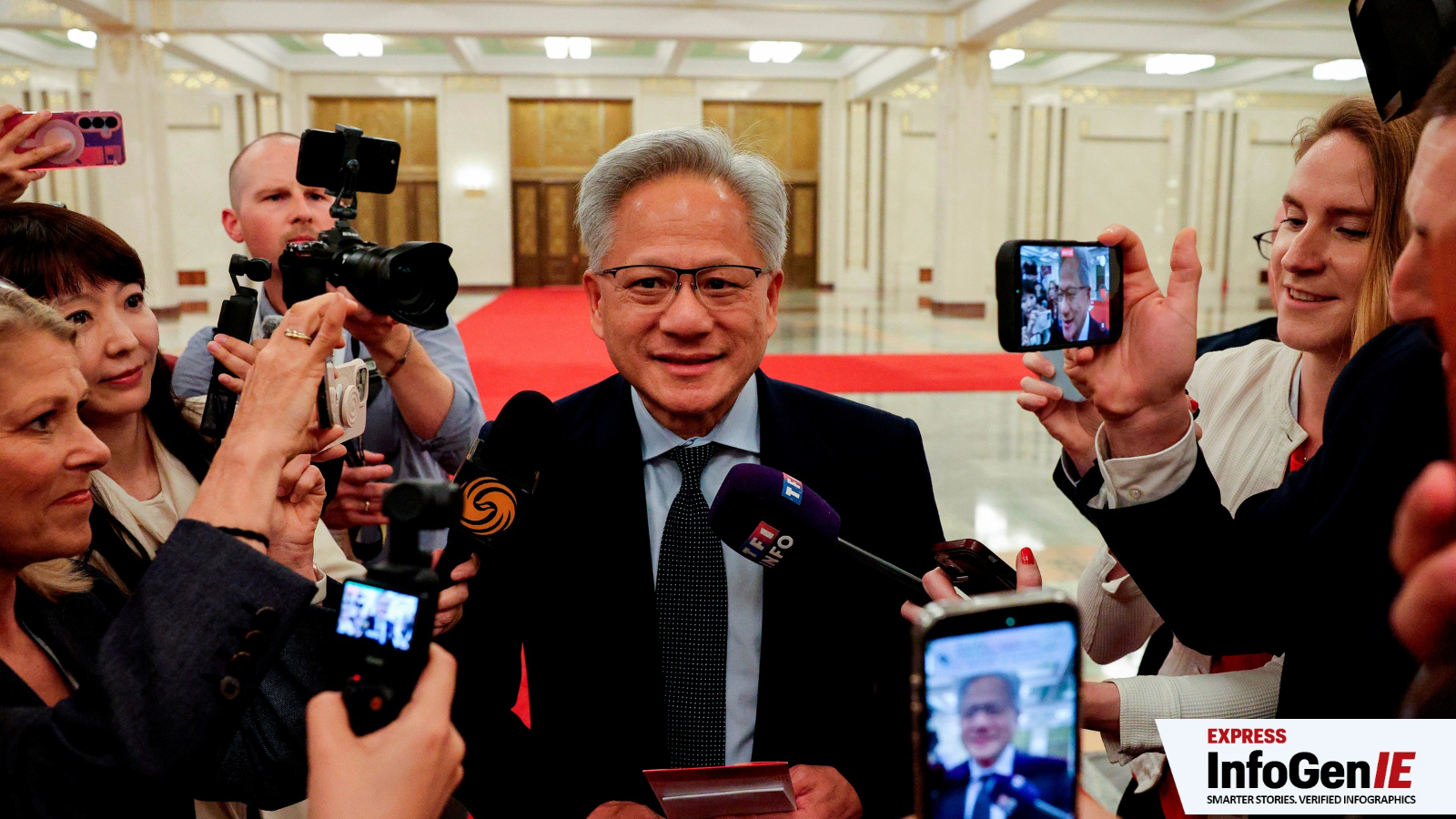
Rumors move faster than electrons in a silicon wafer.
In the quiet corners of financial message boards, in the breathless whispers of late-night tech podcasts, and occasionally in the panicked inbox of a retail investor who misread a headline, a strange ghost story circulates. It goes something like this: Nvidia has no plans to bring back Jensen Huang.
Pause. Read that sentence again.
If you felt a sudden, cold drop in your stomach—the kind you get when you check your brokerage account on a red Tuesday—you are not alone. The phrase sounds like an obituary for an era. It carries the heavy, bureaucratic finality of a corporate press release announcing that a legendary founder has moved on, retired to a vineyard, and will not be returning to save the ship.
There is just one minor detail missing from the panic.
Jensen Huang never left.
To understand why a statement like "Nvidia has no plans to bring back Jensen Huang" exists at all, and why it triggers such visceral anxiety across Wall Street and Silicon Valley, you have to look past the surface of corporate governance. You have to look at the strange, fragile psychology of how modern empires are built, and what happens when the fate of a multi-trillion-dollar industry becomes indistinguishable from the pulse of a single human being in a black leather jacket.
The Anatomy of a Phantom Headline
Let us ground ourselves in the cold, unyielding facts first.
Jensen Huang co-founded Nvidia in 1993 over a booth at a Denny's restaurant in East San Jose, California. He has served as the company’s President and Chief Executive Officer every single day since. Not for a decade. Not for twenty years. For more than thirty-three consecutive years, making him one of the longest-tenured chief executives in the history of the modern technology sector.
He has not stepped down. He has not taken a sabbatical. He has not transitioned into an "Executive Chairman" role to spend more time on philanthropy or yachting. When someone says, "Nvidia has no plans to bring back Jensen Huang," they are engaging in a classic linguistic sleight of hand—a true statement that implies a false premise. You cannot bring back someone who is currently sitting at the head of the table, approving the next generation of Blackwell and Rubin architectures, and signing off on multi-billion-dollar supply chain commitments with TSMC.
So why does the rumor persist? Why do search engines light up with variations of this exact query whenever Nvidia’s stock dips three percent or a competitor announces a new custom chip?
Consider a hypothetical scenario. Picture a mid-level portfolio manager in Chicago—let’s call him Marcus. Marcus manages a pension fund that holds millions of dollars in semiconductor equities. He has spent the last three years watching Nvidia defy the laws of financial gravity, morphing from a niche graphics card maker for PC gamers into the foundational utility of the artificial intelligence boom. Marcus knows the numbers cold. He knows the gross margins, the data center revenue run rates, and the CUDA software moat.
Yet, at 2:00 AM, Marcus wakes up staring at the ceiling. His anxiety isn't about quarterly earnings. His anxiety is about mortality and succession.
In the back of his mind, Marcus remembers what happened to Apple when Steve Jobs stepped down. He remembers the agonizing, decade-long drift of Microsoft after Bill Gates handed the reins to Steve Ballmer, before Satya Nadella finally resurrected the company. He remembers Intel—once the undisputed titan of silicon—slowly losing its manufacturing crown after the departure of Andy Grove’s ruthless, paranoid leadership style.
When investors like Marcus see a headline—even an AI-generated clickbait headline or a misconstrued forum post—suggesting that Nvidia has no plans to "bring back" Jensen, their brains bypass logic and go straight to their deepest unspoken fear: What happens the day he actually leaves?
The Myth of the Replaceable CEO
Corporate textbooks love to pretend that large companies are machines. According to traditional business theory, a well-run corporation has systems, processes, boards of directors, and deep benches of executive talent. If you swap out the person at the top, the machine should keep humming along, perhaps with a slight adjustment in speed or direction.
Anyone who has actually worked inside a founder-led technology company knows this is a comforting lie.
I remember sitting in a cramped, windowless conference room in Santa Clara years ago, listening to a senior engineer describe what it felt like to prepare a presentation for Jensen. There was no script. There were no polite, cushioned buffers of middle management filtering bad news before it reached the top floor. Nvidia famously operates with a remarkably flat organizational structure—dozens of executives report directly to Huang, bypassing the traditional pyramid of corporate hierarchy.
"If your logic has a flaw," the engineer told me, tapping a dry-erase marker against the table until the plastic clicked, "he doesn't ask a vice president to look into it next week. He walks up to the whiteboard, erases your diagram, and asks you why you violated the laws of physics."
That is not a management style you can bottle and hand to a successor in a transition binder.
When a company is led by its founder for over three decades, the organization stops being a mere collection of employees and becomes an extension of that founder's nervous system. At Nvidia, the company’s famous motto—"Our company is thirty days from going out of business"—is not a motivational poster hanging in the breakroom. It is a psychological survival mechanism forged in the fires of 1995, when Nvidia’s first chip, the NV1, flopped so catastrophically that Huang had to lay off half his staff and beg Sega’s CEO for $5 million just to make payroll.
A hired CEO, brought in from the outside or promoted through traditional corporate ranks, is trained to manage risk. Their primary instinct is to protect the moat, optimize margins, and avoid catastrophic failure.
A founder who stared bankruptcy in the face at age thirty-two has a completely different wiring. In 2006, Huang bet the entire company on CUDA—a software platform that allowed graphics chips to perform general-purpose computing. Wall Street hated it. For years, CUDA bloated Nvidia’s research and development costs while producing almost zero immediate revenue, crushing the stock price. A conventional board of directors would have fired a hired CEO for burning that much cash on a science project. Huang stayed the course because he owned the vision, and sixteen years later, when ChatGPT exploded onto the scene, CUDA turned out to be the single most valuable piece of software infrastructure on planet Earth.
This is the invisible stake behind the "bring back Jensen" confusion. People aren't really confused about his current employment status. They are grappling with the terrifying reality of key-person risk on a global macroeconomic scale.
The Weight of the Leather Jacket
Look closely at the public persona of Jensen Huang today, and you will see a study in deliberate, exhausting visibility.
At sixty-three years old, while most billionaires of his stature are retreating into private estates or buying sports teams, Huang is flying across oceans in a relentless blur of keynotes, factory tours, and diplomatic meetings. He stands under blinding stage lights in Taipei, Munich, Tokyo, and San Jose, wearing the exact same uniform: black jeans, a black T-shirt, and a black leather moto jacket.
Why the uniform? He has explained it simply in interviews—it eliminates trivial daily decisions so he can save his cognitive bandwidth for engineering and strategy. It is the same minimalist discipline Steve Jobs applied to black turtlenecks and Mark Zuckerberg applied to gray T-shirts.
But the jacket has also become a totem. For engineers inside Nvidia, it represents accessibility; Huang doesn't even have a traditional private office, preferring to wander the campus and work out of conference rooms. For the broader market, however, that jacket has become the load-bearing pillar of a multi-trillion-dollar valuation.
Consider what happens when a single individual becomes this synonymous with an entire technological revolution.
In the mid-2020s, Nvidia’s market capitalization surged past $3 trillion, briefly making it the most valuable company in the world. Pension funds, sovereign wealth funds, retirement accounts, and index trackers all became tethered to the execution of one company’s product roadmap. Every eighteen months, Nvidia has promised to deliver a massive leap in computing power—from Hopper to Blackwell, from Blackwell to Rubin—compressing decades of traditional Moore's Law progress into brutal, unforgiving annual cycles.
Think about the human toll of that pace. To keep a global supply chain moving at that velocity—coordinating memory suppliers in South Korea, packaging facilities in Taiwan, server builders in Mexico, and hyperscale data center operators in Virginia—requires a leader with absolute authority. When Jensen Huang calls the CEO of a major supplier and says he needs ten thousand more wafers by Tuesday, things move. No committee can replicate that gravitational pull.
Which brings us back to the persistent, nagging question that haunts every serious observer of the semiconductor industry: If there are no plans to "bring him back" because he hasn't left, what are the plans for the day he inevitably steps aside?
The Silence Around Succession
If you search through Nvidia’s official filings with the Securities and Exchange Commission, you will find the standard, legally mandated boilerplate regarding executive succession. The board of directors reviews succession plans periodically. There are seasoned lieutenants running critical divisions—veterans like Chris Malachowsky, the remaining co-founder who oversees technology strategy, or Debora Shoquist, who runs operations, alongside key engineering and enterprise leaders like Ian Buck and Manuvir Das.
Yet, unlike Apple—which spent years visibly grooming Tim Cook, having him step in as acting CEO during Steve Jobs’ medical leaves long before the permanent transition—Nvidia has no obvious heir apparent standing in the spotlight.
There is no "number two" giving half the keynote speeches at GTC, Nvidia's annual developer conference. There is no co-CEO sharing the stage. When Nvidia speaks to the world, it speaks with one voice, and that voice belongs to Jensen.
To be entirely candid, this makes even seasoned market analysts uneasy. It is easy to celebrate founder-led magic when the stock chart is pointing straight up at a forty-five-degree angle. It is much harder to stomach the structural vulnerability it creates. In governance circles, this is known as the "founder's trap." The very qualities that allow a visionary leader to see around corners and outmaneuver bureaucratic rivals are the exact same qualities that make it nearly impossible for anyone else to step into their shoes.
Let us test this with a clear analogy. Imagine a symphony orchestra that has played together for thirty years under a legendary conductor. Over those three decades, the conductor has thrown out the standard sheet music, invented a new system of hand signals that only the musicians understand, and pushed the tempo to a speed no other orchestra can match. The music they produce is breathtaking. Concert halls sell out instantly.
Now imagine someone asks: "Who is going to conduct when he retires?"
You cannot simply hire a talented conductor from Berlin or New York, hand them the baton, and expect the music to sound the same the next night. The orchestra isn't following a written score anymore; they are reading the conductor's eyebrows, his posture, the slight flick of his wrist. If he steps off the podium, the entire ensemble has to relearn how to play together.
Nvidia is that orchestra. And right now, the conductor shows zero signs of putting down the baton.
How Misinformation Exploits Deep Fears
Understanding this underlying tension explains why the internet occasionally churns out bizarre, contradictory narratives about Huang’s status.
We live in an information ecosystem increasingly polluted by automated content farms, algorithmic scrapers, and misattributed quotes. Sometimes, an article discussing a completely different executive—perhaps a former Nvidia vice president who left to join a startup, or a historical piece about a company that did bring back a former CEO, like Starbucks with Howard Schultz or Disney with Bob Iger—gets mangled by an aggregation bot. The bot swaps the names, mashes two headlines together, and spits out a Frankenstein sentence: Nvidia Has No Plans to Bring Back Jensen Huang.
Once that phrase hits the digital bloodstream, human psychology does the rest.
Investors are wired to look for threats. In evolutionary terms, our brains didn't survive on the savanna by ignoring rustling bushes; we survived by assuming every rustle was a predator until proven otherwise. In modern financial markets, that ancient survival instinct manifests as hyper-vigilance toward any signal that the party might be ending.
When a reader sees a headline implying Jensen Huang is out, they don't pause to verify whether he actually resigned. They click out of sheer reflex. And because algorithmic feeds reward clicks above truth, that distorted premise gets amplified, repeated, and searched thousands of times over.
It is a fascinating, slightly unsettling mirror of our times. The technology that Nvidia’s chips power—large language models and automated content engines—is the very same technology that occasionally generates hallucinated confusion about the man who built the hardware.
The Reality Inside Santa Clara
Step away from the glowing screens of financial Twitter and the automated noise of clickbait websites, and look at what is actually happening on the ground at Nvidia’s headquarters in Santa Clara, California.
The campus itself tells you everything you need to know about the company’s time horizon. Endeavor and Voyager—the two massive, geometric buildings that make up Nvidia’s headquarters—look less like traditional office parks and more like starships that landed in Silicon Valley. Inside, there are no corner offices hoarding natural light for senior executives. Instead, sprawling open floors are designed around collisions—places where hardware architects, compiler engineers, and AI researchers cross paths constantly.
Huang’s calendar isn't the calendar of a man winding down. It is the calendar of a man accelerating.
Over the past few years, he has systematically repositioned Nvidia from a component supplier into what he calls an "AI factory" builder. He isn't just selling chips anymore; he is selling entire data center architectures—networking gear through Mellanox, enterprise software licenses through Nvidia AI Enterprise, digital twin simulation platforms through Omniverse, and sovereign AI infrastructure deals negotiated directly with prime ministers and heads of state from France to Japan to India.
You do not spend your sixties negotiating sovereign cloud infrastructure with foreign governments and overhauling the entire global data center stack if you are planning to quietly slip out the back door.
In fact, when asked directly in interviews about retirement—a question journalists increasingly lob at him given his age and immense net worth—Huang’s answer is consistently, almost startlingly blunt. He has stated openly that he has no hobbies outside of his work, that building Nvidia is the joy of his life, and that he intends to keep doing it as long as he is physically and mentally capable of making a meaningful contribution.
For the people who work beside him, there is no mystery here. They aren't waiting for him to come back because they haven't had a moment to miss him. They are too busy trying to keep up with the emails he sends at 1:00 AM—short, direct, bulleted notes that cut straight to the heart of an engineering bottleneck before most people have finished their first REM cycle.
Living With the Single Point of Failure
Still, we have to face the uncomfortable truth that sits beneath the facts. Even if Jensen Huang stays at the helm for another ten or fifteen years, biology remains undefeated. Every era eventually closes.
For anyone whose livelihood, portfolio, or business strategy depends on the trajectory of artificial intelligence, the real challenge isn't debunking fake rumors about Huang’s departure. The real challenge is learning how to navigate an industry where one individual holds extraordinary leverage over the pace of global innovation.
If you are an investor, it means looking past the cult of personality and scrutinizing the institutional durability underneath. Does Nvidia’s software ecosystem—the millions of developers locked into CUDA—have enough gravity to sustain the company long after its founder steps away? Can the culture of "intellectual honesty" and speed survive when the person who enforced it through sheer force of will is no longer walking the halls? History suggests that great founder-led companies can make that leap—Apple proved it with supply chain discipline, and Microsoft proved it by reinventing its culture around cloud computing—but the transition is rarely smooth, and the valuation multiple almost always compresses during the handoff.
If you are a builder or a technology leader, the lesson is even more personal. Watching Huang operate is a masterclass in what happens when deep technical fluency meets relentless execution. He doesn't manage from spreadsheets; he manages from first principles. He understands the physics of heat dissipation in a server rack just as intimately as he understands the economics of hyperscale capital expenditure. In an era where too many executives treat technology as an abstract financial asset, his career is a stubborn reminder that knowing how the machine actually works is still the ultimate competitive advantage.
The next time a strange headline flickers across your screen suggesting that Nvidia has no plans to bring back Jensen Huang, take a breath. Smile at the absurdity of modern algorithmic noise.
Then look toward Silicon Valley. Somewhere between a semiconductor fabrication plant in Taiwan and a sunlit geometric building in Santa Clara, a sixty-three-year-old engineer in a black leather jacket is standing in front of a whiteboard, dry-erase marker in hand, erasing yesterday's limits and drawing tomorrow's reality. He hasn't gone anywhere.