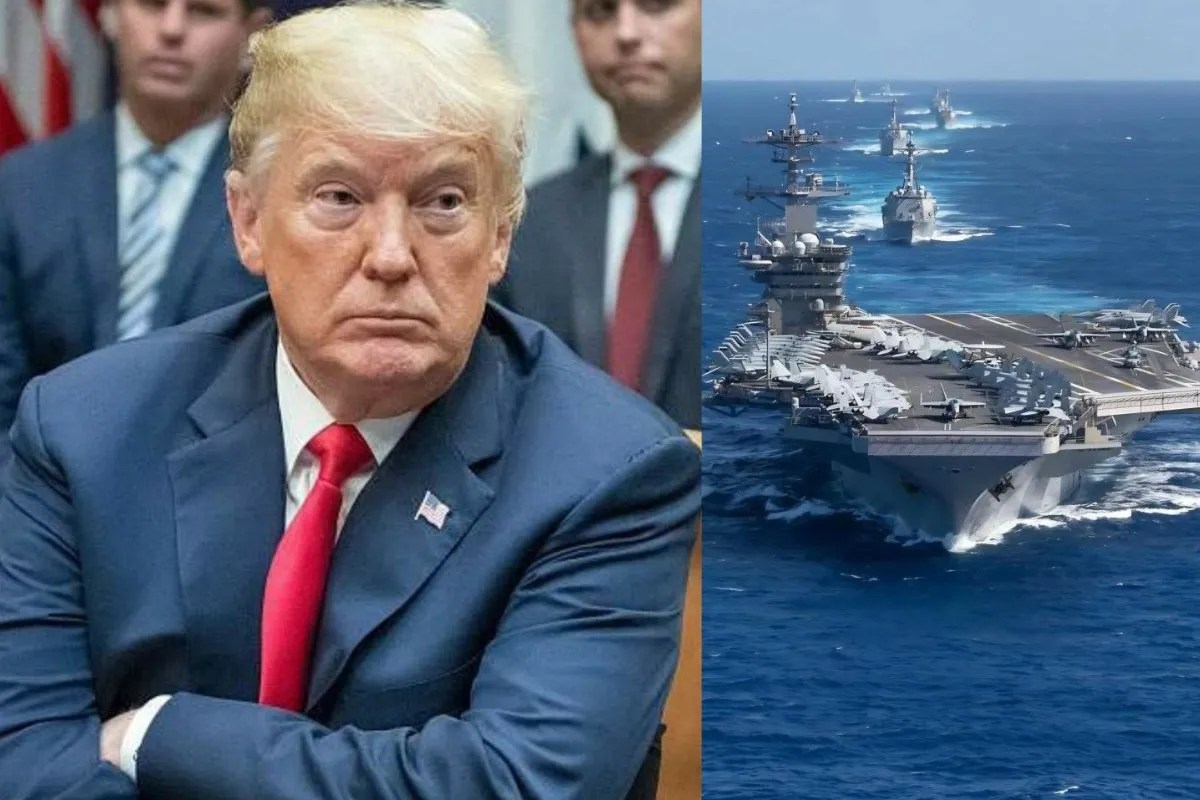
The United States Navy currently faces a strategic reality that few officials are willing to voice in public. By repositioning the USS George Washington from the western Pacific to the Middle East to relieve the exhausted crew of the USS Abraham Lincoln, the Pentagon has effectively drained its carrier presence from the Indo-Pacific. This maneuver serves as a stark admission that the American naval machine is overextended, forced to cannibalize its security architecture in one theater to sustain an open-ended conflict in another.
This is not a simple rotational shift. It is a fundamental friction point in modern American military doctrine.
When the USS Abraham Lincoln was redirected from its planned Pacific deployment to the Middle East in early 2026, it marked the beginning of a procurement and readiness nightmare. The Lincoln has spent more than 250 days at sea, with over 200 of those days occurring without a single port call. For the sailors aboard, this is a grueling, unprecedented test of physical and mental endurance. For the broader defense establishment, it is a glaring indicator that the current fleet size cannot support a sustained high-intensity war in the Middle East while simultaneously maintaining a credible deterrent against regional competitors in Asia.
The shift of the USS George Washington—a massive nuclear-powered statement of intent—leaves a vacuum in the western Pacific. This void does not go unnoticed. Beijing has been quick to frame this move as evidence of American decline. By projecting the image of a distracted, thinning U.S. presence, the Chinese state narrative aims to convince regional partners in Japan, the Philippines, and Indonesia that Washington no longer possesses the staying power to guarantee their security.
The core of the problem lies in a phenomenon known as maintenance debt. The U.S. Navy maintains a nominal force of eleven aircraft carriers, but the reality is much bleaker. These ships require massive, time-consuming overhauls at specialized shipyards. With only two primary facilities capable of handling the most complex maintenance for these nuclear-powered giants, the schedule is perpetually brittle. When a conflict like the war with Iran creates a vacuum that demands constant strike group presence, those maintenance windows are pushed back. The equipment ages, the shipyards clog, and the vessels themselves begin to show signs of mechanical strain.
This leads to a dangerous cycle. Sailors are held at sea longer to compensate for the unavailability of other ships, which leads to lower morale and retention issues. The ships themselves eventually require longer periods in dry dock to fix problems that were ignored during their extended deployments. It is a slow-motion erosion of readiness that experts have warned about for years.
Senior military officials have recently hinted at a shift in strategy, suggesting that the era of complete reliance on these massive, expensive flight decks might be reaching its limit. The vulnerability of a supercarrier to modern, long-range missile systems and swarms of drones is no longer a theoretical exercise. It is a baseline assumption for any commander looking at the current battlefield. Yet, the habit of using these carriers as the primary tool of diplomatic and military signaling remains deeply ingrained in the Pentagon’s institutional memory.
The decision to pull the George Washington from the Pacific also invites a broader question about the Trump administration's foreign policy priorities. While the official line remains focused on managing force exhaustion and maintaining global naval supremacy, the reality on the water tells a different story. If the Pacific is truly the most significant theater for long-term American interests, then the current deployment schedule is moving in the exact opposite direction of that stated goal.
The risks associated with this gap are not limited to the immediate strategic balance of power. They extend to the reliability of alliances. Nations in the Indo-Pacific have based their security calculations on the assumption of a persistent, overwhelming American naval presence. When that presence becomes intermittent, or when it is clear that American attention is entirely consumed by a conflict in the Middle East, those same nations must begin to hedge their bets. They start to look for alternatives, or they begin to accommodate the demands of neighbors who are demonstrably more present.
What happens next is a question of logistics and domestic political will. The Navy could theoretically push more carriers out, but doing so would require an aggressive acceleration of maintenance cycles that the current shipyard infrastructure likely cannot handle without catastrophic failure. There is no hidden reserve of ships waiting to be unleashed. The fleet is currently operating at the maximum capacity allowed by its current configuration.
For now, the George Washington is steaming toward the Indian Ocean, and the Pacific is left to watch, wait, and calculate. The U.S. military is essentially betting that its adversaries will not seize this particular window of opportunity. It is a high-stakes gamble built on the hope that a temporary absence can be managed through rhetoric and special operations exercises, rather than the raw, kinetic presence of a strike group.
The underlying tension remains unresolved. As long as the U.S. continues to pursue its current objectives in the Middle East, the resources available to project power elsewhere will continue to shrink. This is not a failure of individual leadership or a lack of planning; it is the inevitable collision between the geographic reality of two major operational theaters and a fleet that was designed for a different era of global competition. The vacuum in the Pacific is merely the latest symptom of a force stretched far beyond its comfortable limits, waiting for a breaking point that has not yet arrived but is increasingly difficult to ignore.


