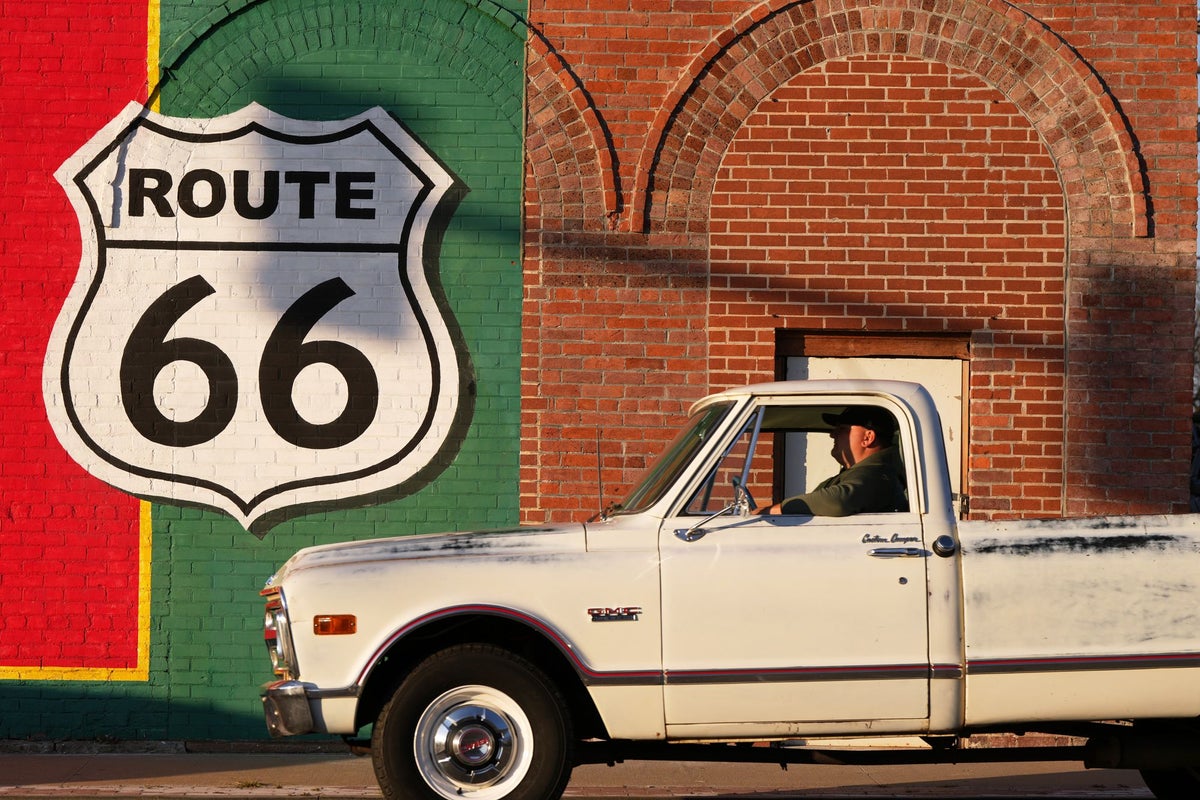
The asphalt hums a different frequency when you cross the border into Oklahoma. It is a vibration felt in the soles of the feet, a rhythmic thrumming that whispers of a hundred years of migration, desperation, and the restless American spirit.
In 1926, Route 66 was just a line on a map, a jagged scar stretching from the concrete canyons of Chicago to the Pacific spray of Santa Monica. It wasn't born out of a desire for tourism. It was born out of a necessity for survival. When the dust bowls of the 1930s turned the Midwest into a graveyard of failed dreams, this road became the artery of hope. Families piled their lives into Model Ts, mattresses strapped to the roof, chasing a California sun that promised work.
Now, as the "Main Street of America" approaches its centennial in 2026, the road has shifted. It is no longer a vital organ of commerce—the interstate highways saw to that decades ago—but something far more complex. It has become a living museum of the American psyche, a place where kitsch and tragedy coexist in the neon glow of a flickering motel sign.
The Man Behind the Counter
Consider a man we will call Elias. Elias runs a diner in a town that most maps stopped printing in the nineties. His coffee is strong enough to peel paint, and his hands are mapped with the same deep creases as the old two-lane blacktop outside his window. To the casual traveler, Elias is a prop. He is part of the "authentic" experience, the guy you take a selfie with before heading back to the climate-controlled comfort of a rental SUV.
But for Elias, the centennial isn't about a celebration of the past. It is a battle for the present.
"People come through looking for the ghost of 1955," he says, wiping a counter that hasn't seen a full house since the Eisenhower administration. "They want the soda fountains and the chrome. They don't want to see the boarded-up windows across the street. They want the myth. They don't want the truth."
The truth is that Route 66 is a lesson in planned obsolescence. When the Federal Aid Highway Act of 1956 authorized the Interstate Highway System, it effectively signed a death warrant for thousands of small-town economies. The high-speed bypasses didn't just move traffic; they moved the soul of the country away from the front porches and into the sterile, uniform service stations of the bypass.
The Architecture of a Dream
We often dismiss the giant fiberglass mufflers and the concrete teepees as "kitsch." We laugh at the absurdity of a two-story tall Blue Whale in Catoosa or the buried Cadillacs of Amarillo. We see them as gimmicks.
They were never just gimmicks.
They were acts of defiance. When the interstates began to bleed the towns dry, the business owners along Route 66 had to find a way to make a driver press the brake pedal. They had to be louder, stranger, and more inviting than the grey monotony of the federal highway. The architecture of Route 66 is the architecture of the underdog. It is the visual language of people refusing to be bypassed.
Every neon sign is a heartbeat. Every giant statue is a shout into the void.
Statistically, the impact of the road's decline was devastating. Between 1960 and 1980, hundreds of towns along the 2,448-mile stretch saw their populations crater. The "Green Book" era added another layer of complexity; for Black travelers, the Mother Road was a gauntlet of "sundown towns" where the neon lights offered no sanctuary. This history isn't tucked away in a textbook. It is etched into the very soil.
The centennial serves as a mirror. It asks us what we value more: the efficiency of getting from point A to point B, or the serendipity of what happens in between.
The Ghost of the Mother Road
Imagine you are driving through the Mojave at 3:00 AM. The air is cool, smelling of sagebrush and old tires. The headlights catch the reflective paint of a decommissioned segment of the road.
This is where the invisible stakes become visible.
The road is a repository of collective memory. It holds the ghosts of the Okies, the hitchhiking beatniks of the fifties, and the vacationing families of the sixties. When we talk about "preserving" Route 66, we aren't just talking about repaving a road. We are talking about preserving the idea that a journey should have a texture.
The modern travel experience is sanitized. We fly over the "flyover states," or we drive on interstates that look exactly the same in Ohio as they do in Arizona. We have traded the grit of the road for the safety of the franchise. Route 66 is the last holdout of the idiosyncratic. It is the only place left where you might find a world-class pie in a building shaped like a shoe.
But the cost of this preservation is high.
State governments and historical societies are pouring millions into "Route 66 Centennial" initiatives. There are grants for neon restoration and funds for museum expansions. This is a business move, certainly. Tourism along the corridor brings in billions of dollars annually. Yet, there is a tension between the commercialization of the road and its inherent, rugged loneliness.
If we turn Route 66 into a theme park, we lose the very thing that made it sacred.
The Physics of Nostalgia
Nostalgia is a powerful, dangerous fuel. It makes us remember things not as they were, but as we wish they had been. We remember the diners, but we forget the segregation. We remember the open road, but we forget the breakdown in the middle of a desert with no cell phone to call for help.
To truly honor the hundredth year of this highway, we have to look at it with clear eyes.
The road is a series of contradictions. It is a symbol of freedom that was built on the backs of chain gangs. It is a symbol of American prosperity that is currently lined with poverty. It is a monument to the automobile, an invention that changed the climate of the planet forever.
Yet, despite all this, we keep driving it.
We drive it because there is a specific kind of magic that happens when you turn off the GPS and just follow the shields. There is a sense of scale that you can only get by crossing the Mississippi River on a bridge that feels like it’s held together by luck and old paint. You see the landscape change from the lush greens of the East to the red dirt of the West, and you realize that the country is too big, too strange, and too beautiful to be contained in a digital feed.
The Silent Passenger
Every person who sets out on Route 66 is looking for something they can't find at home.
For some, it's a connection to a grandfather who made the trip in a Greyhound bus. For others, it's a way to slow down a life that has become too fast, too loud, and too thin. The road acts as a giant reset button. When you are staring down a straight stretch of asphalt in New Mexico that disappears into a shimmering heat haze, your problems start to look very small.
The centennial isn't a funeral. It’s a pulse check.
The towns that have survived are the ones that learned to adapt without losing their edges. They are the towns where the mayor also flips the burgers at the local cafe. They are the places where people still stop to talk to a stranger because they know that every person on the road has a story.
In the end, the road is just a medium. It is the canvas. The people who live along it, the people who drive it, and the people who have been buried beside it are the paint.
As we hit the 100-year mark, the asphalt will be patched, the neon will be relit, and the gift shops will sell a million more plastic magnets. But the true spirit of the Mother Road won't be found in a brochure. It will be found in that moment when you pull over at a scenic overlook, turn off the engine, and listen.
You will hear the wind through the canyon. You will hear the distant roar of a semi-truck on the interstate. And if you listen closely enough, you will hear the echoes of ten million sets of tires, all rolling toward a horizon that never stays still.
The road isn't dying. It’s just waiting for the next dreamer to realize that the destination was never the point.
The sun sets behind the hills of Kingman, casting long, purple shadows across the desert floor. The neon begins to hum, a low, electric buzz that sounds like the heartbeat of a century. You put the car in gear. The road stretches out before you, a ribbon of black glass under a canopy of stars. You aren't just driving. You are participating in a hundred-year-old conversation about what it means to be restless, what it means to be hopeful, and what it means to be home.