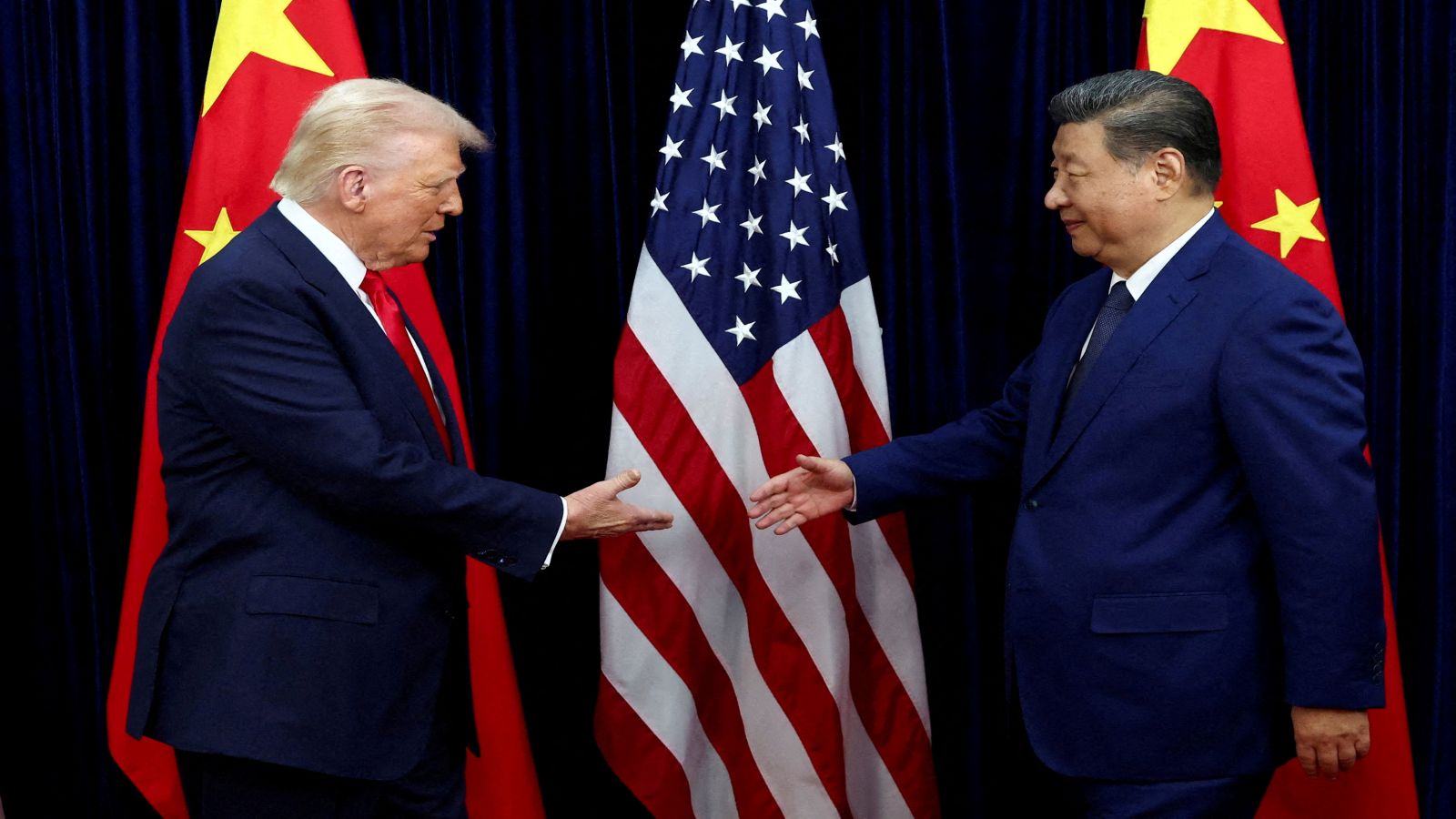
The media is calling it a "diplomatic breakthrough." They’re painting a picture of a grand table where Trump, Musk, Cook, and Huang sit across from Xi Jinping to hammer out the future of global trade. It looks like a summit of titans. It’s actually a surrender ceremony.
When Tim Cook or Jensen Huang board a private jet for Beijing, they aren’t going as ambassadors of American innovation. They are going as supplicants. The mainstream narrative suggests these CEOs are "leveraging" their market cap to influence Chinese policy. That is a fantasy. In reality, the hardware supply chain has become a noose, and the CCP is the one holding the rope.
The consensus view—that these talks are about "stabilizing the economic landscape"—is lazy. It ignores the fundamental physics of the current tech cold war. We are witnessing the culmination of a decade-long strategic error where American C-suites traded long-term national security for short-term quarterly guidance.
The Myth of the "Must-Win" Market
Every analyst on CNBC will tell you that Apple cannot afford to lose the Chinese consumer. They point to the 20% of revenue derived from the Greater China region as if it’s a sacred metric.
They’re wrong.
Apple’s problem isn't that they can’t sell iPhones to Chinese teenagers; it’s that they can’t build iPhones without Chinese compliance. The "China Plus One" strategy—moving manufacturing to India or Vietnam—is largely a marketing gimmick. If you look at the Bill of Materials (BOM) for any high-end electronic device, the deep-tier components, the specialized screws, and the chemical coatings still originate in a narrow corridor of the Pearl River Delta.
I have seen companies dump $500 million into "diversifying" their assembly lines only to realize they are still buying 90% of their sub-assemblies from Chinese-owned subsidiaries in third-party countries. When Tim Cook sits at that table, he isn't negotiating from a position of strength. He is there to ensure his factories aren't "accidentally" hit with environmental inspections or power outages the moment a new tariff is announced.
Jensen Huang and the Ghost of Moore’s Law
The presence of Nvidia’s chief at these talks is the most telling. Nvidia currently sits on a throne made of H100 and Blackwell chips, the literal fuel for the AI revolution. The U.S. government wants to choke off China’s access to this compute power.
But here is the contradiction the "experts" miss: Nvidia’s moat isn't just their architecture; it’s their scale. To maintain the R&D budgets required to stay ahead of the curve, they need the massive revenue injections that come from the Chinese market.
By participating in these talks, Huang is attempting a delicate, perhaps impossible, dance. He is trying to convince the CCP that Nvidia is a neutral utility while convincing the White House that Nvidia is a strategic weapon. You cannot be both. The moment Huang creates a "China-compliant" chip that bypasses U.S. export controls, he weakens the very technical edge the U.S. relies on for its defense systems.
This isn't "synergy." It’s high-stakes double-dealing that usually ends with both sides feeling betrayed.
Musk’s Conflict of Interest is a National Security Risk
Let’s be blunt about Elon Musk’s role in this delegation. He is the only person in the room who owns a major social media platform, a primary defense contractor (SpaceX), and a massive manufacturing footprint in Shanghai (Tesla).
The conflict of interest isn't just "notable"—it’s unprecedented.
When Musk talks to Xi, is he representing the interests of the American taxpayer who funds Starlink? Or is he protecting the Giga Shanghai margins that keep the Tesla stock price from cratering? The mainstream press treats him like a rogue diplomat. He’s actually a man whose most valuable assets are essentially held in escrow by the Chinese Communist Party.
The CCP understands "unrestricted warfare" far better than a Silicon Valley board of directors does. They know that by granting Tesla tax breaks and land, they bought a seat at the table of American political discourse. Musk isn't a bridge between two worlds; he is a structural vulnerability.
The Fallacy of the "CEO Diplomat"
There is a dangerous idea circulating that CEOs can succeed where politicians fail because they "speak the language of business." This is a fundamental misunderstanding of how the Chinese state functions.
In the West, we view the economy and the state as two separate, often clashing, entities. In China, the economy is a subset of national security. When Xi Jinping looks at Tim Cook, he doesn't see a partner. He sees a utility that is currently useful for maintaining Chinese employment levels and absorbing Western capital.
The moment that utility fades—the moment China perfects its own domestic lithography or high-end mobile processors—those CEOs will be discarded.
Imagine a scenario where the U.S. tries to enforce a blockade during a Taiwan contingency. Do you truly believe Apple or Tesla will prioritize the Pentagon over the survival of their physical assets on the mainland? They won't. They can't. Their fiduciary duty to shareholders would literally require them to lobby against American strategic interests to prevent the seizure of their factories.
How to Actually Fix the Dependency
If we were serious about "de-risking," we wouldn't be sending a parade of CEOs to smile for photos in Beijing. We would be doing the hard, expensive, and deeply unpopular work of decoupling the foundational layers of the stack.
- Mandatory Deep-Tier Audits: We need to stop looking at where the final box is checked and start looking at where the raw materials are refined. If your "Made in USA" server uses Chinese power controllers, it’s a Chinese server.
- The Sovereignty Tax: We should impose a heavy tax on any American company whose manufacturing footprint in a "country of concern" exceeds 20% of their total capacity. Use that revenue to subsidize the 10-year lead time required to build domestic alternatives.
- CEO Recusal: Any executive whose company derives more than 15% of its revenue from China should be legally barred from advising the U.S. government on trade or defense policy.
The current path is a slow-motion surrender. We are letting the people who built the dependency tell us how to manage it. It’s like asking a group of tobacco executives to design a lung cancer prevention program.
The CEOs at that table aren't there to save the American economy. They are there to save their own skins and their next bonus cycle. They are playing a 90-day game. Xi Jinping is playing a 90-year game.
Stop cheering for the "dialogue." Start worrying about the price of the ticket.
We aren't winning the trade war; we’re just negotiating the terms of our irrelevance.