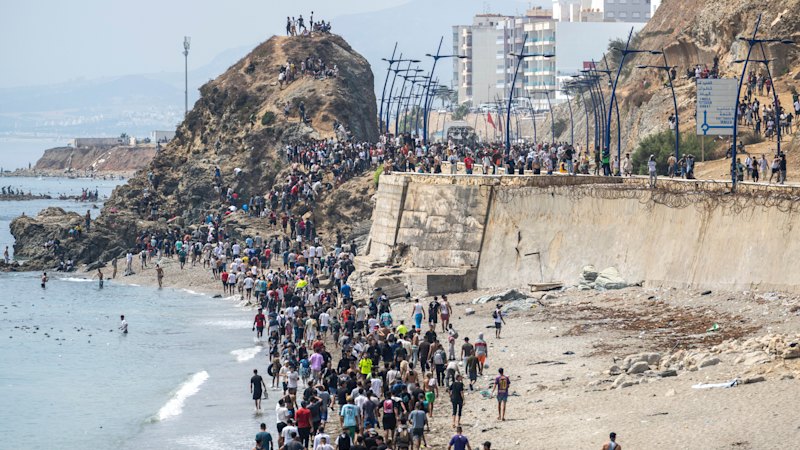
Borders do not merely divide territory; they concentrate political anxiety. When thousands of migrants crossed the frontier into Ceuta, the Spanish enclave on the North African coast, the event was instantly packaged by political opportunists as an existential invasion. The storming of Ceuta became a turning point, accelerating a continent-wide migration shift toward the far-right.
Security footage of desperate swimmers navigating breakwaters and scaling barbed wire fences provided a visual shockwave. Across European capitals, right-wing factions weaponized these images. They argued that the Schengen zone's external borders were porous, weak, and entirely incapable of managing demographic pressure from the Global South.
Yet, reducing the rise of European nationalism to a reaction against border breaches ignores the deeper structural rot. Migration pressure is a symptom, not the core disease. The political realignment currently reshaping parliaments from Rome to Stockholm is fueled by a potent mix of economic stagnation, housing shortages, and the weaponization of state borders by authoritarian neighbors.
The Geopolitical Leverage of Migration
Ceuta is not just a border town. It is a pressure valve for Moroccan foreign policy.
When diplomatic tensions flared between Madrid and Rabat over the disputed Western Sahara, the frontier suddenly became porous. Moroccan border guards simply looked away. Thousands of people, including unaccompanied minors, were funneled toward the fence. This was not a spontaneous humanitarian crisis. It was a calculated geopolitical maneuver designed to extract concessions from the European Union.
This dynamic exposes the fundamental vulnerability of European migration policy. Brussels has increasingly outsourced border enforcement to transit countries like Turkey, Libya, and Morocco. By doing so, the European Union has handed non-democratic regimes an effective blackmail tool. Whenever these external partners want financial aid, trade concessions, or diplomatic backing, they can loosen controls at the border.
The resulting surge of arrivals then lands directly on the domestic political stage of European member states. Right-wing populist parties thrive on these moments. They present the influx as an intentional attack on national sovereignty, framing every arrival as proof of elite incompetence.
The political calculus is brutal and effective. Mainstream center-right parties, terrified of losing voters to insurgent nationalist movements, have adopted the rhetoric and policy proposals of the hard right. Border walls are no longer viewed as extremist propositions. They are funded by the European Commission and defended by mainstream prime ministers who once championed open internal borders.
Economic Anxiety Masquerading as Cultural Panic
To understand why the storming of Ceuta shifted European politics rightward, one must look past the television screens and examine local labor markets.
Nationalist movements do not grow in vacuums. They take root in post-industrial towns where public services are strained and wages have flatlined for a decade. When politicians promise to seal borders, they are often offering a simplistic proxy solution for complex economic anxieties.
Consider the housing crisis gripping major European urban centers. Rents have skyrocketed while municipal housing construction remains stagnant. Far-right parties capitalize on this scarcity by constructing a zero-sum narrative. Every new arrival is depicted as a direct competitor for public housing, healthcare resources, and entry-level jobs.
Economists point out that aging European populations desperately need foreign labor to sustain pension systems and healthcare infrastructure. But economic theory rarely wins elections against visceral imagery. A photograph of young men surging past border fences makes abstract demographic data look irrelevant. The populist argument is immediate, emotional, and easy to digest.
Mainstream political parties have failed to counter this narrative with an economic vision of their own. Instead of investing heavily in public infrastructure to absorb demographic shifts, they have capitulated to the framing that Europe's resources are strictly finite and must be aggressively guarded.
The Normalization of Exclusion
The political normalization of hardline border policies has transformed the European legislative landscape. Measures that were considered unthinkable a decade ago are now standard platform items for center-right and conservative coalitions.
Externalizing asylum processing to third-party nations is no longer fringe rhetoric. It is actively debated in the European Council. Proposals to detain asylum seekers in offshore processing centers mirror models pioneered in Australia, signaling a departure from traditional human rights frameworks enshrined after the Second World War.
This shift has eroded the normative power of the European Union. The bloc was founded on the promise of open markets, the rule of law, and the protection of fundamental human rights. When member states suspend the right to claim asylum at land borders or push migrants back across international boundaries illegally, they undermine their own moral authority on the global stage.
The rightward drift is self-reinforcing. As nationalist parties enter governing coalitions or dictate the policy agendas of traditional conservatives, their ideas move from the margins to the mainstream. Media coverage follows suit, adopting the security-state lexicon of floods, waves, invasions, and threats.
The Path Ahead for European Stability
Stopping this political realignment requires abandoning the illusion that borders can be militarized into absolute impermeability. No amount of razor wire or naval patrols will halt migration driven by climate disruption, regional conflict, and vast global economic inequality.
European leadership must pivot from crisis management to strategic integration. This means building legal pathways for migration that match labor market demands while simultaneously enforcing clear, humane rules at the frontier. It requires dismantling the outsourcing model that leaves Europe vulnerable to the geopolitical whims of authoritarian neighbors.
Until mainstream politicians find the courage to challenge the nativist narrative with structural economic reforms and honest conversations about demographics, events like the storming of Ceuta will continue to dictate the political weather of the continent. The shift to the right is not an aberration. It is the predictable outcome of a system built on crisis management rather than long-term vision, leaving Europe increasingly vulnerable to the very storms it refuses to understand.