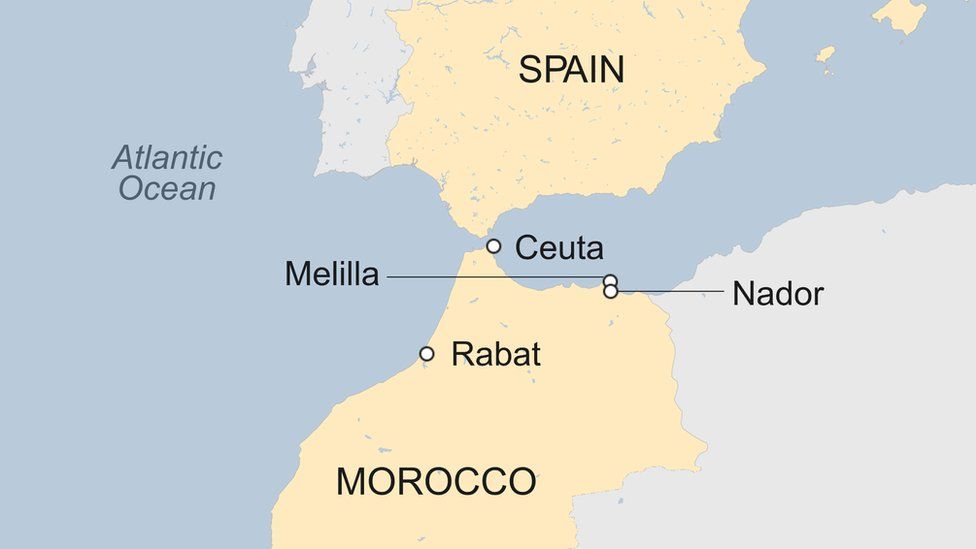
The persistence of unauthorized entry attempts in Ceuta reveals a critical misalignment between judicial policy, physical border enforcement, and geopolitical leverage. When thousands congregate at the perimeter of a European territory, the event is not merely a humanitarian surge; it is a diagnostic indicator of systemic fragility. The recent protest on Ceuta’s urban beach, where migrants demanded asylum to preempt deportation to Morocco, highlights a breakdown in the administrative machinery designed to manage irregular migration.
The Mechanics of the Surge
The current instability originates from a specific feedback loop involving legal interpretation and state-level reaction. On July 8, 2026, the Spanish Supreme Court issued a ruling limiting the state's capacity for immediate returns of migrants arriving by sea. The court determined that streamlined return procedures—previously effective for physical fence breaches—could not be applied to maritime arrivals without specific containment infrastructure.
Criminal networks and irregular migration facilitators interpreted this judicial shift as a reduction in the "cost of entry." By transforming the point of ingress from a land-based wall to a maritime environment, agents effectively bypassed the most potent tool in the Spanish deterrent arsenal: immediate expulsion. This legal opening created a vacuum that social media orchestration exploited in late July, triggering a mass influx of approximately 70,000 people. This surge overwhelmed local reception centers, which were operating at over 2,000 percent of capacity, forcing the city of Ceuta to request a declaration of national emergency.
The Tripartite Constraint Framework
The ongoing situation in Ceuta operates within three rigid constraints that dictate its trajectory:
- The Infrastructure Lag: Ceuta’s geographic limitation as a North African enclave means its capacity for absorption is finite. With a population of roughly 85,000, the sudden arrival of tens of thousands creates an immediate administrative, medical, and security bottleneck. Infrastructure intended for transient populations cannot scale to meet 80,000 arrivals, necessitating rapid transit to the mainland or mass repatriation.
- The Diplomatic Dependency: Spain relies on Moroccan security cooperation to manage the staging areas outside the border. The 2026 crisis underscores the precarious nature of this reliance; when Moroccan border control functions as a variable rather than a constant, the Ceuta border becomes a high-stakes bargaining chip. Diplomatic friction consistently manifests as physical pressure on this border.
- The Judicial Deterrence Gap: The transition from land-based containment to sea-based entry renders standard deterrence ineffective. Until the Spanish state aligns its maritime infrastructure with the standards required by the July Supreme Court ruling—essentially creating physical containment at the maritime boundary—the legal cost of entry will remain artificially low.
Assessing the Asymmetry
The recent protest by hundreds of migrants illustrates the second-order effects of this crisis. These individuals are trapped between two states: one unwilling to grant permanent asylum status due to the need to maintain border integrity, and the other (Morocco) managing the intake of tens of thousands of returned individuals. The protestors’ demand for asylum is a strategic attempt to shift their status from "irregular entrant" to "asylum applicant," thereby activating international protocols that complicate immediate deportation.
This tactic forces a tactical decision upon the Spanish government. If authorities process these individuals through standard asylum channels, the administrative backlog will incentivize further entries. If they prioritize immediate return to Morocco, they face accusations of violating human rights standards and potential diplomatic backlash. The current stalemate is a direct consequence of this strategic ambiguity.
Strategic Implications
The recurring nature of these incidents—specifically comparing the 2021 and 2026 events—indicates that the border is currently operating in a high-volatility state. Security forces have successfully prevented subsequent large-scale incursions by tightening land-side and sea-side surveillance, but this is a reactive posture.
To move beyond the current cycle of emergency response and crisis, the Spanish government must implement a binary strategy:
- Infrastructure Hardening: The state must define and construct the "maritime containment" required by the Supreme Court to regain the ability to execute accelerated returns. Without this, the legal deterrent is non-existent.
- Geopolitical Decoupling: Spain must secure binding agreements with the European Union to treat Ceuta’s border not as a local municipal issue but as a core European external boundary. The current "wait and respond" model invites external actors to use migration flows as leverage in diplomatic negotiations.
The immediate tactical move is to clear the current backlog by finalizing the return of all non-qualifying migrants to their countries of origin via bilateral cooperation with Morocco, while simultaneously accelerating the installation of physical maritime barriers. Any delay in these technical requirements will lead to further rounds of mass ingress and subsequent political instability. The system will continue to fail until the legal framework for "immediate return" is restored through physical infrastructure that meets the letter of the law.