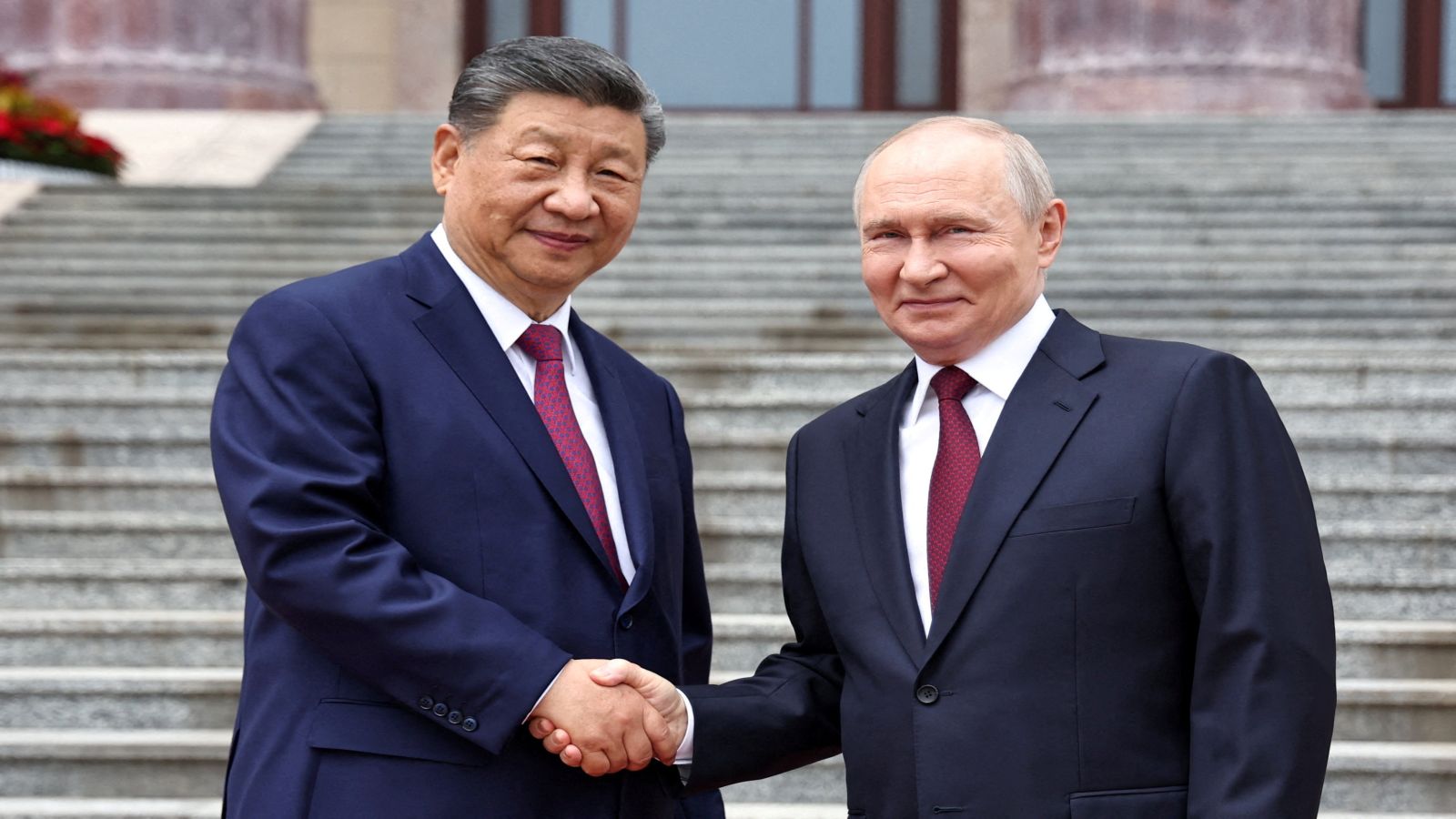
The mainstream media is suffering from a collective panic attack over Beijing. Every time Vladimir Putin and Xi Jinping shake hands in front of a bank of cameras, the foreign policy establishment writes the exact same script. They call it a limitless alliance. They warn of a monolithic bloc of autocracies rewriting the global order. They look at rising bilateral trade figures and see an unstoppable economic engine.
They are misreading the room. Read more on a similar topic: this related article.
What happened in Beijing was not the forging of a new world order. It was a calculated display of mutual desperation. The commentators screaming about a unified Eurasian superpower are missing the glaring structural cracks beneath the surface. This relationship is not a strategic triumph. It is a transactional, deeply paranoid partnership where both sides are playing a weak hand while pretending to hold aces.
The Illusion of the Limitless Partnership
Let us look past the pageantry. The central narrative pushed by Western analysts is that China and Russia have aligned their long-term strategic goals. This is a fundamental misunderstanding of how either nation views sovereignty. Additional journalism by Associated Press explores similar views on the subject.
China operates on a multi-decade horizon focused on economic dominance and technological self-reliance. Russia, driven by immediate geopolitical grievances, operates on short-term disruption. These two philosophies do not complement each other; they collide.
Consider the actual economic data rather than the grand announcements.
While bilateral trade between China and Russia reached record highs, the composition of that trade tells a story of exploitation, not equality. Russia has essentially become a resource colony for the Chinese economy. Moscow sells crude oil, liquefied natural gas, and coal at steep, humiliating discounts because it has lost its primary European markets. Beijing buys these commodities because it loves a bargain, not because it loves Putin.
- The Power of Siberia 2 Pipeline: For years, Moscow has begged Beijing to finalize this project to redirect gas from depleted European routes to Asia. China keeps stalling. Why? Because Beijing demands domestic Chinese pricing, which is far below international market rates, and expects Russia to foot the bill for construction. That is not how you treat an equal ally. That is how you squeeze a desperate supplier.
- The Yuan Dependency: Russia has bragged about de-dollarizing its economy by adopting the Chinese yuan for international settlements. This is a trap. Moscow is now entirely dependent on a currency managed tightly by the People’s Bank of China. If Beijing decides to restrict liquidity to protect its own banks from secondary Western sanctions, the Russian financial system suffocates.
I have watched corporate boards make this exact mistake for decades—mistaking a desperate fire sale for a sustainable joint venture. When a company falls on hard times and sells its core assets to a ruthless competitor at a 40% discount, no one calls it a partnership. They call it a liquidation. That is what we are witnessing with Russia’s economy.
Why the Deepening Trade Figures Flunk Basic Economics
Mainstream reporting loves to point to the raw dollar value of China-Russia trade as proof of a new economic bloc. It is a lazy metric that ignores economic reality.
+-----------------------------------------------------------------+
|               The Reality of China-Russia Trade                 |
+-----------------------------------------------------------------+
| China's Global Export Share:                                    |
| - United States & European Union: ~30-35% of total exports       |
| - Russian Federation: ~2-3% of total exports                    |
+-----------------------------------------------------------------+
Beijing’s real economic oxygen still comes from the West. Xi Jinping cannot afford to completely alienate the consumers in New York, Los Angeles, Berlin, and Paris to satisfy a country with a GDP roughly the size of Spain's.
When the United States threatened secondary sanctions on Chinese financial institutions involved in supplying Russia’s military-industrial complex, what happened? Major Chinese banks—including Chouzhou Commercial Bank and the "Big Four" state-owned banks—immediately began restricting payments from Russian clients. They did not double down on their "limitless" friendship. They protected their access to the SWIFT system and the US dollar.
Beijing understands a principle that Western commentators routinely forget: ideological solidarity does not pay the bills. The Chinese Communist Party's domestic legitimacy relies on maintaining economic stability and employment for its population. Sacrificing access to Western consumer markets to rescue a declining petrostate would be political suicide for Xi.
The Central Asian Tug of War
The narrative of a unified bloc completely ignores the quiet, bitter geopolitical competition happening in Moscow’s backyard. For centuries, Central Asia—Kazakhstan, Uzbekistan, Kyrgyzstan, Tajikistan, and Turkmenistan—was considered Russia’s exclusive sphere of influence.
Today, China is aggressively pushing into the region via infrastructure projects and energy deals, completely bypassing Moscow.
During the China-Central Asia Summit, Xi Jinping met with regional leaders without inviting Putin. Beijing promised massive investments in transport corridors that would allow Central Asian goods to reach Europe without crossing Russian territory.
Imagine a scenario where your supposed best friend spends their weekends buying up the real estate in your neighborhood, locking you out of local businesses, and cutting deals with your tenants behind your back. You would not call them an ally; you would call them an existential threat. Russia tolerates this encroachment because it has no choice, but the strategic resentment in Moscow is palpable.
Dismantling the Mainstream Questions
The public is asking the wrong questions because the media provides the wrong framing. Let us address the flawed premises driving the conversation today.
Does China's support mean Russia can sustain its war indefinitely?
No. China provides dual-use goods—microchips, machine tools, and satellite imagery—but it draws a hard line at lethal military aid. Beijing wants Russia weak enough to be dependent, but stable enough to avoid a chaotic regime collapse on its northern border. This is a strategy of managed decline, not a recipe for Russian victory. Moscow is burning through its sovereign wealth funds and domestic reserves while paying a premium for Chinese technology. This is unsustainable over a multi-year horizon.
Are we entering a new Cold War with two equal superpowers?
This is a false equivalence. The original Cold War featured two distinct economic blocs that were largely decoupled from one another. Today, China is deeply integrated into the global capitalist architecture. Furthermore, Russia is not an equal superpower in this equation; it is a junior partner with a shrinking demographic profile and a one-dimensional economy. Treating them as a monolith overstates their unity and blinds us to the friction points we can exploit.
The Ultimate Risk of the Contrarian Stance
Honesty demands admitting the downside of this perspective. If the West assumes the China-Russia axis is fragile and treats it with complacency, it risks missing the moments where their cooperation does yield tactical dangers.
Their joint naval exercises in the South China Sea and strategic bomber patrols over the Sea of Japan are real military headaches for US allies. They can still cause immense disruption in global cyber security and space tracking intelligence.
But drawing a straight line from tactical coordination to a permanent, unshakeable alliance is a massive analytical leap. It attributes a level of trust to Beijing and Moscow that simply does not exist. Both regimes are hyper-nationalistic, deeply cynical, and historically prone to betrayal.
The Western policy of treating them as a single entity forces them closer together than they naturally want to be. By treating the alliance as a done deal, the West creates a self-fulfilling prophecy, missing opportunities to drive wedges between two capitals that view each other with deep historical suspicion.
Stop looking at the forced smiles in Beijing and calling it a superpower axis. It is a masterclass in geopolitical theater, staged by two actors who know their limitations all too well.
Treat them like the fair-weather business partners they are. Stop reacting to the choreography. Watch the money, watch the banks, and watch the borders. That is where the reality lies.