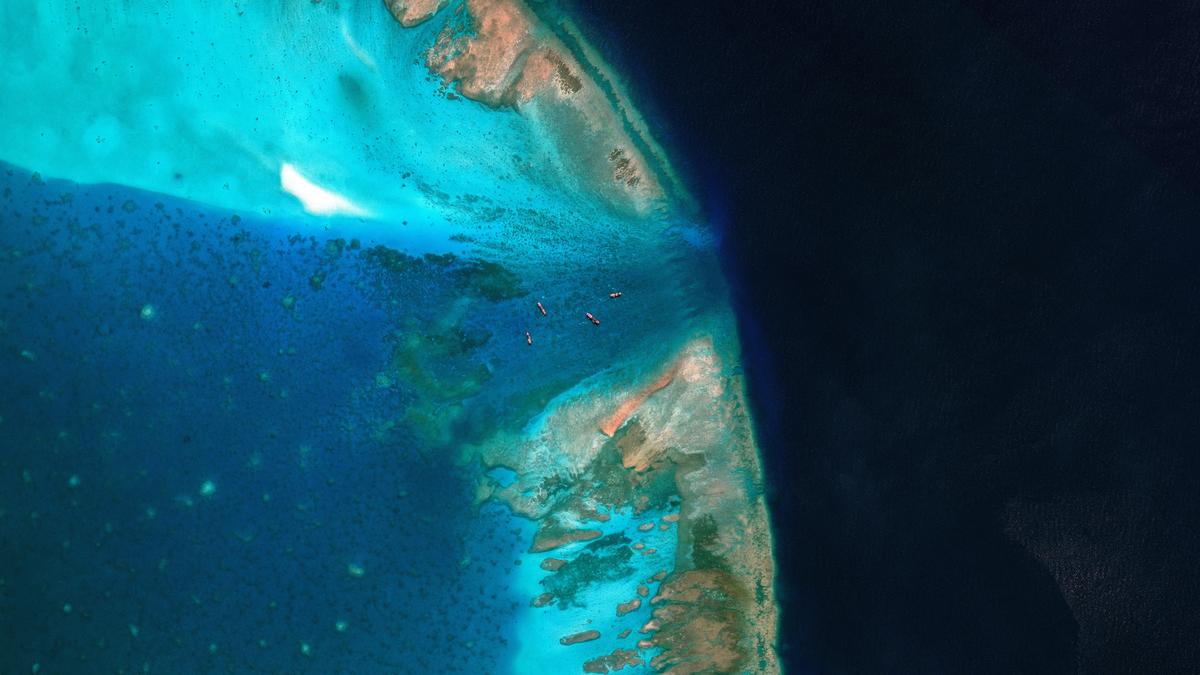
Beijing has effectively seized control of the gateway to Scarborough Shoal, deploying a floating barrier to choke off access for Philippine fishing vessels. New satellite imagery and on-the-ground reports confirm that the China Coast Guard (CCG) has installed a 300-meter-long chain of buoys across the mouth of the lagoon, a move that transforms a long-standing diplomatic stalemate into a hard tactical blockade. This isn't just about fish; it is a calculated stress test of regional defense pacts and a physical manifestation of China’s "salami-slicing" strategy in the South China Sea.
For decades, Scarborough Shoal—a triangular chain of reefs and rocks with a perimeter of 46 kilometers—has been a flashpoint. It sits just 120 nautical miles from the Philippine coast, well within Manila’s Exclusive Economic Zone (EEZ), but nearly 600 nautical miles from China’s Hainan Island. Despite a 2016 ruling by the Permanent Court of Arbitration in The Hague that invalidated China’s sweeping claims, Beijing has ignored the law. Now, the installation of physical barriers signals a shift from presence to total exclusion. Learn more on a connected topic: this related article.
The Mechanics of the Blockade
The physical obstruction at the shoal’s entrance is a low-tech solution to a high-stakes geopolitical problem. By tethering together heavy-duty inflatable buoys, the CCG creates a visible line that Philippine vessels cannot cross without risking mechanical damage or a violent escalation. This isn't a temporary measure. The deployment is timed to coincide with increased Philippine transparency efforts, where the coast guard in Manila has begun inviting journalists to witness Chinese harassment firsthand.
China is using these barriers to dictate the terms of engagement. When a Philippine ship approaches, the CCG doesn't always need to ram it; they simply point to the "border" they have manufactured in the water. It is a psychological game as much as a nautical one. If Manila cuts the ropes—as they have done in the past—Beijing uses the act as a pretext for "defensive" escalation. It is a trap designed to make the victim look like the aggressor. Further reporting by NPR delves into comparable views on the subject.
A Strategy of Incremental Suffocation
China’s maritime strategy relies on the cumulative effect of small, non-kinetic actions. Individually, a floating buoy or a water cannon blast seems manageable. Collectively, they strip away the sovereign rights of neighboring nations. This is the essence of "gray zone" warfare. It stays below the threshold of an armed conflict that would trigger the U.S.-Philippines Mutual Defense Treaty, yet it achieves the same result as a military occupation.
The "why" behind Scarborough is strategic depth. The shoal forms one point of what analysts call the "Strategic Triangle," alongside the Paracel Islands and the Spratly Islands. If China builds a permanent military installation at Scarborough, it would have the capability to monitor all air and sea traffic entering the South China Sea from the Pacific. It would put Chinese fighter jets within striking distance of Subic Bay and Clark Air Base in the Philippines.
The Economic Toll on Coastal Communities
While diplomats argue over maps in air-conditioned rooms, the fishing communities of Zambales and Pangasinan are watching their livelihoods evaporate. Scarborough Shoal is a vital spawning ground. The lagoon’s calm waters provide a sanctuary for boats during storms and a rich harvest of grouper and snapper. By blocking the entrance, China is effectively starving out the local industry.
Philippine fishermen report that the CCG now uses "long-arm" tactics. They don't just block the shoal; they follow fishing boats back toward the mainland, intimidating them into staying within sight of the shore. This creates an invisible fence. The economic cost is measured in tons of lost catch and the slow death of coastal villages that have relied on these waters for generations.
The Failure of International Deterrence
The 2016 Hague ruling was a moral victory for Manila, but it lacked an enforcement mechanism. China’s current brazenness is a direct result of the international community's inability to impose a real cost on Beijing’s expansionism. Statements of "grave concern" from Washington, Tokyo, or Canberra are viewed in Beijing as white noise.
The U.S. presence in the region remains the primary counterweight, but it is a reactive one. Freedom of Navigation Operations (FONOPs) demonstrate that the sea remains international water, but they do nothing to remove a buoy from a reef entrance. The Philippines has shifted its strategy under the Marcos administration, moving away from the defeatist rhetoric of the previous era toward "assertive transparency." By filming and broadcasting every encounter, Manila is trying to shame Beijing on the global stage.
Shame, however, is a weak deterrent against a superpower driven by a "rejuvenation" mandate. Beijing views the South China Sea as its "blue national territory." To them, the buoys aren't a violation; they are a fence around a private backyard.
The Logistics of Permanent Occupation
The real fear among regional analysts is that the buoys are a precursor to dredging. We have seen this playbook before at Mischief Reef and Subi Reef. First comes the presence of the maritime militia, then the blockade of local fishermen, and finally, the arrival of sand-suction dredgers.
Transforming Scarborough into an island would be a massive engineering feat, but China has proven it has the capacity and the will. If they manage to pour concrete at Scarborough, the geopolitical map of Southeast Asia is permanently altered. A permanent radar station there would close the gap in China’s surveillance of the Luzon Strait, a critical chokepoint for global shipping and potential conflict over Taiwan.
The Maritime Militia Factor
Behind the white hulls of the CCG sits the "Little Blue Men"—the People’s Armed Forces Maritime Militia (PAFMM). These are ostensibly commercial fishing boats that are actually subsidized by the state to perform paramilitary functions. At Scarborough, these vessels act as a secondary layer of the blockade. They anchor for weeks at a time, creating a "swarm" that is impossible for the smaller Philippine Coast Guard to penetrate.
The use of the militia provides Beijing with plausible deniability. If a collision occurs, China claims it was a private fishing dispute. This complicates the rules of engagement for Manila. Does a coast guard vessel fire on a "civilian" boat? Doing so would give China the "justification" it seeks to bring in the People’s Liberation Army Navy (PLAN), which usually lurks just over the horizon.
Weaponizing Navigation
The installation of the barrier is also a violation of the International Regulations for Preventing Collisions at Sea (COLREGs). By placing unmarked or poorly lit obstructions in a high-traffic maritime area, China is creating a navigational hazard. This isn't just a political affront; it is a danger to the safety of life at sea.
China’s disregard for these norms reflects a broader ambition to rewrite international maritime law. They are attempting to replace "freedom of the seas" with a "permission-based" system where any activity within the Nine-Dash Line requires Beijing’s approval.
The Fragility of the Status Quo
The situation at Scarborough Shoal is a volatile equilibrium. Manila is under intense domestic pressure to take a harder line, while Beijing is committed to never backing down. The risk of a miscalculation is at its highest point in a decade. If a Philippine vessel attempts to ram through the barrier, or if a Chinese water cannon causes a fatality, the transition from "gray zone" to "red zone" could happen in minutes.
The Philippines is currently trying to build a "minilateral" coalition, strengthening ties with Australia and Japan to conduct joint patrols. The goal is to complicate China’s math. It is one thing to bully a single Philippine patrol boat; it is another to harass a multinational flotilla.
But patrols don't remove barriers. As long as the buoys remain, China holds the shoal. They have realized that in the South China Sea, possession is ten-tenths of the law. The international community's focus on "de-risking" economic ties with China often overlooks these tactical land-grabs, but for the nations on the front line, the risk has already arrived.
The buoys at the entrance of Scarborough Shoal are more than plastic and rope. They are the frontline of a new kind of border—one that moves whenever a larger power decides it should. Every day those barriers remain in place, the international rules-based order loses another inch of ground to the reality of raw power. Manila’s next move isn't just about reclaiming a fishing ground; it’s about whether a smaller nation can exist alongside a giant without becoming a vassal. The buoys are a tether, and Beijing is slowly pulling the cord.