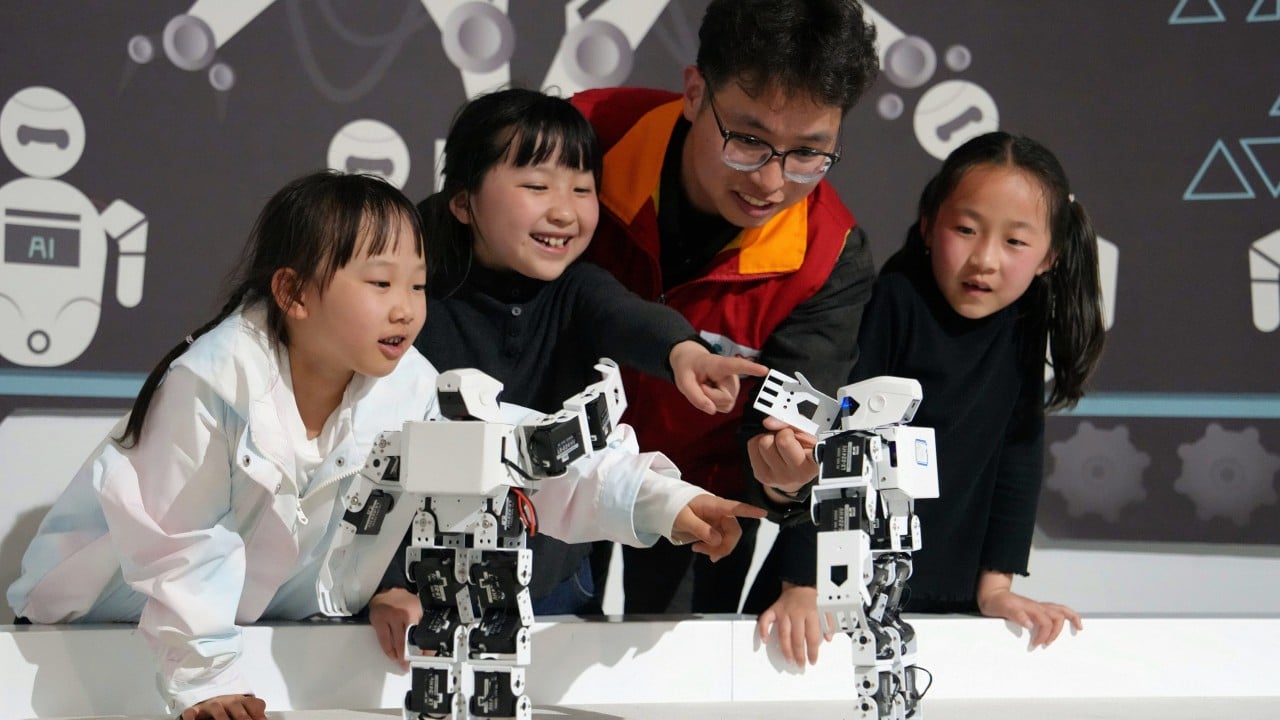
The headlines are predictable. They scream about a "national plan." They fret over "fierce global competition." They paint a picture of millions of students mastering neural networks before they hit puberty.
It sounds like a strategic masterstroke. It’s actually a desperate attempt to institutionalize creativity—a contradiction in terms that will likely result in a generation of technically proficient cogs who can’t think their way out of a paper bag without a pre-defined objective function.
China is doubling down on a top-down mandate to "boost AI education." The consensus view? This is a terrifying power move that will leave the West in the dust. The reality? You cannot mandate innovation from a Ministry of Education office. By the time a curriculum is approved, printed, and distributed across thousands of schools, the underlying technology has already shifted three times.
The Fallacy of the Massive Talent Pool
We’ve seen this movie before.
In the early 2010s, the panic was about "coding." Every child needed to learn Python. Every school needed a computer lab. Fast forward a decade, and the market is flooded with junior developers who can copy-paste from Stack Overflow but lack the fundamental logic to build a novel architecture.
China’s current plan assumes that AI is a subject you study, like history or chemistry. It isn’t. AI is a toolset that evolves at a logarithmic scale. Teaching a middle-schooler how to "prompt" or "understand" current Large Language Models (LLMs) is like teaching a 19th-century student the intricate mechanics of a steam engine. By the time they enter the workforce, the engine is obsolete, and the world has moved to nuclear.
Quantity does not equal quality. Silicon Valley didn't win because it had more engineers; it won because it had more rebels.
I’ve spent fifteen years watching tech giants burn through billions trying to "upskill" their workforce. The hardest workers—the ones who spent 14 hours a day in the lab—were often the first to be replaced by a simple script. Why? Because they were trained to follow a process. AI is the ultimate process-follower. If your education system is built on rote memorization and standardized testing—as the Chinese system famously is—you aren't building an "AI-ready" generation. You are building a generation that is directly competitive with the very machines they are learning to use. And the machines will win every time.
Standardized Education is the Antagonist of Artificial Intelligence
The competitor's article highlights the "national" nature of this plan. That’s precisely why it will fail to produce the "breakthrough" talent they crave.
Real AI breakthroughs come from the fringes. They come from the people who dropped out of the prestigious programs because the curriculum was too slow. They come from the hackers who stayed up all night breaking things, not the students who got the highest marks on the "Ethics and Implementation of AI" exam.
When you centralize education, you create a single point of failure. You create a monoculture of thought. If the national plan emphasizes supervised learning while the rest of the world pivots to a completely different architecture—perhaps something closer to $O(n)$ efficiency that doesn't rely on massive transformer blocks—an entire nation of students is suddenly holding a useless map.
The Math Problem
Let’s talk about the actual mechanics. High-level AI development requires a mastery of linear algebra, multivariable calculus, and probability. These are not subjects you "boost" with a colorful new textbook and some government funding.
The gap between "knowing how to use AI" and "knowing how to build AI" is a chasm. Most of these national initiatives focus on the former. They teach students how to be high-end users of existing platforms. This isn't education; it’s vocational training for a job that won't exist in five years.
The Hardware Blind Spot
China’s plan ignores the elephant in the room: the compute wall.
You can train a billion students, but if your industry is throttled by GPU shortages and export controls, those students are just theorists. They are learning to drive in a world without gasoline.
The Western obsession with China’s "education advantage" misses the point of how research actually works. Research is an expensive, messy, and often wasteful process of trial and error. A state-sponsored plan hates waste. It demands "outcomes." It demands "milestones."
Innovation, however, requires the freedom to fail spectacularly without a government auditor asking why you haven't met the quarterly KPI for "AI literacy."
The Counter-Intuitive Truth: Less is More
If you want to win the AI race, you don't add "AI" to the curriculum. You strip everything else away.
You go back to the basics:
- Raw Logic: Not "coding," but the fundamental philosophy of how systems interact.
- First Principles Physics: Understanding the physical constraints of the world.
- Deep Mathematics: The kind that makes your brain hurt, not the kind you can do on a calculator.
The rest? The actual AI tools? A smart 15-year-old will learn those in a weekend. By "teaching" it in school, you’re just slowing them down with bureaucracy.
The Economic Mirage
The "Global Competition" narrative is a gift to bureaucrats. It’s a justification for endless spending.
Imagine a scenario where China succeeds in its goal. They produce ten million "AI-certified" graduates. What happens to the labor market? You have a massive surplus of labor for a technology designed to reduce the need for labor.
It’s an economic death spiral. You are spending billions to train people for a surplus that will drive their wages to zero. The real winners won't be the ones with the AI degrees; they’ll be the ones who know how to manage the energy grids, the ones who own the physical infrastructure, and the ones who can solve problems that require a physical presence in the real world.
Stop Asking "How Do We Catch Up?"
The question itself is flawed. It assumes there is a finish line.
China is playing a game of "catch up" by building a massive, rigid structure to mimic what they see in the West. But the West didn't get here through a national plan. It got here through a chaotic, decentralized, and often accidental series of events fueled by venture capital and academic freedom.
The competitor’s article worries about the "threat" of this centralized plan. I don't. I see a giant pouring concrete into a mold that is already the wrong shape.
The real threat isn't the nation with the most AI students. It’s the nation with the fewest rules about what those students are allowed to do.
If you want to outpace a national plan, don't build your own. Just get out of the way.
The future isn't going to be won by the students who followed the curriculum perfectly. It’s going to be won by the kid in a basement who thinks the curriculum is a joke and decides to build something that makes the entire "national plan" look like a child’s toy.
Throw away the textbook. Break the system. That’s how you win.