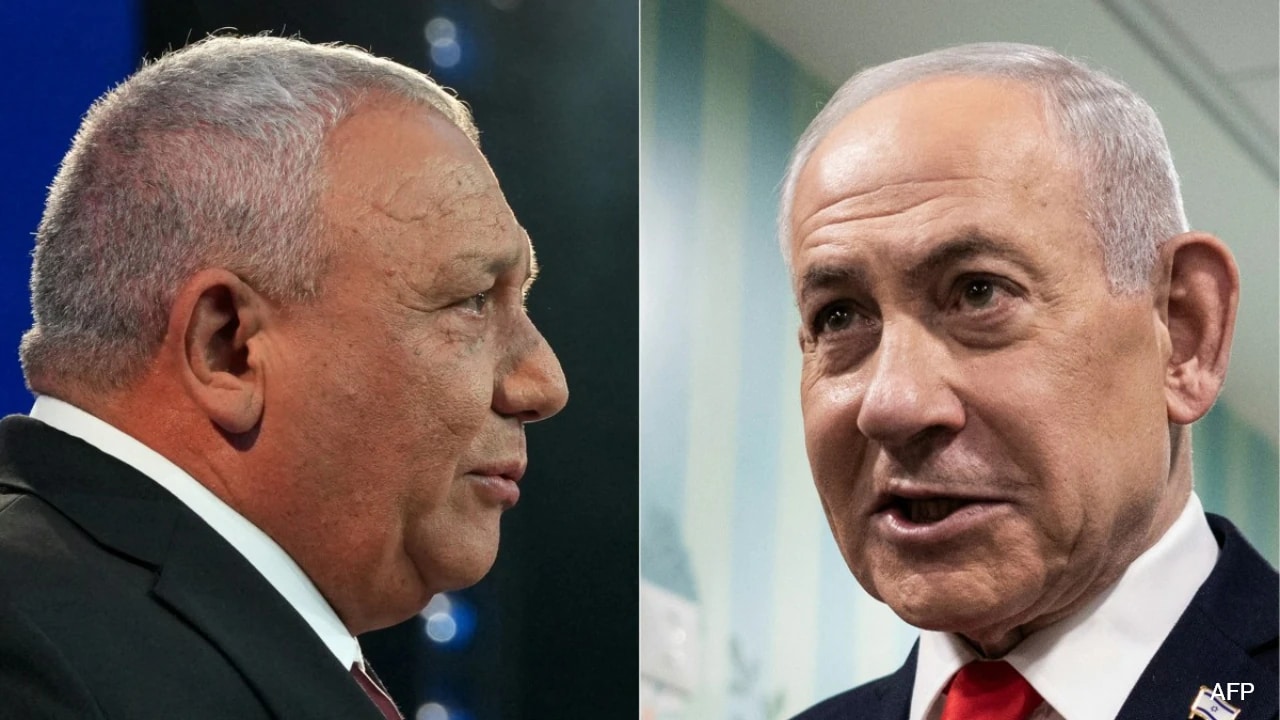
An invitation from Gadi Eisenkot to Benjamin Netanyahu for coalition negotiations does not represent an ideological reconciliation; it functions as a calculated maneuver to alter the bargaining power within the Knesset. In proportional representation systems with a low electoral threshold, political survival depends on breaking existing Nash equilibria. When an opposition figure initiates direct talks with a sitting prime minister, the immediate objective is to lower the transaction costs of coalition formation while stripping extremist flank parties of their veto power. Standard political commentary treats these overtures as mere personality clashes or sudden shifts in loyalty. In reality, they are predictable responses to structural deadlocks in parliamentary arithmetic.
The Structural Arithmetic of Israeli Coalitions
To understand why an opposition leader—specifically a former Chief of Staff of the Israel Defense Forces who entered politics on a platform explicitly opposing Netanyahu's governance—would open a channel for negotiation, one must examine the mechanics of the Knesset. The Israeli parliament consists of 120 seats, requiring a minimum winning coalition of 61 mandates to pass legislation and survive motions of no confidence.
Because Israeli society is fractured along multiple orthogonal axes—secular versus religious, right versus left on security, Ashkenazi versus Mizrahi, and pro-Netanyahu versus anti-Netanyahu—single-party majorities do not exist. Every governing coalition is a multi-party syndicate. The stability of that syndicate is governed by Riker’s Size Principle, which posits that political coalitions will form only to the minimum size necessary to ensure victory, thereby maximizing the share of cabinet portfolios and policy concessions available to each member.
However, when a prime minister relies on narrow, ideologically rigid flank parties to maintain a 61-seat threshold, the system suffers from the tyranny of the minority. Any single faction holding four to seven seats possesses absolute blackmail potential. If that faction defects, the government collapses. This dynamic inflates the political price of every legislative vote, forcing the prime minister to grant disproportionate budgetary allocations and ministerial authority to smaller partners.
Eisenkot’s invitation introduces an alternative coalition geometry. By signaling willingness to enter a unity framework, he offers Netanyahu an exit ramp from dependence on far-right or ultra-Orthodox factions. Simultaneously, Eisenkot attempts to establish himself as the indispensable pivot player—the median legislator without whom no stable, broadly legitimate government can function during periods of acute national crisis.
The Three Pillars of the Unity Gambit
Evaluating this maneuver requires isolating the three distinct operational variables driving both actors toward the negotiating table.
Legitimacy Arbitrage
During prolonged military engagements or severe economic downturns, a narrow partisan government faces rapidly depleting domestic and international legitimacy. Netanyahu gains immediate diplomatic insulation by incorporating a respected former military commander into his decision-making apparatus. Foreign allies, particularly Washington, view figures like Eisenkot as institutional stabilizers. For Eisenkot, the arbitrage works in reverse: he trades his public capital as a trusted security technocrat for direct operational control over war management and strategic policy, bypassing the paralysis of parliamentary opposition.The Shifting of Audience Costs
In political science, audience costs refer to the domestic penalties a leader incurs when backing down from a public commitment. Both Netanyahu and Eisenkot have erected high audience-cost barriers. Eisenkot campaigned on replacing Netanyahu; Netanyahu has spent years framing centrist opponents as weak on security. An explicit invitation to negotiate lowers these costs by reframing the interaction from a partisan surrender to a national emergency imperative. If the talks fail, the initiator captures the moral high ground, demonstrating statesmanship while branding the other party as obstructionist.Veto Player Neutralization
A veto player is an individual or collective actor whose agreement is required for a change in the status quo. In a narrow right-wing coalition, ultranationalist ministers act as absolute veto players on diplomatic initiatives, hostage negotiations, and post-war governance frameworks. Bringing a centrist bloc into the government dilutes the voting weight of these actors. Even if the flank parties do not formally exit the coalition, their threat of defection loses credibility once a centrist safety net is established.
The Transaction Costs of Asymmetric Trust
While the macro-level incentives favor a broad unity coalition, the micro-level execution is plagued by severe principal-agent problems and acute trust deficits. In coalition theory, agreements are not self-enforcing. Because no external court can compel a prime minister to honor a power-sharing deal, the durability of the coalition relies entirely on mutual deterrence and verifiable institutional safeguards.
The primary bottleneck in any negotiation between Eisenkot and Netanyahu is historical precedent. Previous unity arrangements in Israel—most notably the 2020 rotation agreement between Netanyahu and Benny Gantz—collapsed because the sitting prime minister retained control over the legislative calendar and budget mechanisms, allowing him to dissolve the government at a moment advantageous to his own electoral prospects.
To overcome this credibility gap, an incoming partner cannot rely on verbal assurances or non-binding coalition guidelines. The negotiation must focus on structural locks that raise the cost of defection for the prime minister. These locks typically manifest in three ways:
- Parity Mechanisms: Equal representation in the security cabinet, coupled with mutual veto power over key operational decisions, ensuring that the centrist faction cannot be outvoted by the prime minister's loyalists.
- Portfolio Ring-Fencing: Securing control over ministries that dictate resource allocation and legal oversight—specifically Defense, Justice, or Finance—to create an independent power base within the executive branch.
- Statutory Binding: Passing Basic Law amendments prior to swearing in the government, making it legally impossible for the prime minister to fire the incoming ministers without triggering automatic, immediate elections.
Without these structural guarantees, joining the government exposes Eisenkot to political absorption. He would bear collective responsibility for the government's failures while lacking the institutional levers to alter its trajectory.
Strategic Constraints and Operational Limitations
A unity framework is not a permanent solution to Israel's governance crisis; it is a temporary stabilization mechanism with built-in expiration dates. The operational limitations of such an arrangement are severe and predictable.
First, ideological divergence cannot be indefinitely papered over by security emergencies. While centrist and right-wing factions may align on immediate tactical military objectives, their long-term strategic end-states are fundamentally incompatible. Disagreements over post-war administrative control of disputed territories, the conscription of ultra-Orthodox citizens into the military, and the balance of power between the executive and the judiciary will inevitably resurface. Once the immediate existential pressure subsides, these unresolved cleavage issues act as centrifugal forces, tearing the coalition apart from within.
Second, a broad unity government eliminates effective parliamentary oversight. When the primary centrist opposition merges with the ruling party, the remaining opposition consists solely of ideological extremes—far-left, Arab, or disenfranchised right-wing factions—that lack the numbers or coordination to hold the executive accountable. This concentration of power degrades institutional checks and balances, increasing the risk of policy blind spots and executive overreach.
Third, the electorate punishes centrist factions that fail to deliver tangible policy shifts. Voters who support figures like Eisenkot expect them to act as a brake on populist or extremist policies. If the centrist partner is perceived as merely providing a fig leaf for a prime minister they previously denounced, their voter base fractures, defecting either to harder-line opposition parties or into political apathy. The historical trajectory of Israeli centrist parties—from Shinui to Kadima to Blue and White—demonstrates a consistent pattern of rapid rise followed by catastrophic electoral collapse after entering compromise coalitions.
The Mechanism of Political Survival
To evaluate the true intent behind the invitation, analysts must strip away the rhetoric of national unity and examine the payoff matrix for both principals.
For Netanyahu, engaging Eisenkot is a classic divide-and-conquer tactic. The Israeli center-left opposition is frequently fractured among competing egos—Yair Lapid, Benny Gantz, Yair Golan, and Eisenkot himself. By opening a bilateral channel specifically with Eisenkot, Netanyahu sows distrust among opposition leaders, preventing them from forming a unified front. Even if the negotiations yield no formal agreement, the mere act of talking fractures opposition cohesion and buys the prime minister valuable time to navigate immediate legislative or diplomatic hurdles.
For Eisenkot, the calculus is driven by a desire to differentiate himself within the centrist camp. Following the departure of Gantz's National Unity party from the emergency war cabinet, a strategic vacuum emerged. By positioning himself as the pragmatic adult willing to engage the prime minister directly to secure specific national objectives—such as the release of hostages or the stabilization of the northern border—Eisenkot projects leadership and seriousness, contrasting himself with opposition figures who rely solely on street protests and parliamentary boycotts.
This dynamic illustrates a core principle of multi-party bargaining: negotiations are frequently used not to reach an agreement, but to alter the outside options of the participants. By demonstrating that he can talk to Netanyahu, Eisenkot signals to his own allies that he is not bound by their strategic orthodoxy. Conversely, by entertaining Eisenkot, Netanyahu signals to his hardline coalition partners that they are replaceable.
Navigating the Impasse
When evaluating the viability of any resulting political framework, observers must ignore public statements from party spokespeople and track three concrete indicators:
- The Composition of the Decision-Making Forum: Does the proposed agreement dissolve existing partisan security forums in favor of a smaller, statutory war cabinet where centrist voices hold an effective veto? If the broader, right-wing dominated cabinet retains final approval over tactical moves, the unity arrangement is cosmetic.
- The Timeline for Elections: Does the negotiation include a fixed, legally binding date for early elections? A prime minister seeking genuine national healing agrees to an expiration date for his mandate; a prime minister seeking survival insists on serving out the full parliamentary term.
- The Allocation of Legislative Priority: Are contentious domestic bills—such as judicial overhaul legislation or sectarian budget transfers—formally frozen for the duration of the partnership? Without a strict legislative moratorium, the centrist partner will be forced to continuously defend or swallow policies that alienate their core constituency.
The Definitive Strategic Play
If Eisenkot intends to convert this invitation into genuine operational leverage rather than becoming a political casualty, he must enforce a strict precondition before entering substantive policy discussions: the immediate establishment of an agreed-upon date for early elections, codified in law prior to the swearing-in of any new ministers.
By anchoring the coalition to a fixed termination date, Eisenkot removes Netanyahu’s primary incentive to stall, eliminates the blackmail power of the flank parties—who cannot threaten to collapse a government that already has a scheduled end—and transforms the administration from an open-ended political survival vehicle into a time-bound caretaker executive. Without a statutory exit date, entering the coalition is an unhedged bet against an opponent who controls the house rules.


