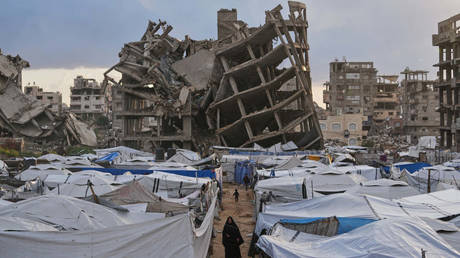
The deployment of heavy armored formations across a contested border simultaneously with the arrival of a senior allied military commander is rarely a coincidence of scheduling; it is a deliberate exercise in coercive signaling. When Israeli armored columns advance into Gaza during a high-level visit by a top United States military official, the operation functions on two distinct planes: the tactical clearance of physical terrain and the strategic compression of diplomatic timelines. Standard news reporting treats the kinetic movement and the diplomatic visit as parallel events connected merely by timing. In reality, they operate as an integrated mechanism designed to establish irreversible facts on the ground before external diplomatic constraints can solidify.
To understand the mechanics of this synchronization, one must separate the physical realities of mechanized urban warfare from the political utility of bilateral defense consultations. Armored incursions require weeks of logistical staging, intelligence preparation of the battlefield, and theater-wide air-land integration. Conversely, high-level visits by commanders from the United States Central Command (CENTCOM) or the Pentagon are orchestrated to align strategic objectives, verify force posture, and manage escalation risks across the broader Middle East. When these two tracks intersect, the resulting friction reveals the core architecture of modern asymmetric deterrence and alliance management. Meanwhile, you can explore other developments here: What History Actually Tells Us About Giving Up Nuclear Weapons.
The Strategic Calculus of Synchronized Escalation
In classical deterrence theory, notably articulated by Thomas Schelling, the manipulation of shared risk is a primary instrument of statecraft. By initiating a ground incursion while a senior U.S. commander is physically present in the region, the initiating state alters the bargaining environment for both its adversary and its principal security guarantor.
First, the kinetic action narrows the diplomatic bandwidth available to the visiting official. Instead of discussing theoretical frameworks for post-conflict governance, ceasefire sequencing, or long-term force reductions, the bilateral agenda is immediately consumed by immediate tactical deconfliction, humanitarian corridor management, and theater-wide air defense readiness. The physical movement of tanks converts abstract policy debates into urgent operational realities. To see the complete picture, we recommend the recent article by NPR.
Second, the timing creates a dual-audience deterrent signal. To the non-state adversary inside Gaza, the presence of a top U.S. commander alongside advancing armor projects implicit alliance cohesion, regardless of whatever private disagreements may exist behind closed doors. To regional state actors—specifically Iran and its aligned networks in Lebanon, Syria, Iraq, and Yemen—the overlapping presence of U.S. command assets and active Israeli ground maneuvers signals that any attempt to open a multi-front war will encounter an already mobilized, coordinated defense architecture.
Third, this synchronization exploits the bureaucratic lag inherent in allied decision-making. Modifying an active armored maneuver requires immediate tactical justification, whereas halting a planned operation prior to launch requires only political hesitation. Once tanks cross the perimeter fence, the diplomatic cost of demanding an immediate withdrawal escalates exponentially for the visiting ally, as doing so risks publicly fracturing alliance credibility during active combat operations.
Operational Mechanics of Armored Maneuvers in Dense Urban Terrain
The decision to commit main battle tanks—such as the Merkava Mark IV—into densely populated urban environments carries severe operational trade-offs. Unlike open desert warfare, where armor dictates tempo through long-range fires and rapid flanking, urban terrain neutralizes traditional mechanical advantages and exposes vehicles to asymmetric anti-armor threats.
The Combined Arms Imperative
Modern armored doctrine strictly prohibits deploying tanks into built-up areas without dense infantry, combat engineering, and overhead intelligence, surveillance, and reconnaissance (ISR) integration. A tank operating independently in an urban canyon suffers from severe blind spots, limited turret elevation against top-attack munitions, and vulnerability to short-range tandem-warhead rocket-propelled grenades and explosively formed penetrators.
To mitigate these vulnerabilities, an armored incursion follows a strict operational sequence:
- Shaping and Isolation: Prior to armored entry, artillery, precision-guided munitions, and electronic warfare assets isolate the target sector, severing adversary command-and-control nodes and collapsing known anti-tank ambush positions.
- Breaching and Route Clearance: Armored combat engineering vehicles—equipped with mine plows, rollers, and explosive line charges—lead the advance to detonate improvised explosive devices (IEDs) and clear rubble barricades that would otherwise channel tanks into pre-sighted kill zones.
- Segmented Advance: Tanks move in mutually supporting pairs or platoons, overwatching adjacent structures while mechanized infantry dismounts to clear buildings and subterranean access shafts.
- Active Protection Saturation: Systems such as Trophy utilize radar to detect incoming projectiles and deploy kinetic countermeasures. While effective against single threats, these systems face saturation risks if an adversary coordinates simultaneous volleys from multiple azimuths.
The Subterranean Friction Factor
In Gaza, the tactical geometry is complicated by extensive subterranean networks. Surface armor can seize geographic coordinates, sever surface supply lines, and destroy above-ground infrastructure, yet it cannot independently neutralize an adversary operating beneath the street grid. This creates a structural divergence between territorial control and adversary degradation. Tanks establish a perimeter and protect engineering teams tasked with locating and collapsing tunnel shafts, turning what appears to be a rapid armored thrust into a slow, methodical, high-attrition clearing operation.
Bilateral Alliance Dynamics and Deconfliction Architecture
The arrival of a top U.S. military commander during an active offensive underscores the complex interdependence between Washington and Jerusalem. The United States serves simultaneously as Israel’s primary arms supplier, intelligence partner, regional deterrent shield, and chief diplomatic mediator with Arab states.
The Three Pillars of U.S. Military Engagement
When a senior Pentagon or CENTCOM leader conducts an unannounced or tightly scheduled visit during an escalation phase, the operational objectives generally fall into three distinct categories:
- Theater-Wide Escalation Control: The primary U.S. military objective is preventing a localized Gaza operation from igniting a regional conflagration. This involves coordinating naval assets in the Eastern Mediterranean and Red Sea, positioning missile defense batteries to protect U.S. and allied bases, and establishing clear rules of engagement if Hezbollah or Houthi forces intensify cross-border strikes.
- Operational Deconfliction and Humanitarian Logistics: High-level military-to-military channels are used to prevent friendly-fire incidents involving U.S. reconnaissance drones, maritime aid corridors, or international humanitarian personnel operating within the theater. The visiting commander reviews granular strike protocols and civilian harm mitigation procedures to ensure compliance with U.S. statutory requirements governing arms transfers.
- Strategic End-State Alignment: Military leaders assess whether the tactical objectives of the armored incursion align with a viable political end-state. From a purely military perspective, the U.S. defense establishment evaluates force sustainability, munition burn rates, and troop fatigue, pressing counterparts to define clear metrics for transitioning from high-intensity clearing operations to stabilization phases.
The Principal-Agent Friction
Alliance politics during wartime inevitably generate principal-agent friction. The United States, as the global superpower, prioritizes regional stability, energy market security, and maintaining diplomatic coalitions across the Arab world. Israel, as the local actor facing immediate territorial threats, prioritizes absolute tactical degradation of the adversary and the restoration of local deterrence, even at the expense of regional diplomatic friction.
When Israeli tanks roll into Gaza during a U.S. commander’s visit, it demonstrates the limits of U.S. leverage. While Washington provides critical precision munitions, air defense interceptors, and diplomatic cover, operational command remains strictly sovereign. The visit itself becomes a mechanism for managing that divergence—allowing U.S. commanders to gather firsthand ground truth rather than relying solely on diplomatic cables, while providing Israeli defense officials a direct channel to justify their tactical necessity to the Pentagon.
The Cost Function of Kinetic Escalation
Every armored deployment carries a quantifiable and non-quantifiable cost function that extends far beyond immediate fuel, munition, and maintenance expenditures. Decision-makers must weigh immediate tactical gains against cumulative strategic degradation across four dimensions:
- Attrition of Specialized Personnel and Materiel: High-tempo urban operations accelerate wear on heavy chassis, transmissions, and barrel life, requiring an intensive logistical tail for field repairs and recovery. Simultaneously, infantry and engineering units operating alongside armor absorb disproportionate casualties during subterranean clearing, eroding the pool of experienced non-commissioned officers.
- Munition Burn Rates and Supply Chain Bottlenecks: Continuous combined-arms operations consume precision-guided munitions, artillery shells, and interceptor missiles faster than domestic industrial bases can replenish them. This creates a direct dependency on foreign military sales and emergency airlifts, giving the supplying ally latent leverage over the duration of the campaign.
- Civilian Infrastructure Collapse and Stabilization Debt: Heavy mechanized maneuvers in dense urban centers inevitably degrade water, sanitation, electrical, and medical infrastructure. The greater the physical destruction required to secure tactical objectives, the higher the long-term financial, administrative, and security burden placed on whoever assumes post-conflict governance.
- Diplomatic Isolation and Regional Alignment Costs: Visible armored advances intensify domestic political pressure on neighboring Arab governments, threatening existing peace treaties, intelligence-sharing agreements, and normalization frameworks.
Distinguishing Verified Facts from Strategic Hypotheses
Rigorous geopolitical analysis requires separating observable, verified events from analytical inference regarding intent.
Verified Operational Facts:
- Israeli armored units and combat engineering formations have repeatedly executed targeted ground incursions into specific sectors of Gaza to dismantle military infrastructure and pressure Hamas negotiating positions.
- Senior U.S. military commanders, including the head of CENTCOM and the Chairman of the Joint Chiefs of Staff, routinely conduct high-level consultations in Israel during periods of heightened operational tempo to coordinate regional air defense and review operational plans.
- Mechanized operations in Gaza rely on heavy armor paired with active protection systems, engineering assets, and close air support to mitigate asymmetric anti-tank threats.
Analytical Hypotheses:
- Deliberate Temporal Coupling: While the exact scheduling of a U.S. commander's flight and an armored brigade's line-of-departure crossing may be influenced by weather, intelligence windows, or logistics, executing the maneuver during the visit maximizes coercive signaling toward regional adversaries.
- Preemptive Negotiation Shaping: Advancing armor into previously uncleared or re-infiltrated sectors immediately prior to or during diplomatic consultations is designed to extract concessions in ceasefire or hostage-release negotiations by demonstrating a willingness to escalate indefinitely.
Limitations of Armored Coercion in Asymmetric Conflicts
A critical failure in superficial military commentary is assuming that armored superiority translates linearly into political victory. History—from the 1982 siege of Beirut to the 2004 battles in Fallujah and the 2016–2017 campaign in Mosul—demonstrates the structural limitations of mechanized force against entrenched irregular adversaries.
Tanks are instruments of shock, firepower, and territorial seizure; they are not instruments of political legitimacy or permanent pacification. An armored brigade can clear a neighborhood in forty-eight hours, yet the moment the heavy vehicles withdraw to rearm and refit, surviving insurgent cells inevitably re-emerge from subterranean networks to reassert control over the civilian population. Without a viable political mechanism and a local security force capable of holding cleared terrain, repeated armored incursions risk degenerating into a cyclical war of attrition—often referred to in Israeli military doctrine as "mowing the grass"—that degrades adversary capabilities temporarily without altering the underlying political equilibrium.
Furthermore, the presence of a visiting U.S. commander highlights the ceiling of unilateral military action. No matter how tactically proficient an armored division performs inside Gaza, its strategic sustainability remains tethered to external diplomatic support, regional air defense integration, and international supply chains.
Strategic Trajectory and Operational Imperatives
The convergence of armored escalation and senior U.S. military diplomacy signals an inflection point where tactical maneuvers are being used to force a decisive phase transition. Rather than viewing the incursion as an open-ended occupation, defense planners and intelligence analysts should evaluate the operation through the lens of leverage extraction prior to a negotiated pause or a shift to lower-intensity raid-based operations.
To navigate the immediate operational environment, military and diplomatic stakeholders must execute three concrete adjustments:
- Decouple Tactical Clearing from Static Holding: Armored formations should be restricted to rapid, intelligence-driven raids aimed at high-value subterranean nodes and command centers, avoiding static urban garrisoning that maximizes exposure to asymmetric attrition and civilian friction.
- Institutionalize Bilateral Deconfliction Cells: Given the overlapping presence of U.S. advisory, intelligence, and humanitarian coordination elements alongside active Israeli combat brigades, both militaries must maintain real-time, co-located liaison cells to prevent miscalculation and ensure rapid adjustment of fire-support coordination lines.
- Anchor Kinetic Milestones to Diplomatic Off-Ramps: Every armored thrust must be paired with a predefined diplomatic benchmark—such as specific prisoner-exchange parameters or third-party border monitoring arrangements—ensuring that tactical momentum is converted into durable strategic concessions before logistics fatigue and regional escalation pressures erode the advantage.