Cold.
That is the single word every shooter in the National Basketball Association dreads, though few ever say it aloud during postgame press conferences. You feel it first in the tips of your fingers while sitting on a padded folding chair three feet from the baseline. Your sweat dries against your jersey. The adrenaline from pregame warmups drains out of your calves. The arena lights seem to hum a little louder while eighteen thousand people watch someone else take the shots you spent six hours practicing before sunrise.
Then, without warning, the coach points down the bench. Your number is called. You tear off your warmups, jog to the scorer's table, kneel on one knee, and wait for the horn. Thirty seconds later, a point guard whips a cross-court pass into your chest with two seconds left on the shot clock and a six-foot-eight defender lunging at your face. You do not get a feel-good layup to warm up your touch. You do not get three dribbles to find your balance. You get one breath, one release, and the entire weight of the Los Angeles Lakers' championship expectations riding on whether your muscles remember what they knew forty-five minutes ago.
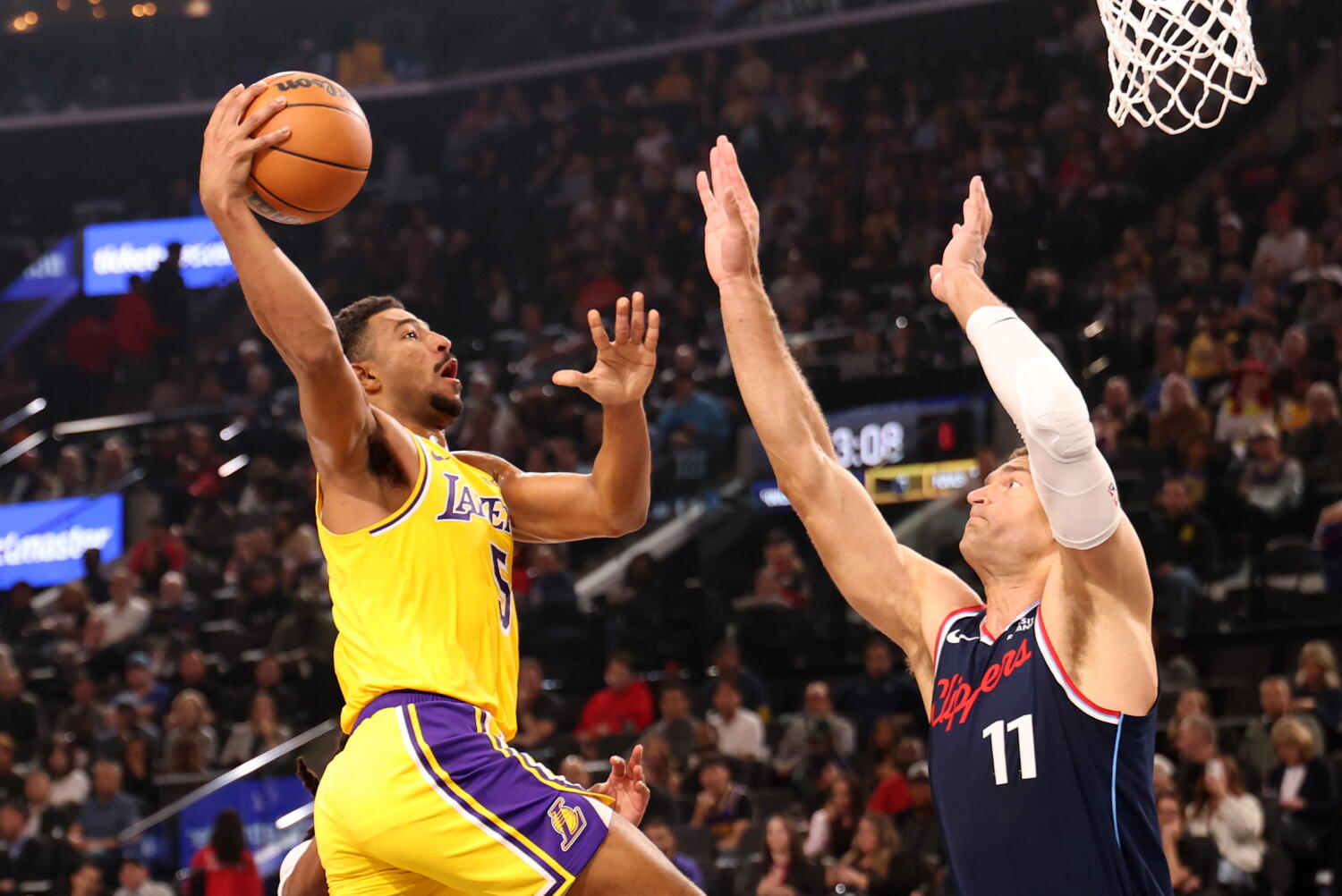
This is the invisible tightrope Quentin Grimes is walking right now in purple and gold.
On paper, the story looks deceptively simple. A sharpshooting guard gets hot from beyond the three-point arc, finds his rhythm in the rotation, and faces the classic basketball adjustment of coming off the bench rather than starting. Standard sports journalism treats this like a math equation. Minutes go down, shots go down, percentages fluctuate, everyone moves on to the next box score.
Anyone who has ever lived inside a locker room knows that math has nothing to do with it.
The Myth of the Automatic Shooter
Fans love to talk about shooters as if they are kitchen appliances. You plug them into the corner, flip a switch, and expect toast to pop up at a reliable forty percent clip. I spent years covering basketball from cramped baseline media rows, watching players try to keep their hands warm with heating pads wrapped around their knuckles during timeouts, and I can tell you the truth that box scores hide. Shooting at the professional level is not mechanical. It is deeply, vulnerably psychological.
Quentin Grimes knows this better than most. When you look at his journey to Los Angeles—drafted out of the University of Houston after learning to play under Kelvin Sampson's famously unforgiving defensive standards, traded across conferences, forced to prove his value in different systems—you see a player whose entire NBA survival has depended on adaptability. Grimes was never handed twenty shots a night to shoot his way out of a slump. He had to earn every look by defending the opposing team's best perimeter scorer first, crashing the glass second, and praying the ball swung back to him in the corner third.
When he caught fire for the Lakers, the basketball world saw the highlight reels. They saw the quick release, the high arc, the effortless splash of the net as defenders arrived a fraction of a second too late. What they did not see was the quiet terror that arrives the moment a hot streak collides with a rotation change.
Move a starter to the second unit, and you change the entire physics of his night.
To understand why, consider a hypothetical scenario on a random Tuesday night in January. Call him Player X, a bench wing who enters the game at the four-minute mark of the first quarter. If Player X misses his first three-pointer because his legs are still stiff from sitting, he might not touch the ball again until the middle of the second quarter. By halftime, he is zero-for-two, his body feels heavy, and every voice in the building—including the loudest one inside his own head—starts whispering that tonight is not his night. A starter gets twenty-five minutes to erase a slow start. A bench player gets four minutes to justify staying on the floor.
Grimes is staring directly into that trap, and his refusal to fall into it says everything about why the Lakers brought him into their orbit.
The Architecture of a Ready Mind
Ask Grimes how he plans to keep his perimeter stroke alive while coming off the bench, and he will not give you mystical nonsense about destiny or confidence. He talks about routine. He talks about preparation. He talks about treating the bench not as a waiting room, but as an extension of the court.
Think of a professional shooter's rhythm like a campfire in the rain. If you walk away from it for twenty minutes, you do not return to roaring flames; you return to wet ash, and striking a match against damp wood is miserable work. The great bench shooters in NBA history—men like Lou Williams, Jamal Crawford, Kyle Korver, and JJ Redick—understood that their real job happened while they were sitting down.
Redick, who now commands the Lakers' sideline and understands the neurosis of perimeter shooting on a cellular level, built an entire career out of obsessive pre-entry rituals. Watching Redick prepare to check into a game used to look like watching a pianist silently finger scales on a wooden tabletop before walking onto the stage at Carnegie Hall. Every breath was measured. Every glance at the defensive alignment was calculated before his sneakers ever crossed the sideline.
Grimes is applying that exact blueprint to his own role in Los Angeles.
When he sits on the Lakers' bench, he is not watching the game like a spectator. He is mapping the floor. He is tracking where the help defender cheats when LeBron James backs down his man on the left block. He is watching how the opposing big man drops into coverage when Austin Reaves turns the corner on a high screen. By the time Grimes checks in, he already knows where the open pocket of air will appear three passes from now.
That mental rehearsal eliminates the half-second of hesitation that kills bench shooters. In the NBA, a half-second is the difference between a clean look and a blocked shot. When a player comes off the bench cold and uncertain, he catches the ball, looks at the rim, checks the closeout, and then decides to shoot. By the time the ball leaves his fingertips, the window has slammed shut. When Grimes catches the ball, the decision was already made while he was still sitting next to the assistant coaches.
Why Los Angeles Needs This Version of Grimes
The Lakers have spent the better part of half a decade searching for a very specific unicorn. Surrounding superstar creators with reliable, high-volume three-point shooters sounds easy until you actually try to do it under the blinding spotlight of Los Angeles.
History is merciless to shooters who put on the Lakers uniform. Players who shot forty-two percent in smaller markets have arrived in Southern California only to watch their percentages crater under the weight of national television broadcasts, relentless social media scrutiny, and the unique spacing demands of playing alongside ball-dominant stars. We saw it happen to Danny Green during stretches of the 2020 run. We saw it happen to Malik Beasley. We saw it happen to countless veterans who discovered too late that wide-open threes in Los Angeles feel strangely narrower than wide-open threes anywhere else in the league.
The pressure does not come from the crowd booing; it comes from the scarcity of rhythm.
When you play on a team with elite primary creators, the offense naturally revolves around their gravity. You might stand in the weak-side corner for four consecutive possessions without touching leather. Your heart rate spikes from sprinting back on defense, drops while you stand stationary behind the arc, spikes again when you fight over a screen, and drops again on the bench. Maintaining fine motor control in your wrist and fingertips through those violent physiological swings requires an almost unnatural level of discipline.
This is where Grimes separates himself from the pure specialists who have washed out of Los Angeles before him.
Grimes is not a statue waiting for a kick-out pass. Watch him closely during a Lakers possession and you notice his feet never stop moving. If the strong side gets clogged, he relocates along the baseline into the corner. If his defender turns his head to watch the ball, Grimes cuts backdoor hard enough to force a rotation, then drifts back out to the perimeter while the defense scrambles to recover. He creates his own rhythm through movement. Even when the ball never touches his hands, his cardio stays elevated, his legs stay springy, and his shooting base stays engaged.
Let us be completely honest about the uncertainty here, though. No shooter, no matter how disciplined his routine or how clean his mechanics, is immune to variance. Basketball is a cruel sport governed by round balls bouncing off cylindrical rims at seventy miles per hour. There will be nights this season when Grimes does everything right—stretches on the sideline, tracks the defensive coverages, steps into a rhythmic catch-and-shoot three—and the ball rattles out three times in a row.
The true test of his bench transition will not happen on the nights he goes five-for-seven. It will happen on the night he goes zero-for-four in twelve minutes, sits down for the final eight minutes of the fourth quarter, and has to show up at the practice facility the next morning at nine o'clock to shoot five hundred more.
The Discipline Behind the Arc
I once asked a longtime NBA shooting coach what separates the guys who stay hot off the bench from the guys who fade out of rotations by February. I expected him to talk about elbow alignment, release point, or lower-body mechanics. Instead, he pointed to the stationary bikes in the tunnel behind the arena.
"Watch who rides the bike in the third quarter," he told me. "Anybody can warm up before tipoff. Show me the guy who keeps his core temperature up when he hasn't played in twenty-five real-time minutes."
That detail sticks with me every time I watch Grimes navigate his minutes with the Lakers. Maintaining a hot hand off the bench is fundamentally an exercise in ego management. Starting in the NBA carries status. It gets your name announced in the dark while spotlights sweep the floor. It guarantees you run onto the court with warm legs and a clean slate. Accepting a bench role—and embracing the unglamorous, repetitive work required to stay sharp inside that role—requires swallowing pride that plenty of talented players choke on.
Grimes approaches the assignment with the blue-collar pragmatism that defined his college days in Houston. Under Kelvin Sampson, nobody cared about your offensive rhythm if you missed a defensive rotation. You earned the right to shoot by surviving the possession on the other end. That wiring never leaves a player. When Grimes checks into a Lakers game off the bench, his first instinct is rarely to hunt a heat-check jumper. His first instinct is to pick up the opposing ball-handler ninety-four feet from the basket, crowd his airspace, and force a difficult pass.
Here is the paradox every great two-way role player eventually discovers: defense is the fastest cure for cold hands.
When you throw yourself into a physical defensive possession—fighting through a hip check from a two-hundred-and-fifty-pound center, contesting a pull-up jumper without fouling, boxing out a bigger wing—the anxiety about your shot evaporates. You stop thinking about your elbow angle. You stop worrying about whether you will get pulled if you miss. Your nervous system locks into pure reaction. And when the rebound bounces to a teammate and the Lakers push the ball up the floor in transition, you sprint to the three-point line not as a nervous specialist trying to prove he belongs, but as a competitor already immersed in the fight.
The Invisible Margins of a Championship Run
Strip away the trade rumors, the nightly box scores, and the endless sports talk debates about rotations, and you arrive at the simple truth of why Quentin Grimes matters so much to this Lakers season.
Championships are rarely won by the top two players on the roster playing well; everyone already assumes the stars will show up in May. Championships are decided in the seven-minute stretches when the stars sit down to catch their breath, the arena energy dips, and the opposing team tries to turn a four-point deficit into a twelve-point lead.
Those minutes belong to the bench. They belong to the players who can walk onto the floor cold, absorb the chaos of a shifting game, and hit two dagger threes that suck the oxygen out of the building.
Think of a bench shooter like a relief pitcher trotting in from the bullpen in the eighth inning with runners on second and third. Nobody cares that he spent the last two hours sitting on a folding chair behind the outfield wall. Nobody cares that his arm might feel tight or that he only got eight warm-up pitches before the umpire yelled play ball. The batter is already in the box, the crowd is on its feet, and the only thing that matters is whether the next pitch hits the outside corner.
Grimes is building his entire routine around owning that eighth-inning moment. Every extra shot after practice, every mental rep from the sidelines, every defensive sprint designed to keep his blood moving while he waits for the ball to find him—all of it is engineered to make sure that when his number is called, there is no transition period at all.
The horn buzzes at the scorer's table. Grimes stands up, peels off his warmups, and steps across the white line into the roar of the arena. He wipes his palms once against the front of his shorts, plants his feet in the left corner, and holds his hands open for the pass—already warm, already locked in, before the ball even leaves his teammate's fingertips.