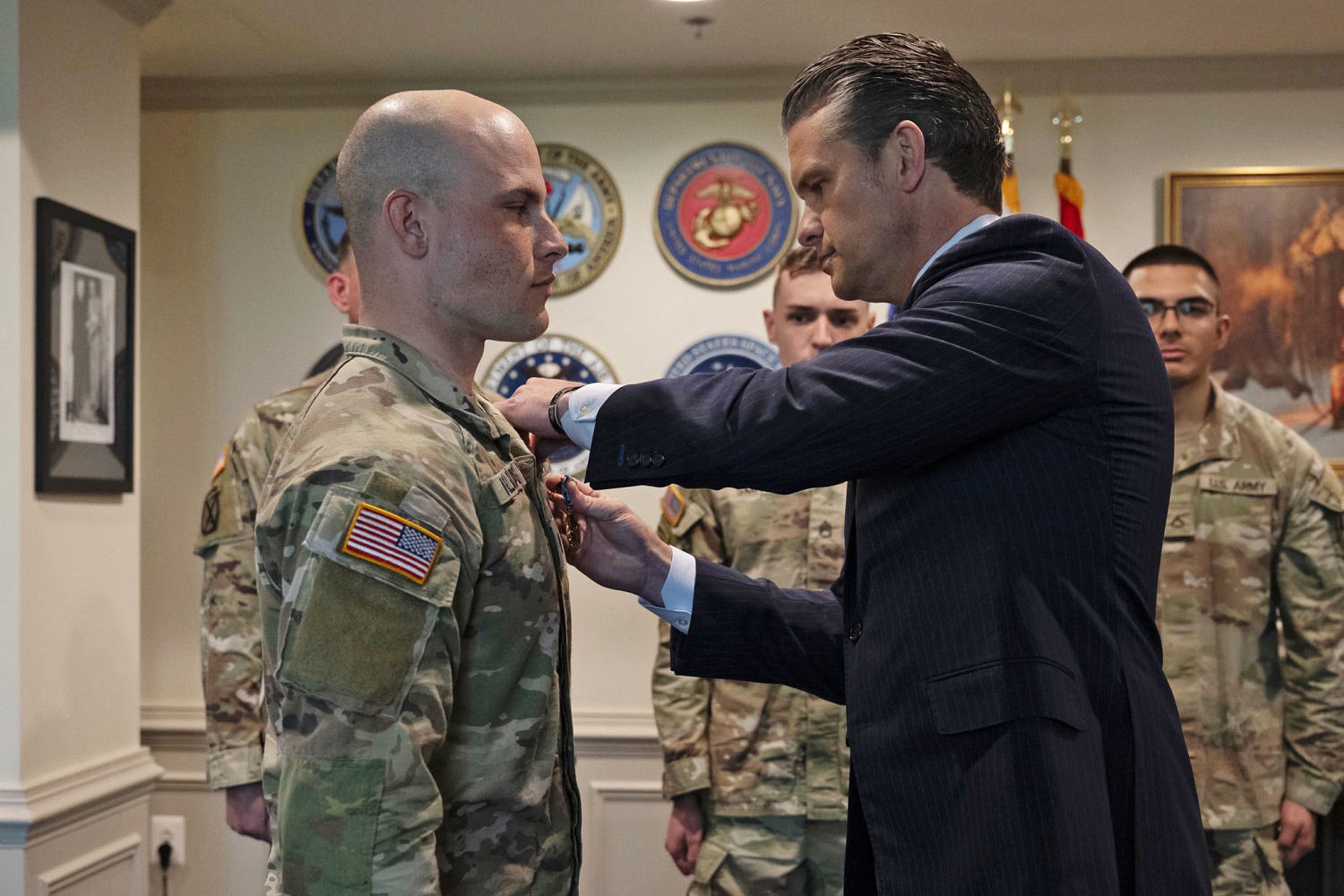
On November 11, 2026, U.S. Defense Secretary Pete Hegseth and his staff were publicly rebuked by Specialist Thomas Iglesias, a sentinel of the 3rd U.S. Infantry Regiment (The Old Guard), for talking and laughing near the Tomb of the Unknown Soldier at Arlington National Cemetery. Twenty-four hours later, on November 12, Hegseth summoned the unit to the Pentagon and pinned the Joint Service Commendation Medal on Iglesias, pairing the ceremony with a public statement endorsing military standards. Most coverage treats this sequence as a human-interest oddity or a routine political damage-control maneuver. That reading misses the operational mechanics at play. The event is a textbook execution of institutional reframing—a crisis-management protocol where a senior executive absorbs an acute status violation by converting the enforcer of the norm into a visual asset for the executive's own brand.
The Structural Collision of Dual Hierarchies
To understand why a junior enlisted soldier can verbally correct the civilian head of the Department of Defense without career-ending blowback, you must map the two competing authority systems operating simultaneously at Arlington National Cemetery.
- Statutory Rank Hierarchy: Under Title 10 of the U.S. Code, the Secretary of Defense sits directly below the President in the operational chain of command. Specialist Iglesias holds pay grade E-4, near the bottom of the enlisted structure. Under normal garrison or combat conditions, an E-4 publicly dressing down a cabinet-level official constitutes a severe breakdown of military order.
- Site-Specific Ritual Jurisdiction: Since 1948, sentinels from The Old Guard have maintained an uninterrupted 24-hour guard at the Tomb of the Unknown Soldier. Within the physical perimeter of the plaza, operational doctrine grants the sentinel absolute, non-negotiable enforcement authority over decorum, silence, and movement. This authority supersedes rank, civilian office, and political status.
When Hegseth and his entourage breached acoustic discipline on Veterans Day, they triggered an automatic protocol. Iglesias did not exercise personal discretion; he executed a pre-programmed institutional script designed to preserve the sanctity of the memorial against all external disruption. The friction occurred because viral video captured the exact moment statutory rank collided with ritual jurisdiction, creating an immediate reputational deficit for the Pentagon's leadership.
The Three-Phase Reputational Recovery Protocol
Left unaddressed, the November 11 footage established a damaging narrative: a defense secretary preaching warrior ethos and discipline while personally failing to maintain basic silence at the nation's primary military shrine. The Pentagon's response deployed a rapid, three-phase recovery sequence within a single 24-hour news cycle.
Phase 1: Immediate De-escalation and Validation
Before Hegseth ever stood in front of a camera on November 12, chief Pentagon spokesman Sean Parnell issued a statement confirming that a soldier had "correctly and respectfully reminded everyone to maintain decorum". This step neutralizes the primary risk in executive crises: defensive denial. By conceding the factual premise immediately, the communications apparatus denied critics the oxygen of a cover-up or a dispute over intent.
Phase 2: Asymmetric Over-Correction via Commendation
A verbal apology leaves the executive in a subordinate posture. Pinning a Joint Service Commendation Medal on the critic inverts the power dynamic.
The Joint Service Commendation Medal is a mid-tier military decoration typically awarded for meritorious achievement or service in a joint-service environment over an extended deployment or staff tour. Awarding it within 24 hours for a routine, 10-second enforcement of standard post orders represents a deliberate administrative escalation. By elevating a standard duty performance into a formal decoration ceremony at the Pentagon, Hegseth reasserted his position at the apex of the statutory hierarchy. He shifted from the subject of a reprimand to the grantor of institutional honor.
Phase 3: Semiotic Co-Optation
The final step replaced the visual record. Search algorithms and social feeds prioritize high-contrast, official imagery over shaky bystander video. By publishing high-resolution photographs of the medal pinning alongside the caption "We love soldiers. We love standards. Well done, Specialist," Hegseth's team overwrote the initial visual frame. The narrative moved from executive carelessness to executive alignment with enlisted rigor.
The Cost Function of Rapid Medal Escalation
While the maneuver succeeded in arresting short-term media bleed, institutional interventions carry measurable second-order costs. Senior leaders managing large organizations must weigh the immediate public-relations yield against long-term systemic friction.
- Decoration Inflation: Military award systems rely on scarcity and objective criteria to retain motivational value. When senior officials use formal commendations as rapid-response communications tools, they dilute the perceived equity of the award among personnel who spend months in austere environments to earn the identical ribbon.
- Incentive Distortion: Publicly rewarding a routine correction with a joint-service medal creates an implicit signaling distortion across the force. Junior personnel observe that high-visibility friction with senior leadership yields accelerated recognition, whereas quiet, unfilmed adherence to standards across thousands of posts yields none.
- Political Vulnerability: The incident did not occur in a vacuum. Just days prior, on November 10, Hegseth survived a House impeachment push led by Representative Thomas Massie and backed by Democrats, with renewed congressional scrutiny projected for the incoming January session. Under intense legislative oversight, every administrative action—including the expedited processing of a military award for personal crisis management—becomes potential ammunition for critics alleging that Pentagon resources and traditions are being subordinated to political image management.
Tactical Blueprint for Executive Status Recovery
Organizations facing public breaches of their own stated cultural standards can extract a clear operational sequence from this case, provided they account for its structural limits.
- Audit Jurisdiction Before Reacting: Determine whether the critic was operating within an established institutional mandate. If the rebuke was procedurally valid, never challenge the enforcer's authority.
- Compress the Response Window: Execute the corrective action within one news cycle (under 24 hours). Delayed acknowledgments allow the initial frame to harden into permanent public consensus.
- Transfer Ownership of the Standard: Publicly validate the enforcement mechanism rather than offering a personal excuse. Frame the breach as proof that the organization's guardrails function without fear or favor.
- Calibrate the Reward Mechanism: Use public praise, formal letters of appreciation, or command coins rather than formal service medals. This achieves the exact same visual inversion without distorting internal promotion and award architectures.
Strategic Forecast
The Pentagon's handling of the Arlington reprimand establishes a repeatable playbook for modern political-military communications: when caught violating an institutional norm, immediately weaponize the enforcement of that norm to validate your own leadership brand. Expect senior officials across executive agencies to adopt this rapid visual-inversion tactic whenever viral friction threatens their public standing. However, because Hegseth relied on a formal military decoration rather than an informal commendation, the Defense Department will face heightened scrutiny from congressional oversight committees and veteran advocacy groups over award-board integrity as the new legislative session opens in January 2027.