The operational architecture of the long-range air campaign has undergone a fundamental structural pivot. In modern attrition warfare, victory is dictated by the economic inversion of strike assets versus defense networks. By engineering low-cost, long-range unmanned aerial vehicles (UAVs) to strike capital-intensive industrial targets deep inside the Russian interior, the strategic objective has transitioned from territorial defense to systemic economic interdiction.
This campaign is not built on random disruption. It operates on a strict mathematical thesis: force a massive, continent-sized state to defend thousands of linear kilometers of industrial infrastructure using a finite supply of surface-to-air missile (SAM) systems. When a $35,000 autonomous drone can disable a primary oil distillation unit that costs tens of millions of dollars and requires years to manufacture, conventional air defense paradigms collapse under the weight of their own cost functions.
The Tri-Pillar Architecture of Drone Atrium Warfare
To evaluate the true efficacy of this long-range interdiction campaign, the strategic mechanism must be broken down into three distinct operational vectors:
1. Kinetic Degradation of Critical Refining Nodes
The primary target selection bypasses generic military installations to focus directly on Atmospheric-Vacuum Distillation units (AVTs). AVTs are the industrial choke points of petroleum refining; they process raw crude into usable fuel fractions like gasoline, diesel, and aviation kerosene.
Because these distillation columns operate under high pressure and temperature, their metallurgy is specialized and highly vulnerable to shrapnel and thermal shock. A relatively small warhead payload of several dozen kilograms is insufficient to breach reinforced concrete bunkers, but it is mathematically optimized to rupture the unarmored, highly flammable pressurized systems of an AVT.
2. Radical Economic Inversion
The cost-exchange ratio governs long-term sustainability in a war of attrition. Traditional Western military paradigms favor hyper-expensive precision-guided munitions (PGMs)—such as Tomahawk cruise missiles costing upwards of $2 million per unit. The current campaign utilizes a decentralized procurement model, leveraging private enterprise competition to scale domestic manufacturing.
When hundreds of low-signature UAVs are launched simultaneously, the defending state must choose between letting an industrial asset burn or depleting a multi-million dollar interceptor missile (such as those fired by S-400 or Pantsir-S1 systems). If the interceptor is fired, the economic ratio favors the attacker by orders of magnitude. If the interceptor is withheld, the resulting industrial damage compounds the economic loss.
3. Saturation and Radars Overwhelm
Air defense systems are fundamentally limited by target tracking channels and missile magazine depth. Simultaneous launches of massive drone salvos are engineered to exceed the maximum engagement capacity of local terminal defenses. By routing strike packages at low altitudes and utilizing low radar-cross-section composites, attackers exploit the gaps in long-range early warning networks, converting localized air defense into a pure numbers game where the defender’s magazine runs dry before the attacker's inventory of low-cost hulls.
Quantifying the Damage Function
The structural impact on the state budget and domestic logistics is measurable through specific economic indicators. A successful air campaign does not require the absolute destruction of every refinery; it requires crossing a critical threshold of refining capacity reduction where domestic supply chains begin to fracture.
[Crude Production Baseline] ---> [Refining Disruption (AVT Cracking)] ---> [Domestic Deficit / Export Collapse]
                                            |
                                            v
                               [Force Majeure Contract Cancellations]
By targeting refineries in the European territory, the strike campaign forces a cascade of supply shocks:
- Production Elasticity Deficits: Crude oil production fell by approximately 5% year-on-year to 8.7 million barrels per day, a deviation of 10% below planned benchmarks. When refining capacity is lost, upstream oil wells must be capped or production slowed because raw crude storage is highly finite.
- Capital Loss and Force Majeure: The destruction of fuel assets triggers immediate contract failures. Court arbitrations, such as those handled by the Moscow Arbitration Court regarding destroyed fuel at the Morskoy Neftyanoy Terminal, demonstrate that wholesale distributors are systematically failing to deliver product, leading to widespread legal invocations of force majeure.
- Direct Value Attrition: Cumulative infrastructure strikes have imposed direct capital damages exceeding $7 billion.
The primary bottleneck for the defending state is not financial liquidity; it is technical supply-chain isolation. Modern deep-processing and high-efficiency petrochemical refinery components rely heavily on imported components and Western machinery. Sanctions regimes prevent the rapid, legal procurement of these specialized valves, pumps, and control systems. Consequently, even minor kinetic damage to a secondary processing unit can mothball a facility for months due to the lack of specialized spare parts.
Systematic Failures in Point-Defense Doctrines
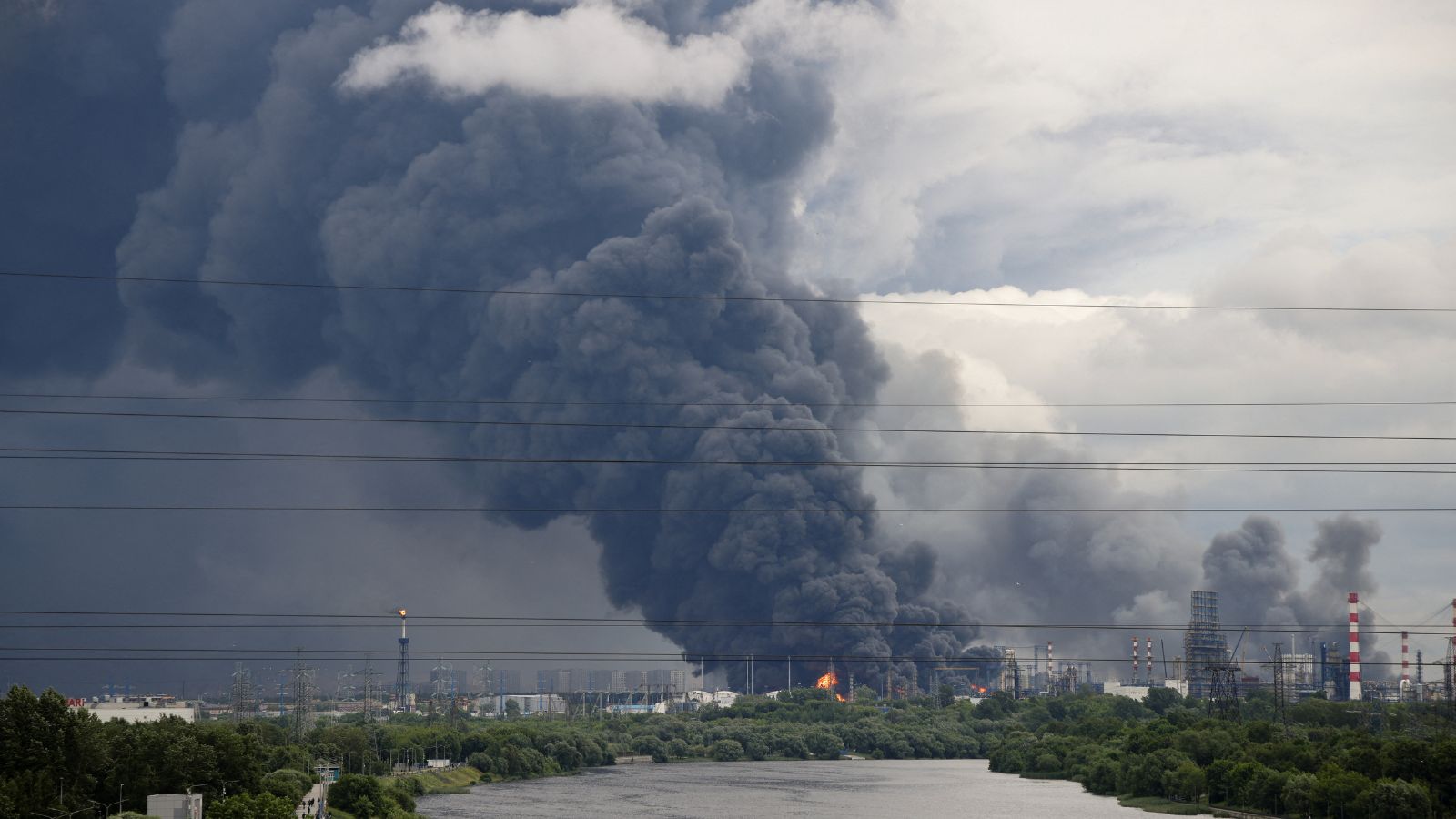
The inability to protect critical capital assets inside major metropolitan hubs—evidenced by sequential breakthroughs at the Moscow Oil Refinery—uncovers a structural vulnerability in conventional air defense architecture.
Traditional air defense doctrines were designed to counter high-velocity cruise missiles or coordinated multi-role aircraft wings. These threats possess high thermal and radar signatures, allowing centralized early warning radars to vector long-range SAMs well before the target reaches terminal range.
Autonomous drone fleets invalidate this paradigm via three structural gaps:
- Lack of Integrated Border Tracking: The border regions lack a continuous, low-altitude tracking radar network. Drones flying at tree-top levels bypass traditional search radars by utilizing terrain masking.
- Sensor Interoperability Deficits: There is no automated, real-time data-sharing protocol connecting local military installations with commercial or civilian observation assets. Automated tracking remains siloed, preventing the rapid deployment of mobile intercept weapons.
- Over-Reliance on Specialized SAMs: Relying on heavy surface-to-air missile batteries for point defense creates an asymmetric vulnerability. Because these systems are finite and costly to manufacture, they cannot be deployed to every civilian industrial site without dangerously exposing front-line military formations.
Conversely, effective counter-UAV frameworks require an integrated, multi-layered complex: acoustic sensor networks to track engine harmonics across territory, high-frequency localized radar grids, and mobile fire teams equipped with cheap interceptor drones utilizing machine-vision guidance. Without this architecture, point defenses are easily saturated by sheer volume.
Strategic Constraints and the Evolution of the Kill Zone
While the economic and logistical returns of this long-range drone strategy are high, the campaign is bound by severe operational limitations. It is not a singular silver bullet.
First, lightweight long-range UAVs carry small payloads, making them ineffective against heavily fortified or deeply buried military infrastructure. They are precision tools for soft, volatile industrial targets, not instruments for systematic tactical destruction of concrete fortifications or hardened command bunkers.
Second, the electronic warfare environment is highly dynamic. As the defender adjusts jammer frequencies and deploys localized GPS-spoofing arrays, drone guidance systems must continuously evolve. This has forced a rapid technological migration toward fiber-optic control lines for short-range tactical deployments and automated machine-vision targeting algorithms for long-range autonomous terminal guidance. These technologies bypass traditional radio-frequency jamming entirely, but they introduce new vulnerabilities, such as physical wire breakage or optical occlusion caused by heavy smoke and adverse weather conditions.
On the tactical frontline, this saturation of unmanned systems has established a "pointillist" battlefield. The conventional, contiguous frontline has dissolved into a 15-to-25 kilometer deep "kill zone." In this space, the constant presence of reconnaissance and First Person View (FPV) strike drones makes large-scale mechanized maneuver impossible. Any concentration of armor or logistics is identified and targeted within minutes, forcing both sides to disperse forces into small, isolated units and reducing the territorial advance rate to a grinding crawl.
The Next Structural Pivot
To maintain strategic initiative, the long-range air campaign must transition from sporadic infrastructure raiding to systematic, scheduled saturation of the energy logistics nexus. The strategic play is to synchronize long-range industrial attrition with tactical maneuvers within the frontline kill zone.
By forcing the systematic withdrawal of SAM batteries from the front lines to protect Western-interior refining assets, vulnerabilities will inevitably open along the tactical perimeter. The ultimate vector of success will not be measured by the total number of drones launched, but by the precise execution of target selection that keeps the enemy's air defense grid permanently divided, economically inverted, and structurally frozen.