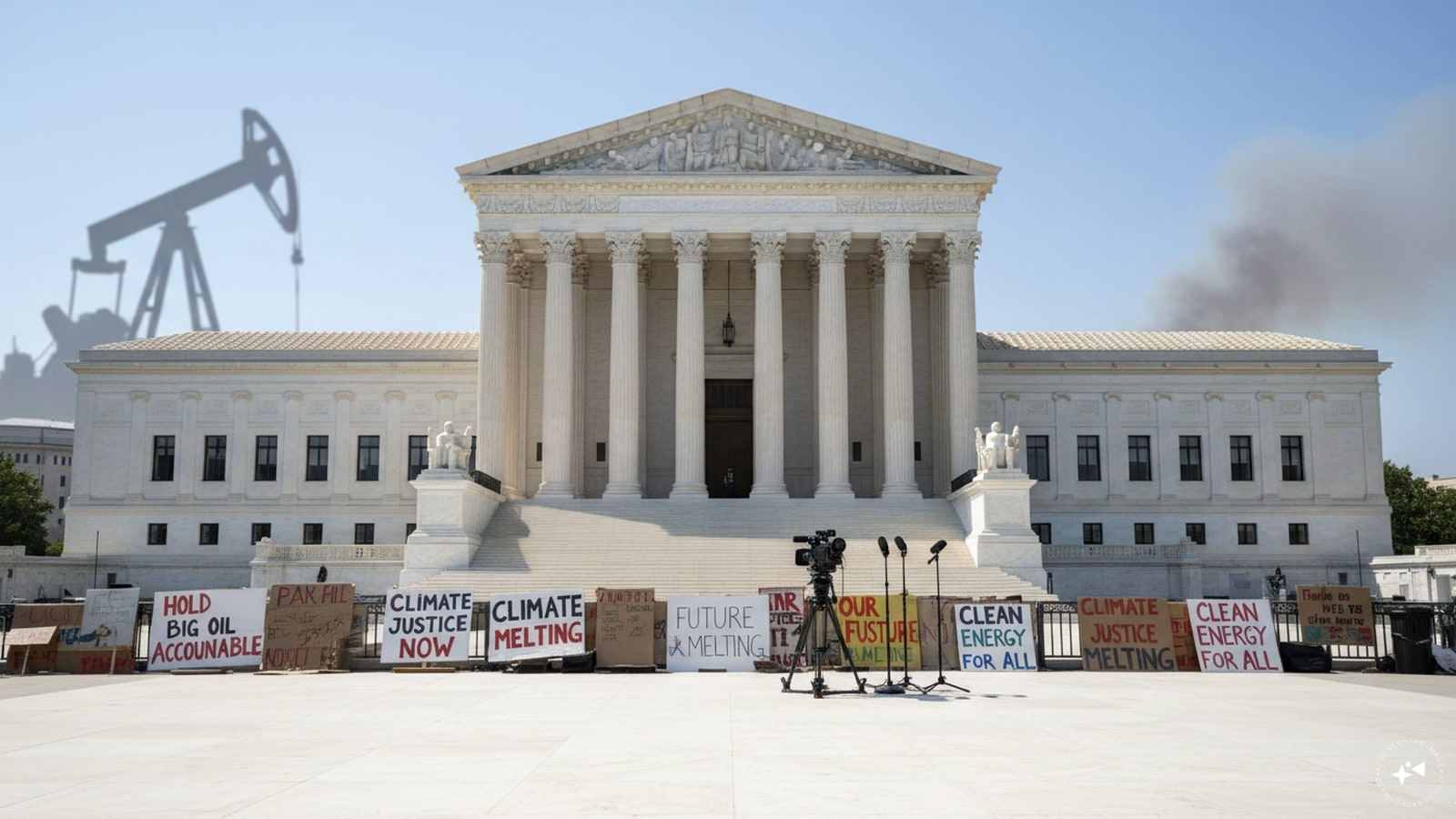
The coffee in the corner diner has been lukewarm since six in the morning, tasting faintly of burnt aluminum and yesterday's desperation. Across town, inside a limestone fortress guarded by silent stone and heavy mahogany, nine people are deciding whether a town that floods every spring is allowed to ask who turned up the heat.
We forget that abstract legal petitions have a pulse. When energy conglomerates ask the United States Supreme Court to slam the courthouse doors shut on municipal climate lawsuits, they use clean, clinical language. They talk about federal preemption, constitutional boundaries, and the Clean Air Act. They talk about jurisdiction.
They do not talk about water in the basement.
Consider a hypothetical homeowner named Martha, whose family has farmed the same stretch of coastal acreage in Maryland for four generations. Martha is not a constitutional scholar. She does not read briefs filed by corporate defense teams in Washington, District of Columbia. She only knows the dock where her grandfather taught her to bait a hook. That dock is now underwater during high tide, even on calm days when the sky is the color of old pewter.
When local governments across America—from the sun-bleached coasts of California to the salt-bitten shores of Rhode Island—decided to sue major fossil fuel producers, they were doing something unprecedented. They were taking decades of corporate public relations campaigns, internal memos acknowledging carbon risks, and soaring global temperatures, and translating them into the language of public nuisance. They said: You knew. You profited. Now help us pay to build the seawalls.
Energy companies look at these lawsuits and see an existential threat. If municipal courts can hold energy producers liable for global emissions under state tort laws, the floodgates open. Not just water, but liability. Trillions of dollars in potential damages. A patchwork of fifty different states setting fifty different standards for energy production and climate accountability.
So they petitioned the highest court in the land to settle the matter. They want a uniform rule. They want federal law to swallow state claims whole. They want a declaration that climate change is a global atmospheric phenomenon governed exclusively by federal legislation and international treaties, leaving local communities with no legal recourse in their own backyard.
This is where the law collides with human grief.
To understand the stakes of this Supreme Court showdown, you have to look past the docket numbers and examine the mechanics of accountability. For decades, the companies extracting and refining oil and gas enjoyed a peculiar kind of immunity born of distance. The smoke from the stack drifted upward; the dividends flowed downward; the consequences spread outward across the entire planet, diffuse and untraceable to any single hand.
Except science evolved. Attribution science can now trace specific molecules of carbon in the atmosphere back to the corporate balance sheets that put them there. Researchers can calculate precisely how much a warming ocean has raised sea levels in specific tidal basins. The invisible has become measurable.
And once something is measurable, it can be argued in front of a jury.
That terrifies corporate boardrooms. A trial in front of a local jury in a flood-prone county is not a polite seminar on regulatory compliance. It is a reckoning. It puts executives on the stand to answer for decades of corporate messaging that downplayed the risks their own scientists were whispering about behind closed doors.
The fossil fuel industry argues that holding individual companies liable for a global crisis is inherently unfair. They point out that every single one of us burns gasoline, turns on the air conditioning, and participates in the modern carbon economy. They argue that Congress and the executive branch—elected bodies accountable to the electorate—are the proper venues for crafting environmental policy, not unelected judges and local juries motivated by local property damage.
There is a logical consistency to their argument. Energy policy is broad, complex, and national in scope. If every municipal court in America can dictate the terms of energy production through tort litigation, the resulting chaos could paralyze the nation's grid.
Yet, the counter-argument is equally visceral. When a community faces billions of dollars in infrastructure costs to protect its citizens from rising seas, who should bear the burden? The taxpayers who bought groceries and drove to work, or the corporations that extracted the fossil fuels, marketed them, and fought regulatory efforts while knowing the scientific reality of what would happen?
This tension is the fault line running through the current Supreme Court bid.
The justices are weighing whether federal law preempts these state-level public nuisance claims. If the Court rules in favor of the industry, it effectively immunizes energy companies from state tort liability regarding climate change. It closes the courtroom door. It tells Martha and millions like her that their local grievances belong in an arena where federal gridlock ensures nothing will ever happen.
If the Court rules against the industry, or declines to intervene and lets the lower court rulings stand, the litigation proceeds. Dozens of cities and states will move toward discovery. Trials will happen. Internal corporate documents will be entered into evidence under oath. The financial exposure will become a tangible reality on corporate balance sheets.
We stand at this strange, quiet intersection of law and survival.
The coffee shop closes its doors at four. The tide in Maryland continues its slow, relentless creep over the old wooden pilings. Inside the marble halls of the Supreme Court, the black robes rustle as opinions are weighed, clauses are parsed, and the boundaries of accountability are redrawn.
The water does not care about jurisdiction. It rises anyway. And somewhere out there, in the gathering dusk, a coastline waits to see who is going to pay to hold it back.