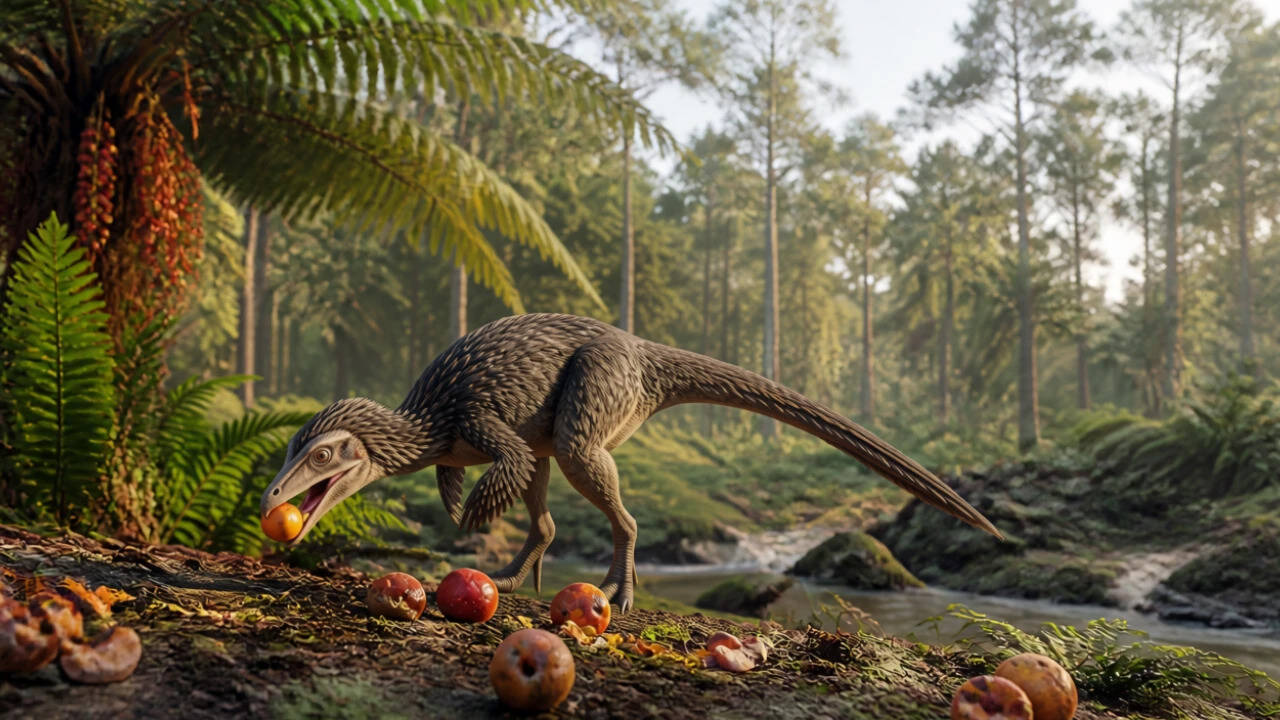
Yes, a newly identified bird-like dinosaur from the Early Cretaceous period, Jeholornis, provides the oldest direct fossil evidence of fruit consumption in dinosaurs, dating back roughly 120 million years. By analyzing preserved stomach contents containing intact seeds and examining specialized skull and beak morphology, researchers confirmed this turkey-sized theropod functioned as an early seed disperser. This discovery fundamentally alters our timeline of co-evolution, demonstrating that dinosaurs actively drove the geographic spread of flowering plants millions of years before modern birds and mammals dominated terrestrial ecosystems.
For decades, paleobotanists and vertebrate paleontologists operated in separate silos, arguing over a chicken-and-egg evolutionary puzzle. Flowering plants, known as angiosperms, suddenly exploded in diversity during the Cretaceous period. Darwin himself famously called their rapid rise an "abominable mystery." We knew that fleshy fruits evolved specifically to attract animals that would eat the pulp and deposit the seeds elsewhere. What we lacked was the smoking gun proving which animals were doing the heavy lifting during the Mesozoic Era.
The Smoking Gun in the Jehol Biota
The breakthrough did not come from a single massive skeleton, nor did it rely on guesswork about tooth wear. It came from the extraordinarily fine-grained volcanic ash beds of northeastern China's Jehol Biota. This lagerstätte—a sedimentary deposit exhibiting extraordinary fossil preservation—captured Jeholornis in exquisite detail, right down to its feathers and the final meals trapped inside its digestive tract.
When paleontologists examined multiple specimens of Jeholornis, they noticed clusters of oval structures situated directly in the abdominal cavity. Early interpretations suggested these might be stomach stones, or gastroliths, which many birds and reptiles swallow to grind up tough vegetation. Closer inspection under high-powered scanning electron microscopy shattered that assumption. Those oval structures were not rocks. They were intact, uncrushed seeds belonging to an ancient lineage of fruiting plants.
The distinction is critical. Had Jeholornis been a pure seed predator—like a modern finch or parrot—its digestive tract would have crushed those seeds to extract the nutrient-dense endosperm inside. Instead, the seeds remained whole. The animal was stripping away the fleshy outer layers, digesting the sugars, and passing the viable seeds through its gut. It was acting as an biological delivery system.
Anatomy of an Ancient Frugivore
To verify that this was habitual behavior rather than a fluke last meal, researchers turned to comparative anatomy and biomechanics. A skull tells you how an animal makes a living. When you look at the cranium of Jeholornis, you see a fascinating transitional mosaic—part predatory theropod, part modern fruit-eating bird.
Jeholornis retained a long, bony tail tipped with a fan of feathers, a classic primitive trait inherited from its dromaeosaurid cousins like Velociraptor. Yet its skull tells a completely different story. Unlike its meat-eating relatives, which sported long snouts lined with serrated, blade-like teeth, Jeholornis possessed a short, deep, robust snout. Its teeth were drastically reduced in both size and number, completely absent from the upper jaw and reduced to a few tiny pegs in the lower mandible.
Using finite element analysis—a computer modeling technique originally developed by engineers to test stress on bridges and airplane wings—scientists reconstructed the bite force and cranial mechanics of Jeholornis. The results showed a skull poorly suited for tearing flesh or cracking hard nuts. Instead, the jaw mechanics were optimized for plucking, squashing, and manipulating soft, yielding objects.
Consider a hypothetical comparison between a modern toucan and a hawk. A hawk's beak is engineered for high-stress shearing and tearing, concentrating force at a sharp, hooked point. A toucan's beak is lightweight, broad, and built to reach out, snip a berry from a branch, and toss it back into the throat without crushing the pit. Jeholornis was operating on the early blueprint of the toucan model, proving that specialized frugivory was already wired into dinosaur anatomy 120 million years ago.
Rewriting the Cretaceous Co-Evolution Timeline
Why does a turkey-sized dinosaur eating berries matter to anyone outside a university museum? Because without this mechanism, the modern world would look entirely different.
Before the rise of angiosperms, terrestrial landscapes were dominated by gymnosperms—conifers, cycads, and ginkgoes. These plants relied largely on wind or water to scatter their pollen and seeds. Wind dispersal is inefficient. It keeps plant populations relatively localized and makes it difficult for species to colonize fragmented habitats or recover quickly after wildfires and volcanic eruptions.
Fruiting plants changed the rules of botanical warfare by outsourcing their logistics to animals. By wrapping their seeds in caloric, nutrient-rich flesh, plants bribed mobile vertebrates to carry their offspring miles away from the parent tree, depositing them in a neat package of fertilizer.
Until now, the prevailing consensus held that small mammals and more derived, crown-group birds drove this botanical revolution much later in the Cretaceous or early Cenozoic. The Jeholornis evidence pushes that partnership back by tens of millions of years. Dinosaurs were not merely passive bystanders lumbering through Mesozoic forests; they were the primary architects of forest expansion. As Jeholornis flew from canopy to canopy, it actively planted the very ecosystems that would eventually sustain the rest of the planet.
What the Headlines Miss About Dinosaur Diets
Whenever a study like this drops, mainstream science coverage tends to oversimplify the narrative into neat, binary boxes. Dinosaurs are suddenly recast from ferocious carnivores into peaceful fruit-eaters. That is bad journalism and worse science.
Biology is rarely binary. In modern ecology, strict frugivores are exceedingly rare. Even birds we associate heavily with fruit, like cedar waxwings or hornbills, rely heavily on insects and small vertebrates during breeding seasons to get the protein and calcium required to grow chicks and produce eggs.
The fossil record of Jeholornis reflects this exact ecological nuance. While several specimens show stomachs packed with seeds, other individuals from the exact same formation preserve insects and other invertebrates in their gut contents. Jeholornis was not a dogmatic vegan; it was an opportunistic omnivore. It exploited seasonal abundance. When fruiting trees were heavy with crops, it gorged on sugar. When the season shifted, it hunted bugs.
Furthermore, we have to address the preservation bias inherent in paleontology. Soft tissues, leaves, and fruit pulp almost never fossilize. They rot away within days of an animal's death. Seeds, particularly those with hard outer coats, survive the fossilization process far better than pulpy fruit or soft-bodied grubs. We are looking at the Mesozoic diet through a keyhole, seeing only the hardest, most durable remnants of what these animals actually consumed.
The Fierce Debate Over Seed Dispersal vs Seed Predation
Not every paleontologist is ready to pop champagne over the seed-dispersal hypothesis. Science advances through friction, and there is a legitimate, ongoing debate regarding how to interpret gut contents in fossil vertebrates.
Skeptics point out a major methodological hurdle: determining whether a seed in a fossilized stomach was destined to be passed intact or ground to dust later in the digestive cycle. Modern granivorous (seed-eating) birds often swallow whole seeds, store them in a muscular crop, and then pass them into a powerful gizzard filled with grit to pulverize them.
If a bird dies suddenly—say, suffocated by volcanic ash in the Jehol Biota—before those seeds reach the grinding stage of the lower digestive tract, the fossil will preserve intact seeds. To an observer 120 million years later, a seed predator caught mid-meal looks remarkably similar to a fruit-eating seed disperser.
The counter-argument rests on the sheer volume of specimens and the absence of gastroliths. In Jeholornis fossils containing seeds, researchers consistently find a total lack of the heavy stomach stones required to pulverize hard seed coats. Moreover, the seeds preserved in the gut cavity show zero signs of mechanical abrasion or cracking. Compare that to other Cretaceous bird-like dinosaurs, such as Yanornis, where fossilized stomachs are packed with crushed fish bones or piles of grinding stones. The anatomical and paleontological data align cleanly: Jeholornis lacked the internal machinery to destroy those seeds, meaning they were almost certainly excreted whole and viable.
The Evolutionary Ripple Effect Across the Mesozoic
Once you accept that Jeholornis was dining on fruit, you have to look at the rest of the Cretaceous ecosystem through a completely different lens. Flight was the ultimate competitive advantage for a frugivore.
Fruit grows at the terminal tips of thin branches, high in the canopy, specifically to keep heavy, ground-dwelling browsers from stripping the entire plant bare without carrying the seeds away. A massive sauropod like Brachiosaurus could reach the canopy, sure, but its sheer bulk would destroy the tree in the process. Small, agile, volant theropods like Jeholornis could perch on slender outer branches, harvest the fruit without damaging the plant, and fly across rivers or mountain ridges to deposit the seeds.
This created an evolutionary feedback loop. Plants that produced brighter, sweeter, more accessible fruits attracted more winged dinosaurs. Those dinosaurs, thriving on an abundant, easily harvested energy source, diversified rapidly. Selection pressure favored better flight mechanics, more agile perching feet—noticeable in Jeholornis's reversed first toe, or hallux, which allowed it to grip branches securely—and more specialized beaks.
At the same time, this dietary shift opened up new ecological niches on the forest floor. Every fruit dropped accidentally by a feeding Jeholornis became a windfall for small terrestrial mammals, lizards, and ground-dwelling ornithischian dinosaurs. The canopy became an engine of caloric production that fed every tier of the forest below it.
Why Modern Ecosystems Still Carry This Cretaceous Blueprint
You do not need a time machine to see the legacy of Jeholornis. Walk into any tropical rainforest today—from the Amazon basin to the cloud forests of Costa Rica—and you are watching the exact same ecological machinery in motion.
Modern frugivorous birds like quetzals, toucans, and bellbirds are the direct ecological successors to Jeholornis. Up to 90 percent of tree species in modern tropical forests rely on animals, predominantly birds, to disperse their seeds. When large frugivorous birds are hunted out of a forest fragment, the entire ecosystem begins to collapse within a few decades. Large-seeded trees stop reproducing because their seeds simply fall directly beneath the parent canopy, where they succumb to fungal pathogens, shade, and seed predators.
The discovery of fruit-eating in Jeholornis proves that this foundational pillar of terrestrial ecology is not a recent Cenozoic invention. It is an ancient contract forged between dinosaurs and flowering plants during the Early Cretaceous, surviving asteroid impacts, mass extinctions, and continental drift to shape the greenery outside your window right now.