The sound of Centre Court when it falls silent is unlike any other quiet in the world. It is not empty. It is heavy, packed tight with the held breath of fifteen thousand people who desperately want to scream but have suddenly forgotten how to breathe.
You can hear the precise thud of a yellow ball hitting the taut gut of a racket. You can hear the squeak of a tennis shoe fighting for traction on grass that has grown slick under the afternoon heat. Most of all, you can hear the expectation. It hangs over Southwest London like the low-hanging summer clouds, thick and suffocating.
For Katie Boulter, that silence became an adversary far more formidable than the net or the white lines.
To understand what happened out there, you have to understand the peculiar cruelty of the British summer. Every July, the nation looks for a savior in white shorts or a pleated skirt. They want a narrative of redemption, a home-grown hero to validate the strawberries, the cream, and the hours spent queuing in the rain. Boulter, with her striking presence, her undeniable talent, and her status as the British number one, was cast in the role before she even stepped onto the lawn.
Then came the qualifier.
She was a teenager whose name most of the crowd had to look up on their digital programs. A girl with no grand expectations, no historic legacy to carry, and absolutely nothing to lose. When you have spent the last three weeks playing on windswept clay courts in obscure corners of Europe just to earn a spot in the draw, the main stage of Wimbledon does not feel like a pressure cooker. It feels like a playground.
The contrast was brutal from the opening game.
The Architecture of Pressure
Watch a player under immense pressure and you see it first in the shoulders. They tighten. The fluid, violent grace of a professional tennis swing becomes mechanical, a series of calculated levers rather than a singular explosion of instinct.
Boulter started with the familiar rhythm that had carried her to titles and into the upper echelons of the sport. Her serve, usually a weapon capable of dictating terms from the baseline, looked formidable in the warm-up. But warm-ups are a mathematical exercise. The match is an emotional one.
Across the net, the teenager stood bouncing on the balls of her feet, an emblem of pure, unadulterated adrenaline.
Consider the mechanics of the upset. In modern tennis, the gap between the top thirty players in the world and a hungry qualifier is not a gap of talent. It is a gap of consistency and scar tissue. The qualifier has fewer memories of devastating losses. She has not yet learned the precise geometry of failure. She simply hits the ball.
When that teenage fearlessness meets a home favorite carrying the psychological weight of an entire country, the physics of the sport begin to warp.
The first break of serve did not come from a brilliant winner. It came from a subtle tightening of Boulter’s forearm on a routine forehand, sending the ball three inches past the baseline. A collective groan rippled through the stands—a sound like a giant velvet blanket being dragged across gravel. That groan is a physical force. It settles into a player's bones.
The Illusion of Control
We like to believe that elite athletes are immune to the ambient noise of their environment. We are told stories of their focus, their metaphorical bubbles, their ability to lock out the world.
It is a myth.
When you are playing on a show court at your home Grand Slam, you hear every individual voice. You hear the sympathetic "Come on, Katie" that feels more like a plea for mercy than an expression of confidence. You see the celebrities in the Royal Box shifting in their seats. You are acutely aware that millions of television screens across the country are flickering with your movements, analysts dissecting your footwork before the ball has even cleared the net.
The teenager, meanwhile, lived in a different reality. Every risky down-the-line backhand she attempted found the paint. When a shot like that lands in during the first set, a strange alchemy occurs. The underdog begins to believe that they are anointed.
The match quickly transformed from a tactical chess game into an emotional rescue mission for Boulter. She began chasing the lines, trying to hit her way out of the suffocating feeling of being hunted. But grass is a surface that rewards patience as much as power. If you rush, the ball skids lower, the bounce becomes truer, and your mistakes multiply exponentially.
By the time the first set slipped away, the narrative had hardened. The crowd was no longer cheering for a victory; they were begging for a survival story.
The Loneliness of the Baseline
Tennis is the loneliest sport. There are no timeouts. No teammates to absorb a bad pass. No manager to pull you from the mound when your fastball loses its bite. You stand there, isolated in a rectangle of chalk, entirely naked to the world's judgment.
During the changeovers, Boulter sat staring at the strings of her racket, adjusting them with meticulous, desperate care. It is a universal tennis ritual, a manifestation of the desire to control something, anything, when the macro-environment has spun completely out of hand.
The metaphorical tide was rising, and the teenager was swimming with the current. Every point won by the qualifier was met with a fist pump and a feral shout that echoed off the stadium roof. It was the sound of youth realizing its own power in real time.
There was a brief moment in the second set where the momentum threatened to shift. Boulter manufactured a break point, a solitary crack in the teenager’s armor. The crowd erupted, a sudden, violent surge of noise that shook the stadium. For a second, the old magic of Wimbledon felt alive. The home favorite looked up, a glimmer of the familiar defiance returning to her eyes.
But the teenager did not blink. She did not look at the crowd. She did not look at her box. She simply stepped up and hit a second serve so close to the T that it left a small puff of white chalk in the air.
Ace.
The window slammed shut. The air left the stadium again.
The Final Chord
The end of a great match is rarely a explosion. It is a slow evaporation.
In the final games, the tactical adjustments no longer mattered. It was a battle of momentum against gravity. Boulter fought, saving match points with the pride of a champion who refused to go quietly into the night, but the result had been written an hour prior in the shifting psychology of the court.
When the final error flew wide, the teenager collapsed onto the grass, covering her face in a mixture of disbelief and pure, unburdened joy. It was a beautiful moment, the kind that makes sports the most compelling unscripted drama on earth.
But if you turned your eyes just a few feet away, you saw the true cost of the spectacle.
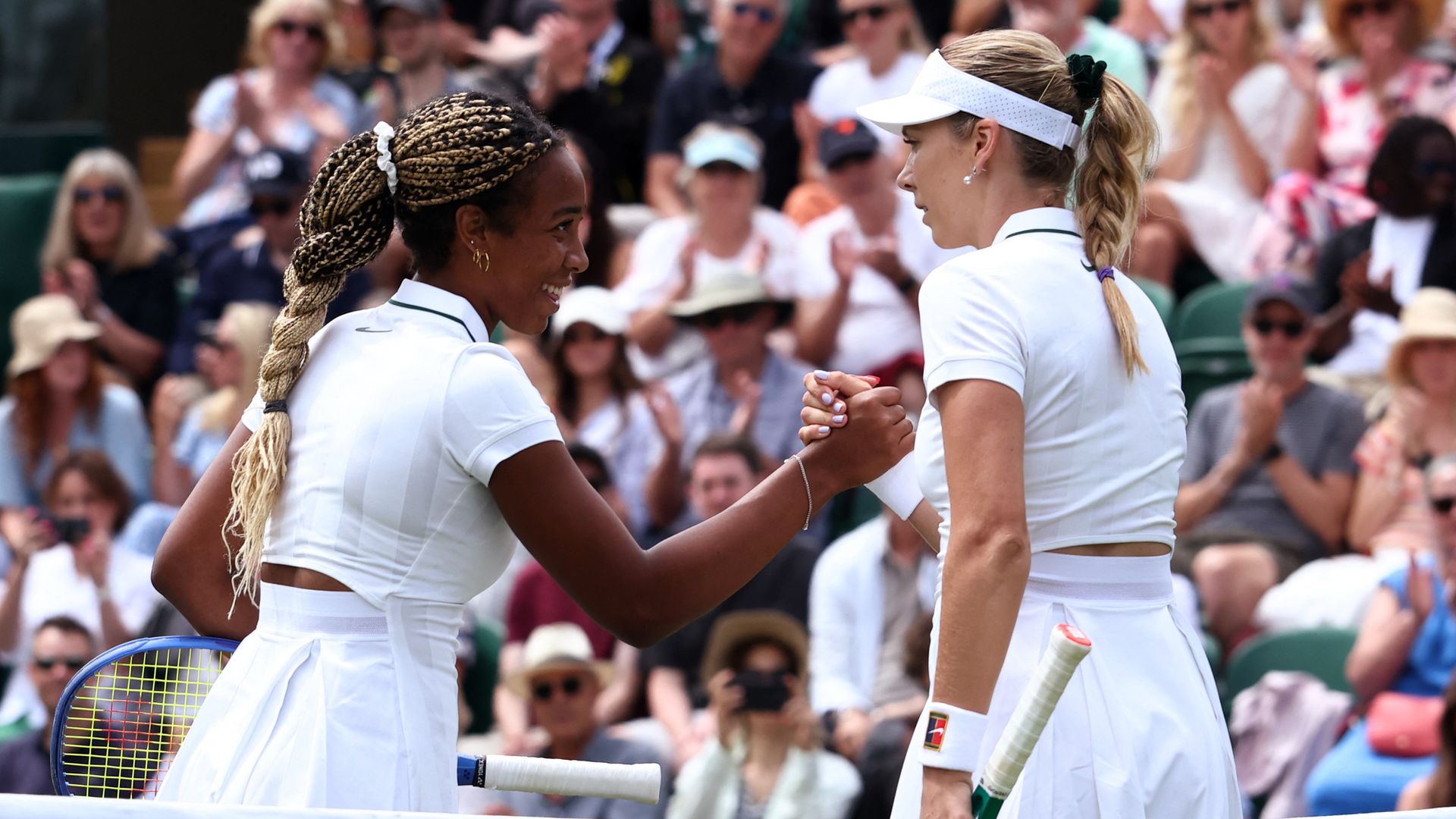
Boulter stood at the net, her posture rigid, a polite, heartbroken smile fixed on her face as she shook her opponent's hand. She walked off the court to a standing ovation, but it was an ovation laced with pity, the absolute worst medicine for an competitor of her caliber.
She walked through the dark tunnels of the All England Club, past the portraits of past champions, leaving behind the heat, the noise, and the crushing expectation of another summer that promised everything and delivered nothing but the cold reality of the scoreboard.
The circus will move on. The teenager will become the new story, scrutinized and weighed until she too carries her own baggage. But for one afternoon, the grass belonged to the girl who had nothing to lose, and the shadow belonged to the woman who was asked to carry it all.