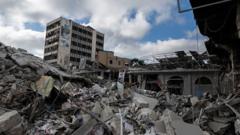
The mainstream press loves a diplomatic signing ceremony. Pictures of officials smiling, handshakes mediated by American envoys, and sweeping declarations of economic stability. When Israel and Lebanon signed their US-brokered framework agreement, the consensus narrative solidified instantly. The media hailed it as a triumph, a victory for energy security, and a template for regional de-escalation.
They are completely wrong.
This agreement is not a foundation for stability. It is a temporary management contract masquerading as a diplomatic breakthrough. By treating a deeply entrenched ideological conflict as a mere commercial real estate dispute over offshore gas fields, the negotiators did not solve the crisis. They merely subsidized the status quo.
The Myth of Economic Interdependence
The core argument driving the optimistic coverage is simple: money breeds peace. The logic dictates that if both nations possess lucrative gas fields—Karish for Israel and Qana for Lebanon—neither side will risk war because conflict would destroy their economic windfalls.
This theory assumes that all regional actors operate under the same capitalist playbook. It completely misunderstands the nature of asymmetric warfare and ideological governance.
For decades, international relations theorists have clung to the notion that economic interdependence prevents conflict. History repeatedly proves this false. Europe was deeply integrated economically in 1914. Energy dependence did not stop the conflict in Ukraine. In the Levant, economic assets are not deterrents; they are highly attractive targets.
Imagine a scenario where Lebanon's economy stabilizes slightly due to gas revenues. Does this weaken non-state armed groups? No. It provides a bigger pie for corrupt political factions to slice up. The state infrastructure remains captured. Wealth generated under a flawed political setup does not trickle down to build a stable democracy; it funds the patronage networks that keep the country fragile.
The Sovereignty Paradox
The framework agreement is praised for resolving maritime boundaries without forcing Lebanon to formally recognize Israel. Commentators call this a masterful stroke of creative diplomacy.
In reality, it is a dangerous legal fiction.
A border is only as secure as the sovereign power enforcing it. Lebanon is currently experiencing severe state degradation. The central government in Beirut does not hold a monopoly on the use of force. Therefore, signing an agreement with the official Lebanese state is like signing a contract with the manager of a store when a cartel controls the warehouse.
The agreement creates a false sense of security for international energy conglomerates. Companies like TotalEnergies enter these waters under the assumption that a piece of paper signed in Naqoura guarantees operational safety.
Who Actually Wins
Let us look at the hard realities of the energy market rather than the idealistic press releases.
- The Political Class: The deal allowed embattled politicians on both sides to claim a victory before critical domestic transitions, using the promise of future energy wealth to distract from immediate internal failures.
- The Mediators: Washington secures a short-term diplomatic win to showcase its continued relevance in regional mediation, ignoring the fact that the underlying structural tensions remain completely unaddressed.
- The Energy Cartesian Elite: Corporations get extraction rights, but they pass the security risks and costs onto consumers and taxpayers.
The idea that this framework serves as a model for future regional agreements is fundamentally flawed. It cannot be replicated because it relies on a specific, fragile alignment of temporary interests.
The Security Miscalculation
The consensus view states that the deal reduces the likelihood of a maritime escalation. The reality is that it shifts the arena of confrontation.
By neutralizing the immediate maritime dispute, the agreement removes a specific flashpoint but leaves the broader land border and airspace tensions untouched. It creates a localized zone of commercial interest while the surrounding geopolitical environment remains highly volatile. Security cannot be unbundled. You cannot have a peaceful maritime zone surrounded by a landscape of proxy conflict.
True stability requires addressing the core drivers of tension: state weakness, regional proxy strategies, and the absence of formal diplomatic recognition. Until those foundational issues are resolved, every framework agreement is just a pause button, not a solution.
Stop celebrating the signature on the paper. Look at the structural realities on the ground. The deal did not bring peace; it just rescheduled the conflict.