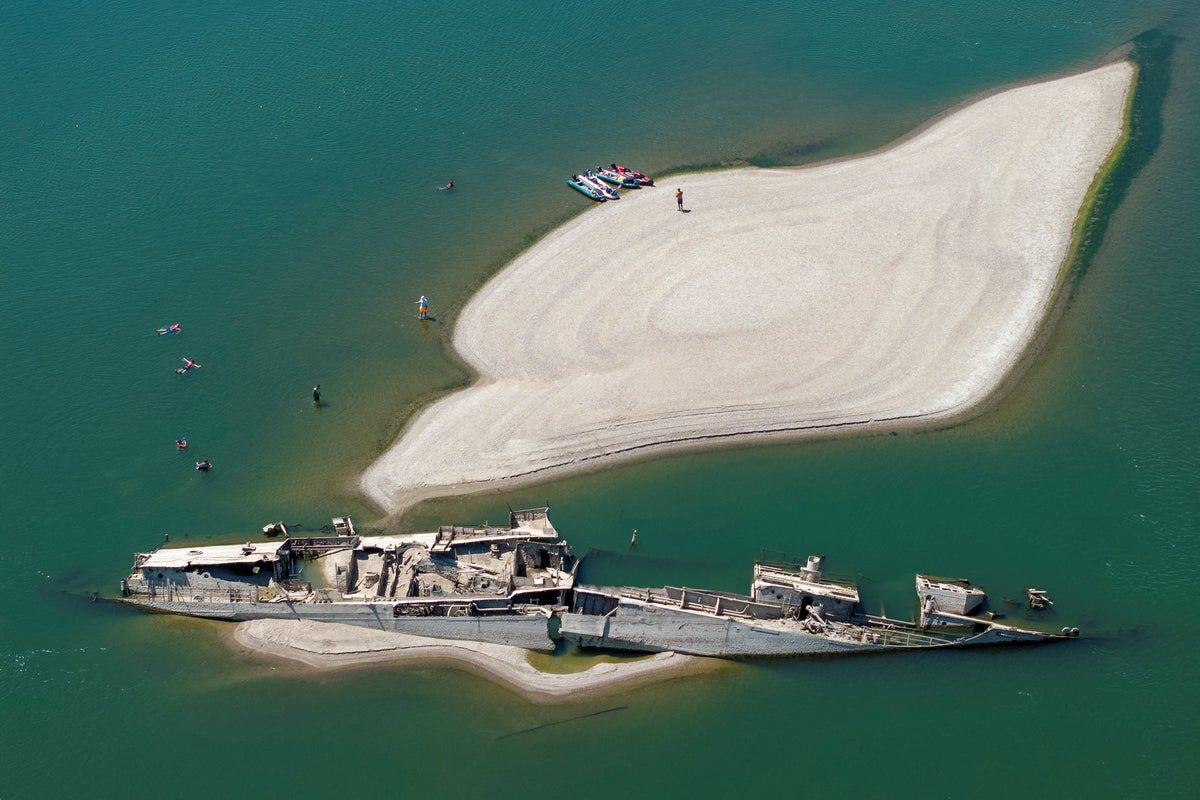
Climate anomalies do more than wither crops and crack dry earth. Sometimes, they act as crude historians, stripping away centuries of silt to reveal the iron bones of forgotten conflicts. Along the shrinking shipping lanes of the Danube River, a severe European heatwave has dropped water levels to historic lows, exposing a submerged fleet of Nazi warships laden with explosives. These vessels, scuttled during the waning days of the Second World War, are no longer mere footnotes in dusty military archives. They are rusted, volatile obstructions choking one of Europe’s most vital commercial arteries.
The appearance of these sunken hulks near the Serbian port town of Prahovo brings far more than a momentary thrill for local onlookers and history buffs. It exposes a profound vulnerability in European infrastructure. As climate volatility accelerates, rivers that have served as dependable shipping highways for generations are failing. The Danube is shrinking, and the exposed warships of the Black Sea Fleet are physical proof of an industrial and ecological strain that modern policymakers are ill-prepared to handle.
The Ghost Fleet of 1944
To understand why these armed hulls rest on the riverbed today, one must look back to the autumn of 1944. The Nazi war machine was in total retreat across Eastern Europe. The Soviet Red Army was advancing rapidly, threatening to trap entire German naval detachments in the Black Sea basin. Under the command of Rear Admiral Paul Zahn, a sizeable flotilla of roughly two hundred vessels—including minesweepers, transport ships, and heavily armed escorts—steamed westward up the Danube. Their objective was safe passage back to Germany.
They never made it.
Blocked by advancing Soviet forces near the narrows of the Iron Gate gorge, the German command faced an impossible logistical bottleneck. Rather than surrender the fleet, Zahn ordered his men to scuttle the ships en masse. They blew holes in the hulls, sank the armaments, and watched hundreds of millions of Reichsmarks in military hardware slide beneath the murky waters.
Crucially, these vessels were not stripped of their munitions before sinking. Tons of unexploded ordnance, torpedoes, and heavy-caliber shells went down with them. For nearly eight decades, the ships remained hidden beneath deep water and thick layers of river silt. They were occasionally brushed by deep-draft commercial vessels, but largely ignored—until the unprecedented droughts of recent years radically altered the bathymetry of the river.
When Low Water Halts Global Supply Chains
The unearthing of the Nazi fleet is an extraordinary visual spectacle, but the real crisis lies in the physics of river navigation. The Danube is Europe's second-longest river, coursing through ten countries from the Black Forest to the Black Sea. It forms an essential shipping corridor connecting Western industrial centers with Eastern markets and ports.
When water levels plunge, the math of logistics changes instantly. Barges that normally carry one thousand five hundred tons of cargo must lighten their loads by half or more to avoid scraping the river bottom.
This reduction in payload capacity creates severe bottlenecks. Grain shipments from Ukraine and Romania, vital for global food security, face agonizing delays. Coal shipments destined for power plants struggle to move upstream. Chemical manufacturers along the German and Austrian stretches of the river find their supply lines severed because standard transport vessels cannot navigate the shallow channels.
The economic fallout is direct and measurable. Higher shipping costs translate directly into higher prices for commodities, compounding inflationary pressures across the continent. When a river loses its depth, entire national economies feel the pinch. Yet, for years, regional transportation ministries treated low-water events as anomalous, one-off weather anomalies rather than the structural reality of a shifting climate.
The Peril of Removal
Clearing the Danube of these sunken warships is not as simple as sending in a crane and hauling them ashore. The operation is fraught with acute danger.
Modern engineering teams attempting to clear the Prahovo sector face a deadly puzzle. The decades spent underwater have rendered the explosives inside the sunken hulls highly unstable. Salt, silt, and shifting currents have corroded fuses and detonators. A single miscalculated cut from an underwater torch or an accidental bump from a salvage crane could detonate tons of World War II-era munitions, threatening nearby towns, bridges, and infrastructure.
The Serbian government, with financial backing and technical assistance from the European Union, has launched phased attempts to clear the channel. It is a painstakingly slow process. Divers must map each wreck individually, neutralize or remove exposed ammunition packages, and cut the steel hulls into manageable pieces before lifting them to the surface.
Contractors working on the project frequently discover that the official military charts from 1944 are wildly inaccurate. Shifting sandbars have buried some vessels deeper than initially estimated, while exposing others completely. The river itself is an active participant in the salvage effort, constantly changing the parameters of the worksite with every upstream storm or dry spell.
The Broader European Water Crisis
The wrecks in the Danube are a symptom of a much larger, systemic failure in how Europe manages its hydrological resources. Rivers are treated primarily as commercial canals and municipal dumping grounds, rather than delicate ecological systems under severe climate stress.
Across the continent, historic waterways are suffering. The Rhine, the Po, and the Loire have all experienced severe drops in water levels during successive summers. Nuclear power plants in France have had to curtail operations because the rivers used for cooling water were too warm or too low to sustain safe intake levels.
The reliance on these waterways for freight transport looks increasingly precarious. For decades, river transport was championed as a green alternative to heavy trucking, producing lower carbon emissions per ton-kilometer. However, the assumption of permanent water availability is no longer valid. Governments have been slow to invest in the dredging and infrastructure modifications required to maintain navigable channels under low-flow conditions, preferring reactive crisis management over long-term strategic adaptation.
Historical Ghosts Meet Future Realities
The sunken Nazi warship fleet in the Danube serves as a stark metaphor for the current era. We are living among the physical remains of past conflicts and industrial choices, suddenly thrust into public view by environmental conditions our ancestors never anticipated.
As the climate continues to warm, the riverbeds of Europe will likely yield more secrets. Sunken aircraft, medieval artifacts, and forgotten municipal ruins will emerge from retreating waters and receding glaciers. But these discoveries carry a warning. The past is surfacing, and with it comes the urgent demand to address the fragility of the infrastructure we rely on today.
The rusted iron hulls near Prahovo will eventually be cut apart, neutralized, and hauled away. But the shallow channels they leave behind will remain, a persistent reminder that the old ways of moving goods and managing water are running dry.