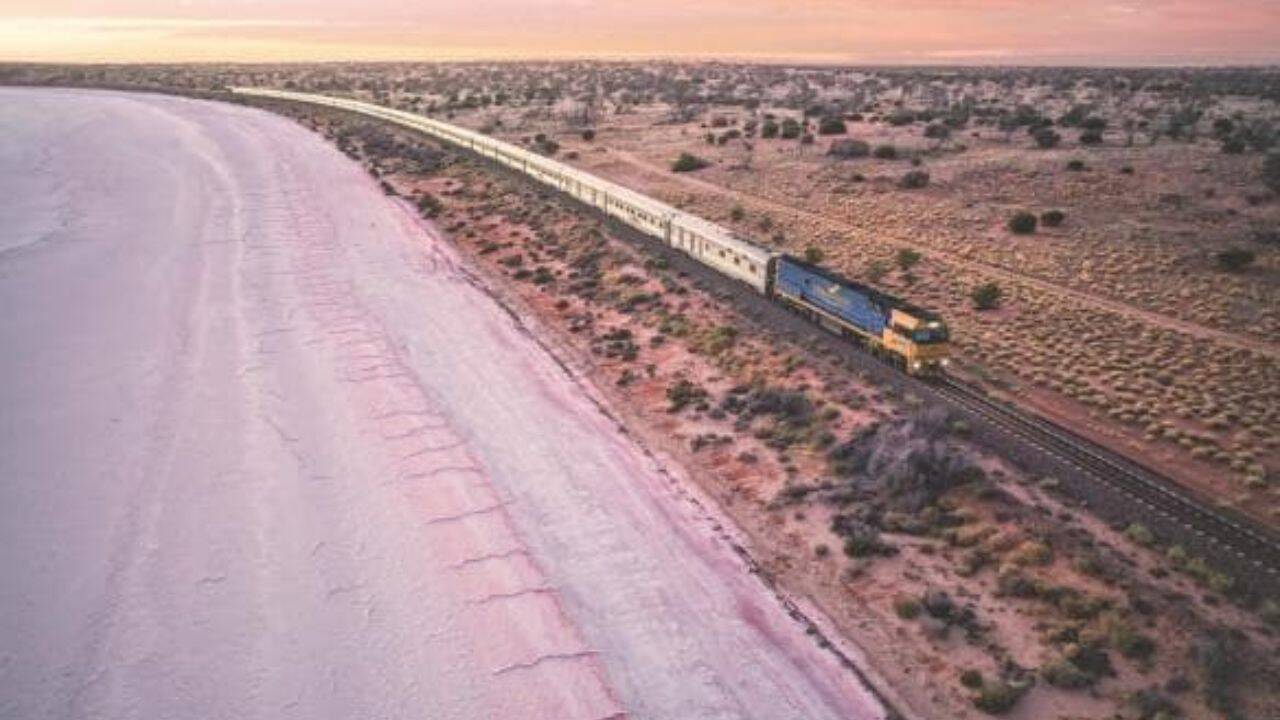
You stand on the edge of a shoreline that looks less like Earth and more like a fever dream. The water stretching to the horizon isn't blue. It is a violent, shocking shade of strawberry milk. You rub your eyes, convinced the mid-afternoon glare is playing tricks on your retinas. It isn't. The air smells thick, heavy with the sharp tang of salt and something else—something ancient, biological, and faintly metallic.
For decades, travelers have flown across the globe, descending upon the vast Australian wilderness to glimpse these anomalies. They snap photos, post them online, and move on. But looking at these surreal waters forces a stranger realization. You are standing before an environmental magic trick, a biological battlefield where survival looks like a masterpiece.
We often view nature through a predictable lens. Water is blue. Grass is green. The sky is vast and empty. When a landscape breaks those rules so aggressively, it triggers a primal sort of cognitive dissonance. It forces us to ask what else we are misinterpreting about the natural world.
The Secret Chemistry of the Extreme
Consider a hypothetical traveler named Elena. She spent three months saving for a trek into the heart of Western Australia, driven by a single image she saw in a magazine: Hutt Lagoon. When she finally stood on its banks, the reality was jarring. The water wasn't just pink; it changed by the hour. Under a heavy morning cloud, it loomed a dark, bruised plum. By noon, it screamed a brilliant, neon fuchsia.
The standard explanation you find in brochures is simple enough to understand: it is just algae. But that explanation is lazy. It robs the phenomenon of its true brilliance.
To understand why a body of water turns the color of a neon sign, you have to look at the invisible stakes of microscopic survival. The primary architect behind this transformation is a microalgae called Dunaliella salina.
Imagine living in an environment so hostile that almost every living creature would shrivel and die within minutes. The salt concentration in these lakes is often far higher than the ocean. As the blistering Australian sun beats down, evaporation turns the water into a thick, briny soup. To survive the intense ultraviolet radiation and the suffocating salinity, Dunaliella salina produces a massive amount of beta-carotene. This is the same pigment that makes carrots orange and sweet potatoes rich. Here, it acts as a cellular sunscreen.
Millions of these tiny organisms accumulate in every drop of water. They absorb the blue and ultraviolet light, reflecting a vibrant spectrum of reds and pinks back to the human eye. It is not a passive trait. It is a desperate, highly active defense mechanism against incineration.
A Tour Through the Crimson Map
The phenomenon isn't isolated to a single hidden valley. Australia holds a constellation of these strange waters, each with its own distinct personality and internal rhythm.
Hutt Lagoon
Sprawling along the Coral Coast of Western Australia, this is perhaps the most iconic of the group. It is vast, shifting dynamically depending on the season and the time of day. The lake is so reliable in its pigment production that it has been used for commercial harvesting, providing natural coloring for foods and cosmetics. Standing here feels like witnessing a living factory, where the machinery is entirely microscopic.
Lake Hillier
Located on Middle Island off the coast of Esperance, Hillier is the ultimate paradox. Unlike other pink lakes that shift shades as the salt levels fluctuate, Hillier remains stubbornly, permanently pink. Even if you scoop a handful of the water into a clear glass, the fluid retains its distinct rose hue. For years, scientists puzzled over its permanence. Recent genetic testing revealed a complex community of extremophiles, including not just algae but unique bacteria like Salinibacter ruber, working in tandem to lock the color in place.
The Pink Lakes of Murray-Sunset
Tucked away in the northwest corner of Victoria, these lakes present a softer, more melancholic beauty. During the cooler, wetter months, they can look entirely ordinary. But as summer takes hold and the moisture evaporates, the beds crystallize into brilliant sheets of pink and white salt. Walking across them feels like stepping onto the surface of a frozen, colored moon.
Lake MacDonnell
Situated on the Eyre Peninsula in South Australia, MacDonnell offers one of the most visually jarring contrasts on the planet. A single dirt road cuts directly through the water. On one side, the water is a deep, rich blue-green. On the other, it is a striking shade of watermelon pink. The road acts as a barrier, altering the water flow and salinity levels on either side, creating a literal line in the sand between two entirely different ecological realities.
Lake Bumbunga
Less than two hours from Adelaide, Bumbunga is famously mercurial. It can shift from a soft pink to white, and occasionally to a clear blue, depending on the rainfall and the salinity balance. It serves as a stark reminder that these places are not static tourist attractions. They are highly sensitive barometers of the surrounding climate.
Lake Eyre
Kati Thanda-Lake Eyre is a sleeping giant in the desert of South Australia. Most of the time, it is a vast, blinding white salt pan, completely devoid of water. But every few years, floods from the north travel down to fill the basin. When the water level is just right, the dormant cysts of algae wake up, triggering a sudden, explosive bloom that turns the massive inland sea into a shifting expanse of pink and orange.
Quairading Pink Lake
Located in Western Australia, this smaller lake is uniquely bisected by a road, much like MacDonnell. At certain times of the year, one side turns a vivid pink while the other remains standard green. It showcases how even minor human interventions can create distinct micro-climates that amplify nature's eccentricities.
The Fragility of the Visual Miracle
The real problem lies in our assumption that these places will always be there, frozen in time like a postcard. They won't. They are profoundly fragile ecosystems balanced on a razor's edge.
A few years ago, travelers heading to the town of Esperance to see a famously named "Pink Lake" were met with a heartbreaking sight. The water was gray. The pink was completely gone.
What went wrong? The answer is a cautionary tale about human misunderstanding. Decades earlier, engineering projects, road constructions, and salt harvesting altered the natural flow of water into the basin. The delicate balance of salinity was disrupted. The water became too fresh, flushing out the salt levels that the specialized algae required to trigger their protective coloration. The organism didn't die out completely, but it no longer needed to fight for its life by producing beta-carotene. The sunscreen was turned off. The magic vanished.
It is a sobering realization for anyone standing on the shores of Hutt Lagoon or Lake Hillier. We tend to view these landscapes as robust, eternal fixtures of the earth. In reality, they are transient. They exist because a highly specific set of variables—rainfall, heat, wind, and mineral runoff—happen to intersect perfectly at this precise moment in geological history.
The Human Need for the Unnatural
Why do we travel thousands of miles just to look at colored water?
Perhaps it is because we live in a world that feels increasingly paved, quantified, and explained. We have mapped the globe, analyzed the deep oceans, and cataloged millions of species. Yet, standing before a pink lake offers a rare jolt of genuine wonder. It looks wrong. It looks like someone poured thousands of gallons of paint into the wilderness as a prank.
That visual shock breaks us out of our routine. It reminds us that nature does not care about our design aesthetics or our expectations of what a landscape should look like. The pink lakes of Australia are beautiful, yes, but their beauty is accidental. It is the byproduct of an intense, silent struggle for survival occurring at a scale we cannot see without a microscope.
The late afternoon sun begins to dip below the horizon at Hutt Lagoon. The fuchsia water deepens into a rich, dark magenta, reflecting the first stars appearing in the southern sky. The wind picks up, sending small, pink-tinged waves lapping against a crust of pure white salt crystals. You realize you aren't just looking at a beautiful view. You are looking at life finding a way to thrive in the dark, turning hardship into color.