A 42-year-old business owner died while pinned face down on an asphalt road in Bologna during a summer heatwave. Abderrahim Fakir, a Moroccan-born entrepreneur who ran a local removals firm and had lived in Italy since childhood, lost consciousness as two officers restrained him following reports of a mental health breakdown. The incident triggered two consecutive nights of violent unrest in northern Italy, leaving eleven people injured as riot squads deployed tear gas and water cannons against demonstrators throwing fireworks and bottles. The death has set off a fierce political conflict over law enforcement tactics and minority safety across the country.
The clash in the Pilastro neighborhood occurred when temperatures soared past 35 degrees Celsius. Police responded to emergency calls regarding a man displaying erratic behavior and damaging a parked vehicle. Eyewitness video captured by residents from nearby apartment windows shows officers using pepper spray before forcing Fakir face down onto the pavement.
For several minutes, Fakir called out in Italian, shouting "help, help, that is enough" while officers applied pressure to his torso. The recording reveals that even after he stopped moving, officers proceeded to bind his ankles together before checking his pulse alongside paramedics who had been standing nearby.
Local prosecutors opened an inquiry using a newly introduced legal procedure known as Model 45 bis. This mechanism, created under recent security legislation, allows authorities to conduct preliminary investigations involving officers without immediately placing them under formal criminal suspect status.
High Heat and Systemic Failure in Pilastro
Restraint tactics applied during acute psychiatric episodes carry notorious medical risks. Medical experts have long warned about positional asphyxia, a condition where a person's posture prevents adequate breathing, particularly when prone restraint is combined with physical exertion, high temperature, and preexisting respiratory conditions such as asthma.
The sequence of events in Bologna exposes critical gaps in how municipal authorities handle behavioral health crises. When patrol officers arrive at a scene involving severe agitation, standard physical containment tactics often escalate panic rather than de-escalate danger.
In the Pilastro incident, medical personnel were present on site during the struggle. Yet, video evidence shows emergency crews remained at a distance while physical force was applied, intervening only after the suspect had gone silent and his extremities were secured.
A Nation Divided Along Political Lines
The political reaction was immediate and aggressive. Government officials aligned with the ruling right-wing coalition moved quickly to defend the actions of the officers.
Deputy Prime Minister Matteo Salvini praised the conduct of the force, asserting that officers were performing their duties to protect residents from erratic behavior. Government ministers condemned anti-police chants heard during the street rallies, characterizing public hostility toward law enforcement as disgraceful and unwarranted.
Opposition leaders took a starkly different stance. Senator Ilaria Cucchi, whose brother died in police custody in 2009, publicly condemned the government response, arguing that aggressive security policies have normalized excessive force against vulnerable individuals. Other center-left legislators warned against adopting heavy-handed enforcement tactics that mimic military-style policing.
Unrest in the Streets and Calls for Accountability
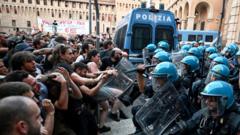
What began as a peaceful vigil rapidly turned into violent street confrontations in central Bologna. Demonstrators marched toward the local prefecture and police headquarters, kneeling in squares with raised fists to signal protest against systemic mistreatment.
As the night progressed, splinter groups threw firecrackers and projectiles at public buildings. Riot police responded with water cannons and tear gas, scattering crowds through the historic center and leaving charred vehicles along the avenues.
The victim's family publicly urged calm while demanding answers. Relatives clarified that violent rioting served only to obscure the demand for legal truth regarding how an arrest for a behavioral disruption ended in a loss of life.
The inquiry now hinges on body-worn camera recordings and autopsy results to establish whether asphyxiation or medical distress caused the death. The outcome will test the legal boundaries of Italy's new security framework and decide whether frontline officers faced justifiable peril or exceeded lawful force.