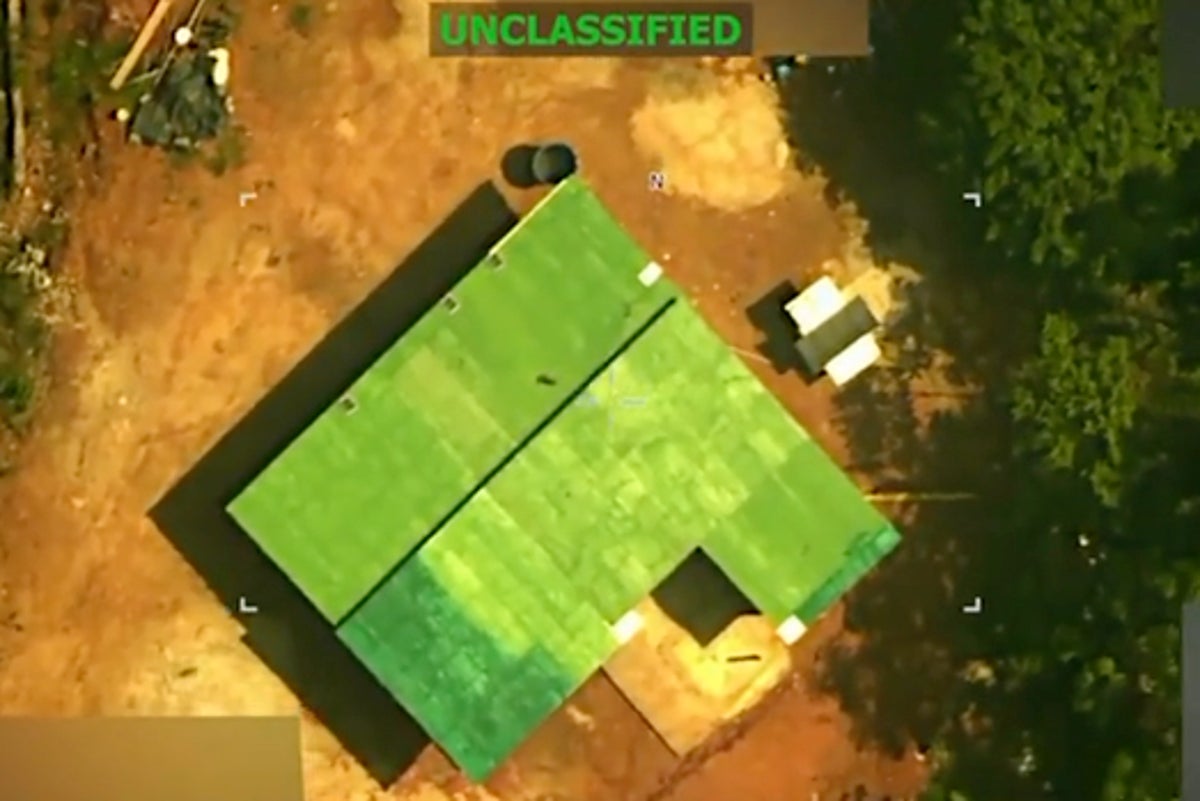
The footage released on Friday by the White House is clinical. A grainy, high-altitude perspective captures a small compound in Venezuela suddenly erased by a precision strike. By the time the dust settled, President Donald Trump had already claimed the life of Hector Rusthenford Guerrero Flores, the man known as Niño Guerrero. The leader of the Tren de Aragua syndicate was officially struck down in what the administration describes as a swift, kinetic operation. The timing—sandwiched between the opening ceremonies of the World Cup and the routine hum of a summer weekend—is no accident. It is a signal of a shift in how Washington projects power.
For decades, the United States maintained a distinct distance between domestic law enforcement and foreign military intervention. That line has not merely blurred; it has been discarded. The neutralization of Guerrero Flores in the state of Bolívar represents the logical conclusion of an administration strategy that redefined transnational criminal syndicates as foreign terrorist organizations. When a gang is treated as an army, the state eventually responds with the tactics of a war cabinet.
Observers focused on the immediate optics of the strike miss the underlying mechanical shift. This was not a standard police extradition or a clandestine rendition. By employing U.S. Southern Command to conduct a kinetic strike on foreign soil, the White House has codified a doctrine where American security interests in the Western Hemisphere are managed through force, regardless of the target’s traditional categorization as a street criminal. This is statecraft stripped of diplomacy, favoring the blunt instrument of the airstrike over the slow grinding of international treaties.
The involvement of the current Venezuelan government is the most uncomfortable variable in this equation. Only months ago, the collapse of the previous regime in Caracas left a vacuum that Washington moved quickly to fill, effectively resetting the regional hierarchy. The coordination cited by the Pentagon implies a new, fragile arrangement: the Venezuelan state providing the intelligence or the physical access, and the United States providing the payload. It is a pragmatic, cold-blooded cooperation that would have been unthinkable during the prior decade of ideological posturing.
Critics point to the inconsistency of these assertions. An intelligence assessment from the National Intelligence Council last year explicitly contradicted the claim that Tren de Aragua operated under the total direction of the state, yet the narrative of the gang as a unified, state-sponsored insurgency remains the bedrock of current policy. This narrative serves a dual purpose. It justifies the domestic crackdown on immigration by framing it as a front in an external war, and it provides a legal framework for military action abroad. If you define your problem as an invasion, every solution becomes a matter of national defense.
The reality on the ground in the Andean corridor suggests the reach of Tren de Aragua was always more fluid and fragmented than the "terrorist army" label implies. They are a network of convenience, thriving on corruption, human smuggling, and extortion. By decapitating the leadership, Washington hopes to shatter the organization. History, however, offers a warning. Decentralized criminal networks often function like hydras. Removing a figurehead like Guerrero Flores rarely dissolves the infrastructure of trade in drugs and people; it often triggers a brutal, chaotic scramble for control among mid-level commanders, frequently leading to a spike in localized violence.
This is the hidden cost of the current strategy. While the Pentagon reports success, the vacuum left by a leader like Niño Guerrero is almost never empty for long. The pressure applied by the United States forces these groups to become more covert, more paranoid, and arguably more dangerous to the populations they exploit. We are seeing a move toward a high-intensity, low-visibility shadow war that avoids the scrutiny of public debate but ensures that the cycle of violence remains tethered to American military output.
The administration is not seeking a sustainable social solution to the conditions that allow organizations like Tren de Aragua to flourish. Instead, they are doubling down on the premise that lethal force can alter the trajectory of human migration and criminal enterprise. Whether this approach delivers security or simply creates a new class of martyrs and more resilient, decentralized threats is the central question of the next two years.
By prioritizing the optics of a strike over the long-term stabilization of the region, the White House has effectively committed to a path of perpetual escalation. The video released from the Oval Office is not just a tactical victory; it is a declaration of a long-term posture where every corner of the hemisphere is a potential theater of operations. We are no longer policing the border. We are hunting across it. The hunt itself is now the policy.