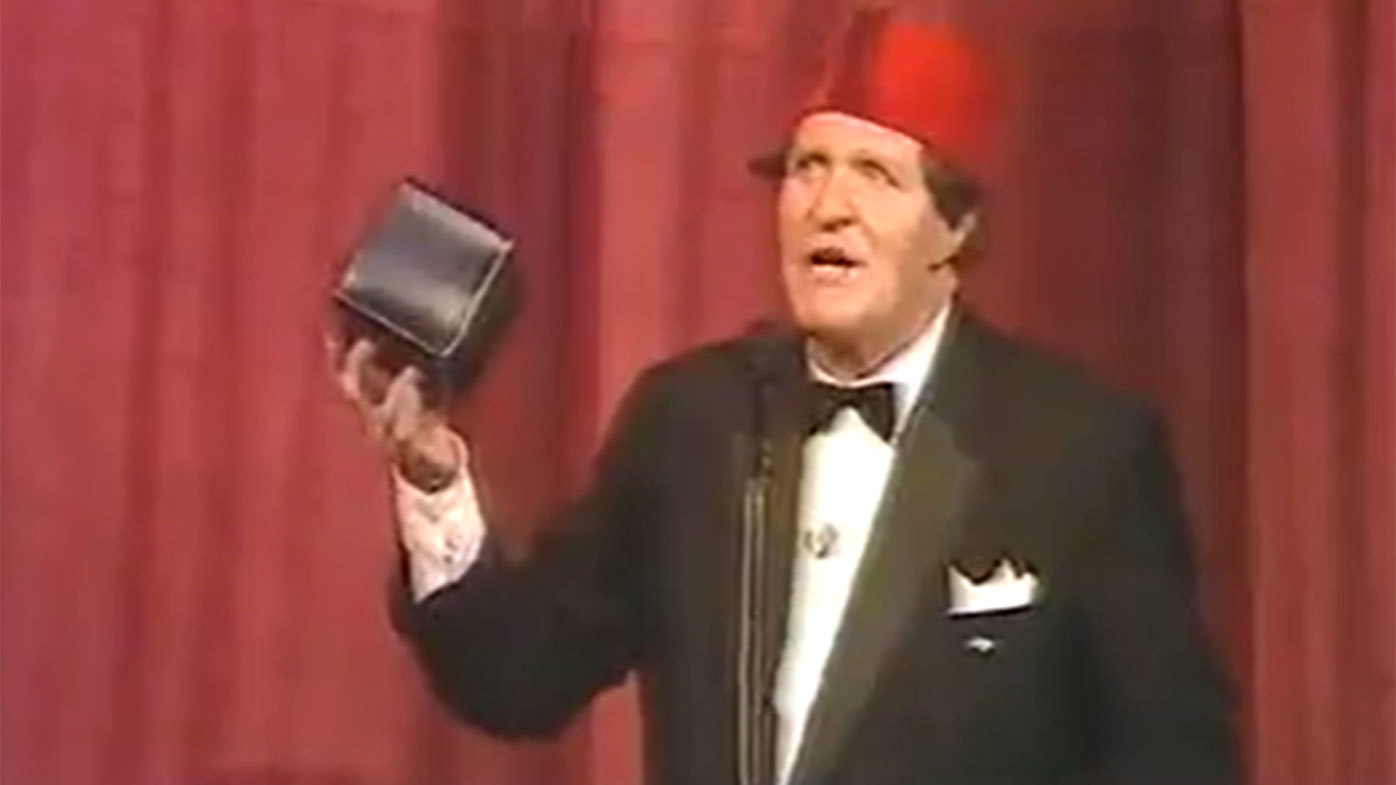
The prevailing narrative surrounding Tommy Cooper’s 1984 collapse on live television is one of tragedy wrapped in a "horrific" misunderstanding. The standard take goes like this: a beloved comedian dies in front of millions, and the audience, blinded by the expectations of the medium, laughs at his final moments because they thought it was a bit. Every retrospective on this event treats the crowd’s reaction as a failure of human empathy—a glitch in the matrix of social intelligence.
They’re wrong. If you enjoyed this article, you might want to read: this related article.
The audience didn't fail. They were reacting to a masterclass in branding that was so effective it transcended the biological reality of death. To suggest the audience "should have known" is to fundamentally misunderstand the contract between a professional entertainer and their public. Tommy Cooper spent decades training his audience to expect the unexpected, the clumsy, and the chaotic. When he fell, he wasn't a man dying; he was a character reaching his logical conclusion.
The Tyranny of the Persona
Tommy Cooper was not a man who performed magic; he was a man who performed bad magic. His entire professional identity was built on the foundation of simulated failure. In the world of show business, this is the most difficult niche to maintain. If you are a flawless technician, the audience waits for the trick to work. If you are Tommy Cooper, the audience waits for the trick to break. For another angle on this development, see the latest coverage from The Hollywood Reporter.
On April 15, 1984, during Live from Her Majesty's, Cooper suffered a massive heart attack behind a gold curtain while an assistant looked on. He slumped down. His breathing became labored. And the audience roared.
The lazy consensus calls this a "tragedy of errors." I call it the ultimate validation of a performer’s craft. Cooper had so thoroughly convinced the world of his incompetence that even his own heart failing looked like a punchline. Most performers spend their entire lives trying to get an audience to believe their act is real. Cooper succeeded so well that even reality was mistaken for an act.
Why We Demand a Clean Exit
Society has a pathological need to sanitize death, especially the deaths of public figures. We want them to pass away in quiet rooms, surrounded by family, or perhaps in a sudden, unambiguous accident. When the line between entertainment and expiration blurs, it makes us uncomfortable because it suggests that our "idols" are actually just meat and bone, subject to the same mechanics as a faulty prop.
The "People Also Ask" sections of the internet often fixate on: "Why didn't anyone help Tommy Cooper sooner?"
The answer is brutal: Because he was too good at his job.
In a high-stakes live broadcast, the pacing is a machine. If a performer drops to the floor, the stage manager isn't looking for a pulse; they are looking for the cue. I have worked in live production environments where a literal fire was ignored because it looked like "part of the lighting rig." We are conditioned to believe that everything within the frame of a screen or the proscenium arch is intentional.
To blame the audience for laughing is to ignore the psychological phenomenon of Inattentional Blindness. We see what we expect to see. If you go to a horror movie and someone screams in the back row, you don't call the police; you assume they’re a "good" audience member. The crowd at Her Majesty's Theatre was being "good." They were paying Cooper the highest compliment an entertainer can receive: total suspension of disbelief.
The Comedian’s Debt to the Absurd
We need to stop pretending that there is a "correct" way to die. For a man like Cooper, whose life was dedicated to the subversion of dignity, dying in the middle of a joke—even one he didn't intend to tell—is a poetic synchronicity that we should stop mourning.
Compare this to the modern "celebrity death" cycle. We get a PR-sanctioned statement on social media, a black-and-white photo, and a week of curated grieving. It’s sterile. It’s boring. Cooper’s exit was visceral. It was a collision of the mundane (a biological failure) and the extraordinary (theatrical spectacle).
The logic used by critics who find the laughter "ghastly" is the same logic that stifles true art. They want boundaries. They want a clear sign that says "Laughter Stops Here." But comedy doesn't work that way. The best comedy lives in the "uncanny valley" between safety and danger.
The Myth of the "Silent" Audience
There is a persistent idea that if the audience had been more "aware," they could have saved him. This is a fantasy. A massive myocardial infarction on a live stage doesn't wait for a standing ovation or a medical intervention. The outcome was fixed the moment his arteries failed.
By insisting that the laughter was a mistake, we strip the moment of its raw, accidental power. We turn a unique historical event into a cautionary tale about "audience cruelty." But there was no cruelty. There was only a crowd of people being transported away from their daily lives by a man in a fez who had spent thirty years making them feel safe in the presence of chaos.
If you want to talk about "Expertise" in this field, look at the reactions of his peers. Many comedians have expressed a dark, professional envy of Cooper’s exit. To die at the height of a laugh? That isn't a tragedy. That’s a miracle. Most of us will die in beige hospital rooms while a TV in the corner plays a soap opera no one is watching. Cooper died while the world was looking at him, laughing with him, and celebrating his existence.
Stop Moralizing the Macabre
The obsession with the "horror" of the audience's reaction says more about our modern fragility than it does about the 1984 crowd. We are now a culture that requires "trigger warnings" and "content labels." We hate the idea that something could happen without our consent or without a clear explanation of how we should feel.
The Tommy Cooper incident was the last time a mass audience experienced something truly unscripted. It was the ultimate "live" moment. The fact that it was a death is incidental to the fact that it was real.
We should stop asking how the audience could be so blind and start asking why we are so desperate to turn every complex human moment into a morality play. The audience wasn't laughing at a man dying. They were laughing at Tommy Cooper. And as far as he was concerned, that was the only reason for him to be on that stage in the first place.
If you’re looking for a lesson, it’s this: The brand you build in life will be the lens through which people view your death. If you spend your life being a clown, don't be surprised when people find your fall funny. In fact, if you’re any good at it, you should count on it.
The laughter wasn't a failure of the audience. It was the final, resounding success of the performer.
Leave the faux-outrage to the people who don't understand the stage.