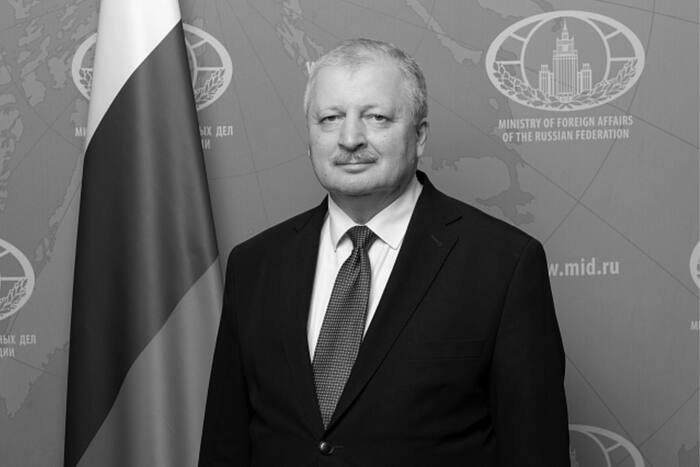
The obituary machines are already humming. Pundits across Washington and London are treating the sudden death of Moscow’s 66-year-old ambassador to the United States like the loss of a structural load-bearing wall in global diplomacy.
They are wrong. Dead wrong.
If you read the standard wire copy coming out of the Russian Foreign Ministry’s announcement, you are fed a comforting, nineteenth-century fairy tale. In that fairy tale, an ambassador is a master strategist, a vital bridge between nuclear superpowers, and a irreplaceable conduit for peace. When one dies at 66, the narrative goes, a dangerous vacuum opens up on Wisconsin Avenue.
Here is the reality nobody in the diplomatic press corps wants to print: the ambassadorship in Washington has been a ceremonial ghost ship for over a decade.
The Myth of the Indispensable Envoy
I spent years watching back-channel negotiations stall out in Geneva and Vienna while embassy staffers in D.C. spent their days hosting sparsely attended receptions and drafting cables nobody in the Kremlin bothered to read. The lazy consensus assumes that physical presence in a foreign capital equals influence. In modern US-Russia relations, the exact opposite is true.
When bilateral trust drops below freezing, an ambassador stops being a negotiator and becomes a glorified mail carrier—and a heavily surveilled one at that.
Look at the actual mechanics of Russian foreign policy under the current Kremlin architecture. Decisions do not flow up from the ambassador’s residence on 16th Street to Smolenskaya Square and then across to the Presidential Administration. They flow strictly downward. The ambassador is given talking points, told when to show up at the State Department to receive a formal demarche, and instructed to read pre-approved grievances to the few American journalists still willing to take the meeting.
To pretend that a sudden passing at age 66 alters the trajectory of nuclear arms control, sanctions regimes, or regional proxy wars is to fundamentally misunderstand how power operates in Moscow today.
What Everyone Gets Wrong About Diplomatic Back-Channels
Whenever a senior Russian diplomat passes away or gets rotated out, the public immediately asks the same predictable questions. Let us dismantle them one by one.
Does this leave a dangerous communication gap between Washington and Moscow?
No. The idea that the White House and the Kremlin rely on a 66-year-old career bureaucrat sitting in Northwest Washington to prevent accidental nuclear escalation is pure Hollywood fiction.
Real crisis management happens through specialized, direct channels that bypass traditional embassies entirely. When Washington and Moscow actually need to talk—whether about prisoner swaps, deconfliction lines in active conflict zones, or strategic stability—the calls happen between the CIA Director and the head of the SVR, or between the Chairman of the Joint Chiefs of Staff and the Chief of the Russian General Staff.
Those channels exist precisely because the public diplomatic track is broken. The embassy in Washington has been crippled by tit-for-tat visa restrictions, property seizures, and diplomatic expulsions since 2016. With skeletal staffing and frozen consular operations, the ambassador was presiding over an administrative shell, not a functioning diplomatic powerhouse.
Will the Kremlin use this moment to appoint a "moderate" bridge-builder?
Stop waiting for a savior in a tailored suit. The Russian Foreign Ministry does not produce rogue peacemakers, and the Kremlin does not reward diplomats who show empathy for their host country.
In the Soviet era, figures like Anatoly Dobrynin survived in Washington for 24 years because the Politburo valued institutional continuity and deep-cover intelligence gathering on American political sentiment. Dobrynin had direct access to Henry Kissinger and the Oval Office. Today, no Russian ambassador gets within five miles of the West Wing unless they are being summoned to get yelled at.
Whoever replaces the late envoy will come from the exact same mold: a hardened bureaucratic survivor from the Ministry’s North America department, trained to recite Moscow’s official line without blinking. Expecting a sudden thaw because a new name goes on the embassy letterhead is like expecting a different movie because you changed the usher at the theater door.
Why did the Foreign Ministry announce it so bluntly?
Because in Russian statecraft, brevity is control. Notice how the announcement stripped away any room for speculation—stating the age, the post, and nothing else. In a system obsessed with projecting absolute stability and institutional permanence, the death of a senior official is treated as a minor logistical hiccup, not a moment for public vulnerability or introspection.
The Structural Reality of Modern Embassy Warfare
To understand why this death is a non-event for geopolitics, you have to look at the cold, hard math of diplomatic attrition between Washington and Moscow over the last ten years.
- The Compound Seizures: Starting in late 2016, the US shut down Russian diplomatic compounds in Maryland and New York. Russia retaliated by slashing the US diplomatic mission in Russia by over 700 personnel.
- The Visa Choke Point: Routine administrative rotations ground to a halt. Diplomats could not get replacements approved, turning embassies into understaffed bunkers focused entirely on basic facility maintenance and security.
- The Social Quarantine: In Washington, being seen at a Russian embassy event became political suicide for anyone in Congress, the think-tank circuit, or the executive branch. An ambassador without access to the host country's elite is functionally blind.
I have seen foreign ministries burn millions of dollars maintaining massive diplomatic footprints in hostile capitals purely out of stubborn pride. Neither side wants to be the first to lower their flag and formally sever relations, because keeping the building open preserves a useful propaganda platform.
That is what the Washington post had become: a stage for domestic Russian television. When the ambassador went on American cable news or issued fiery statements on Telegram, the intended audience was never the American public or the State Department. The audience was sitting in offices in Moscow, watching to make sure their man in Washington was fighting the information war with sufficient aggression.
The Counter-Intuitive Risk Nobody Is Watching
While mainstream analysts fret over a mythical loss of high-level dialogue, they are missing the only real consequence of this sudden vacancy.
The danger is not silence; the danger is internal bureaucratic paralysis.
When an ambassador dies unexpectedly in office, the embassy falls under the temporary command of a chargé d'affaires—usually the Minister-Counselor, the number two diplomat in the building. In a hyper-centralized, risk-averse bureaucracy like the Russian Foreign Ministry, an acting chief has zero incentive to take initiative and every incentive to pass the buck.
Imagine a scenario where a minor consular crisis or an unscripted incident involving Russian nationals occurs in the United States during this interim period. A confirmed ambassador, backed by decades of rank, might at least have the confidence to manage the immediate optics before Moscow weighs in. An acting chargé d'affaires, auditioning to keep their career alive while awaiting a permanent replacement, will freeze. Every minor decision will be kicked back to Moscow for approval, slowing down already glacial response times.
This is the hidden flaw in hyper-centralized diplomacy: when the figurehead disappears, the machine does not adapt; it locks up until a new set of orders arrives from headquarters.
Stop Reading the Obituary and Watch the Replacement Queue
Of course, there is a downside to dismissing the individual completely. Even in a broken system, personality dictates friction. A notoriously abrasive ambassador can turn a routine diplomatic protest into a week-long media circus, while a quieter technocrat keeps the temperature low enough for the intelligence and military channels to do their real work out of the spotlight.
Furthermore, the sudden death of a 66-year-old career diplomat serves as a stark reminder of the brutal physical toll of these postings. High-stress isolation, hostile media environments, and the relentless pressure of representing a pariah state in the capital of its primary adversary will grind anyone down.
If you actually want to understand where US-Russia relations are heading next, stop mourning the loss of a diplomatic bridge that collapsed years ago. Watch two things instead:
- Who gets the nod for the agrément: Watch how long the White House takes to formally accept the credentials of the next nominee. If Washington drags its feet for months, that tells you far more about the state of bilateral relations than any tribute paid to the late ambassador.
- The seniority of the pick: If Moscow sends a heavy-hitter deputy foreign minister, they are signaling a desire to keep the channel at least theoretically open for future negotiations. If they send a mid-level functionary nearing retirement, they are openly admitting the post is just a parking spot until the current geopolitical era ends.
The diplomatic corps will offer their polite condolences. The pundits will write their solemn columns about the end of an era and the loss of an experienced hand at a critical juncture.
Do not buy it. The desk in Washington is empty, the flags are at half-mast, and the trajectory of the most dangerous rivalry on earth has not shifted by a single millimeter.