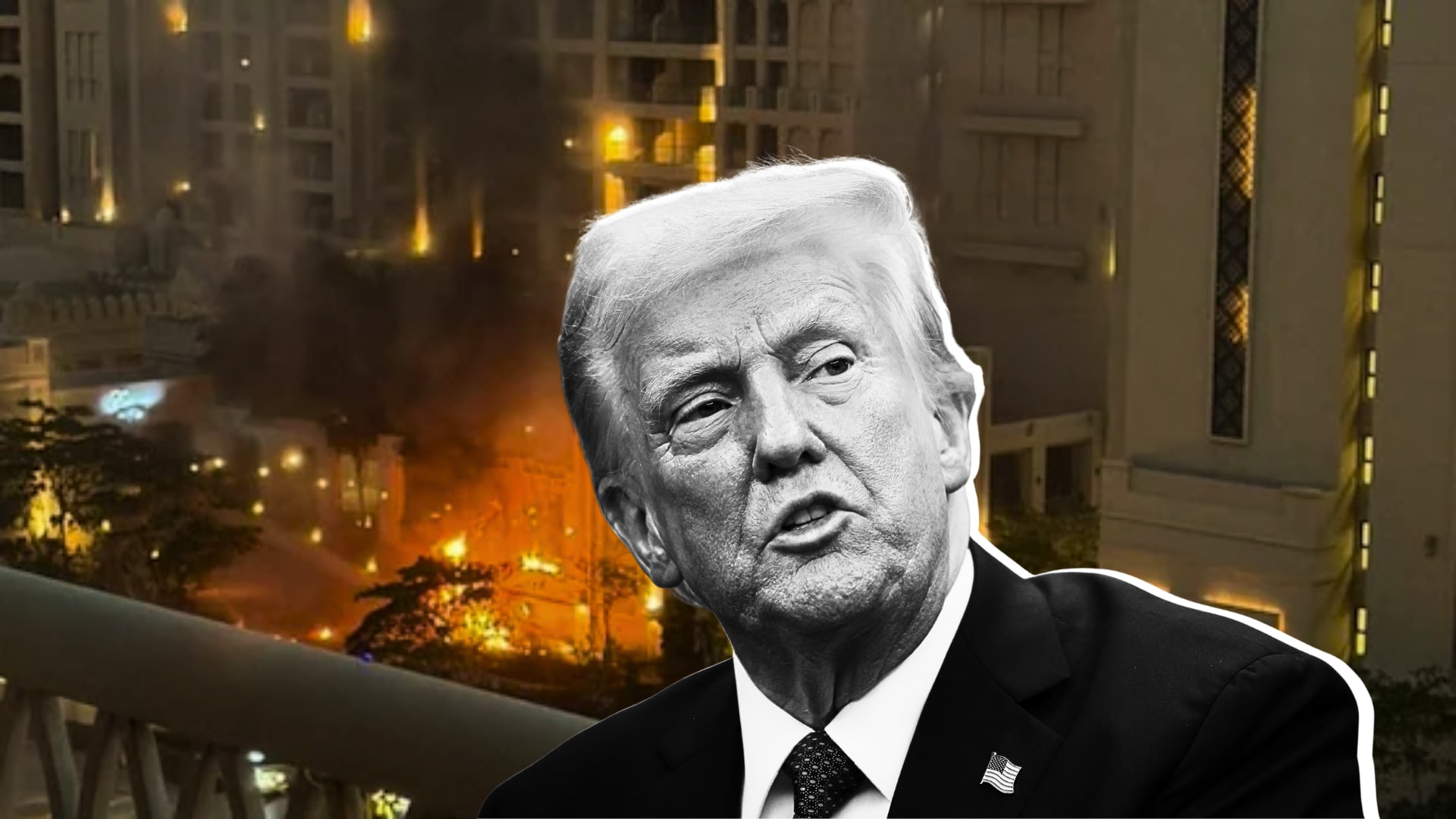
The smoke rising over Tehran this week is not just the byproduct of precision-guided munitions; it is the physical manifestation of a collapsed regional order. For forty-seven years, the Islamic Republic of Iran operated on a doctrine of "strategic patience" and proxy-led attrition. That doctrine died on February 28, 2026. Within ninety-six hours of the initial joint U.S.-Israeli strikes, President Donald Trump declared the Iranian military apparatus and its top-tier leadership "gone." While the administration paints this as a completed objective, the reality on the ground suggests a far more volatile transition from conventional warfare to a chaotic, leaderless vacuum.
The 96 Hour Erasure
The speed of the degradation is without historical precedent in the Middle East. According to military analysts and satellite reconnaissance, the combined weight of Operation Midnight Hammer and subsequent strikes effectively neutralized the three pillars of Iranian sovereignty: the Integrated Air Defense System (IADS), the clerical leadership, and the naval capability to close the Strait of Hormuz.
By March 3, Trump signaled a sharp pivot from his weekend stance. On Sunday, he hinted at a willingness to talk to the "new leadership" emerging from the rubble. By Tuesday, that door was slammed shut. "I said 'Too Late!'" he posted, arguing that the time for leverage had passed because the entity capable of negotiating no longer exists in a coherent form. This isn't just rhetoric. The confirmed death of Supreme Leader Ayatollah Ali Khamenei and at least 48 other high-ranking officials has left a "headless" state.
Total Systems Failure
The technical proficiency of the strikes focused on command-and-control nodes rather than just hardware.
- Air Defense: The S-400 and indigenous Bavar-373 batteries were blinded in the opening minutes, reportedly via a combination of cyber-intrusion and high-altitude electromagnetic pulses.
- The Navy: Small-boat swarms, once the primary threat to global energy transit, were caught in harbor or neutralized by autonomous underwater vehicles before they could deploy.
- The Leadership: The assassination of Khamenei in a hardened bunker complex indicates a level of intelligence penetration that makes future governance by the old guard nearly impossible.
The Consolidation Doctrine
This isn't an isolated flare-up. It is part of what some are calling the "Consolidation Doctrine." Following the January removal of Nicolás Maduro in Venezuela, the Trump administration appears to be systematically checking off legacy national security threats through high-intensity, short-duration interventions. The goal is to clear the board of "forever problems" to focus resources elsewhere.
However, "decapitation" is a high-risk gamble. In Venezuela, the transition to Delcy Rodriguez has largely served U.S. interests, specifically regarding oil flow. Iran is a different beast. Unlike Venezuela, Iran has a deeply embedded ideological bureaucracy and a "forward defense" network of proxies that do not simply vanish because a central figure is killed.
The Ghost in the Machine
While the "military leadership is gone," the Islamic Revolutionary Guard Corps (IRGC) remains an asymmetric threat. Even with their navy at the bottom of the Persian Gulf and their air force grounded, the IRGC’s regional architecture—Hezbollah in Lebanon, the Houthis in Yemen, and various militias in Iraq—retains its teeth.
The administration’s claim of "unlimited mid to upper tier weaponry" suggests they are prepared for a long-haul suppression campaign. But history warns that a decapitated state often bleeds into its neighbors. We are already seeing this. Bahrain has intercepted nearly 100 missiles and drones in the last 72 hours. The "too late for talks" stance assumes that there is no need to negotiate with a corpse, but the corpse of a state as large as Iran can remain a biohazard for the entire region.
The Succession Crisis
Inside Tehran, an interim council led by President Masoud Pezeshkian is attempting to project stability, but the power is purely theoretical. With the Assembly of Experts in disarray, the legal mechanism for picking a new Supreme Leader is broken. Trump’s open musing about "who comes next" and his warnings to the Iranian people to "take over your government" are intended to spark a popular uprising.
Protests had already begun in early 2026 due to a crumbling economy. Now, the people are caught between the joy of a potential new era and the literal falling debris of the old one. The risk is that instead of a pro-Western democracy, the vacuum is filled by the most radical remnants of the security services who have nothing left to lose.
The Energy Exit
The immediate concern for the global economy remains the Strait of Hormuz. Despite Trump’s dismissive tone toward oil price hikes, the reality is that 20% of the world’s petroleum flows past the Iranian coast. While the U.S. has decimated the Iranian Navy, "lone wolf" IRGC elements or remote-controlled mines can still turn the waterway into a graveyard for tankers.
The administration is betting that the sheer speed of the collapse will deter the remaining Iranian forces from suicidal moves against global shipping. It is a bet that relies on the "brutal stuff" in the American arsenal to act as a permanent deterrent. If the gamble fails, the "short version" of this war that Trump promised could easily morph into the "longer version" he mentioned as a secondary possibility.
The Iranian regime spent decades preparing for a war of attrition. They were not prepared for a war of erasure. As the dust settles, the question is no longer whether the Islamic Republic can survive, but what will grow in the crater it left behind. The administration has won the battle of the skies; the battle for the "day after" has only just begun.


