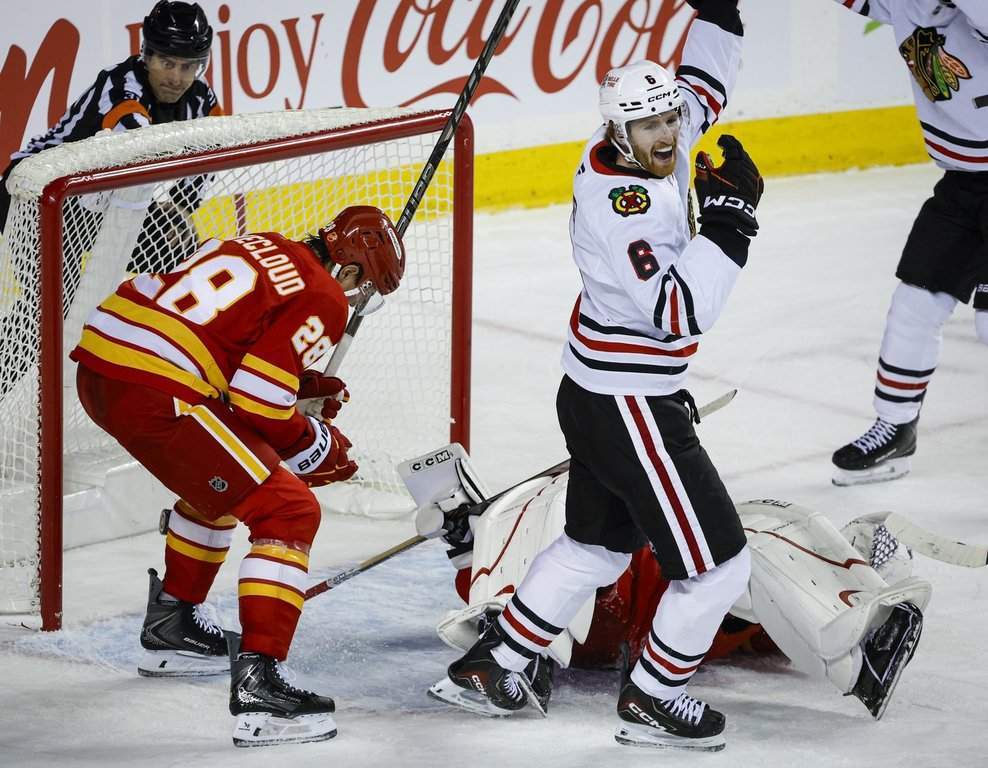
Sam Rinzel’s five-game multi-assist streak in November 2026 did not happen in a vacuum; it is the direct mathematical byproduct of an injury-forced usage spike, a tactical power-play realignment, and a steep reduction in cognitive processing latency. When the 22-year-old Chicago Blackhawks defenseman recorded two assists and the overtime winner in a 4-3 road victory against the Calgary Flames on November 21, 2026, he became the first blueliner in franchise history—and only the fourth in NHL history alongside Bobby Orr, Borje Salming, and Mark Howe—to post multiple assists in five consecutive games. Standard sports coverage attributes this run to intangible confidence and "swagger." An operational audit reveals a far more concrete reality: Rinzel’s production is the result of structural vacancy on Chicago’s top defensive pair colliding with elite physical tools and high-percentage distribution lanes.
The Anatomy of the Streak and Historical Context
To evaluate whether Rinzel’s five-game run signals a permanent baseline shift or an unsustainable heater, we must separate the historical rarity of the box-score output from the underlying rate metrics. Over the five-game span ending in Calgary, Rinzel accumulated 11 assists and 12 total points, pushing his season totals to 2 goals and 15 assists across Chicago’s first 23 games (7-14-2). That output immediately eclipsed his previous single-season NHL career high of 14 points.
Within the Chicago Blackhawks’ century-long franchise ledger, only two other players—both Hall of Fame centers—ever strung together five consecutive multi-assist performances:
- Stan Mikita (1968–69): Five consecutive games during the peak of his Art Ross-caliber playmaking era.
- Denis Savard (1984–85 and 1987–88): Accomplished the feat twice, logging five straight games in 1984–85 and six straight in 1987–88.
- Sam Rinzel (2026–27): Five consecutive games, standing alone as the sole defenseman in Chicago history to reach the threshold.
Across the entire National Hockey League, the cohort of defensemen with a five-game multi-assist streak is restricted to three Hall of Famers: Bobby Orr (1970–71), Borje Salming (1984–85), and Mark Howe (1987–88).
The analytical distinction between Rinzel and those historical comparables lies in era-adjusted scoring environments and sample size. Orr, Salming, and Howe achieved their streaks during high-event offensive eras while operating as established, multi-year No. 1 defensemen. Rinzel achieved his in a compressed 10-day window while filling a sudden deployment vacuum. Treating the five-game streak as proof that Rinzel has reached a Hall of Fame talent tier is a classic small-sample fallacy. Treating it as evidence that his ceiling as a primary puck-moving engine was severely undervalued is entirely supported by the mechanics of his play.
The Opportunity Cost Function of Bowen Byram’s Absence
In professional hockey, ice time and zone starts are zero-sum resources. Offensive production for a young defenseman rarely scales linearly; instead, it jumps in step-functions when an injury removes an incumbent ahead of him on the depth chart.
Rinzel’s breakout correlates directly with the prolonged absence of Bowen Byram, Chicago’s high-profile offseason blueline acquisition. By the time the Blackhawks snapped their nine-game season-opening road winless skid (0-8-1) in Calgary, the 25-year-old Byram had missed 16 consecutive games. Under normal roster health, Byram absorbs the lion’s share of offensive-zone faceoffs, top-unit power-play minutes, and late-game trailing situations. His injury forced head coach Jeff Blashill to redistribute high-leverage offensive minutes down the depth chart.
This reallocation created a specific set of compounding advantages for Rinzel:
- Top-Unit Power-Play Quarterbacking: With Byram sidelined, Blashill installed Rinzel at the top of the first power-play umbrella. Chicago’s man-advantage efficiency surged from a dismal 9.8 percent across the first 18 games to 18.4 percent by the end of the Calgary matchup.
- Handedness Geometry: As a right-shot defenseman operating at the center point, Rinzel altered the passing angles for Chicago’s flank shooters. Veteran winger Patrick Kane explicitly noted the tactical value of Rinzel’s right-handedness, which provides a natural one-timer threat from the point while opening crisp forehand-to-forehand cross-seam feeds to the left circle.
- High-Leverage Overtime Deployment: Coaches rarely trust 22-year-old defensemen in three-on-three sudden-death overtime unless forced by necessity or earned through immediate execution. Rinzel’s presence on the ice at the expiration of a power play in the final seconds of overtime in Calgary—where he batted a loose puck past goaltender Dustin Wolf with 15 seconds remaining—demonstrates complete coaching trust in the highest-variance situations.
Had Byram remained healthy through October and November, Rinzel would likely have remained insulated on a second or third pair, logging 16 to 18 minutes a night with secondary power-play duties. The injury eliminated the organizational bottleneck, giving Rinzel an uninterrupted runway to absorb primary puck-distribution responsibilities.
The Three Pillars of Rinzel’s Tactical Execution
High usage only converts into historic box-score output if the player possesses the mechanical tools to survive the elevated pace of play. Rinzel’s surge rests on three interlocking operational pillars: biomechanical leverage, cognitive processing speed, and defensive transition triggers.
1. Biomechanical Reach and Blue-Line Walking
At 6-foot-4, Rinzel possesses a wingspan that fundamentally changes how opposing penalty killers and forecheckers must angle their pressure. Smaller offensive defensemen must rely entirely on edgework and deception to evade the top forward in a diamond or wedge penalty-kill formation. Rinzel combines fluid lateral mobility with a massive stick-and-body radius.
When walking the offensive blue line, he protects the puck outside the reach of lunging sticks while keeping his chest and eyes oriented toward the net front. This creates a structural dilemma for defending wingers: if they step up to challenge his shot lane, Rinzel uses his reach to pull the puck laterally around their triangle and thread a seam pass; if they sag back to protect the slot, he steps into uncontested wrist shots and one-timers that create rebound chaos—precisely how he generated his overtime winner.
2. Reduction of Cognitive Latency
The most revealing data point from Rinzel’s post-game interviews was not a statistic, but his description of his mental state: "It's just getting back to not thinking and just playing." In sports science and motor-learning theory, this describes the transition from explicit, conscious processing (Fitts and Posner’s cognitive/associative stages) to autonomous execution.
Young defensemen entering the NHL typically suffer from processing latency. They receive a rimmed puck under forecheck pressure, spend an extra half-second scanning for a safe outlet, and allow the opposing F1 forechecker to close the gap. That half-second delay turns clean exits into contested wall battles or turnovers. Over this five-game stretch, Rinzel’s decision-making accelerated. By pre-scanning the ice before puck retrieval, he eliminated the hesitation between reception and distribution. This speed allowed him to hit forwards like Kane, Ryan Donato, and rookie goal-scoring leader Roman Kantserov in stride through the neutral zone, generating secondary and primary assists on rush entries rather than static cycle plays.
3. Defensive Stops as Offensive Catalysts
Elite offensive defensemen do not generate points solely in the attacking zone; they generate them by killing opposing cycles early. Rinzel’s offensive streak has been anchored by steady defensive play, a fact emphasized by Blashill when noting that points fluctuate while Rinzel’s underlying structure remained consistent.
In the final minute of regulation against Calgary, with the score tied 3-3, Flames forward Matt Coronato attempted a wraparound that would have sealed a regulation loss for Chicago. Rinzel’s stick check disrupted the attempt at the post, preserving the tie and forcing overtime. That single defensive intervention directly created the overtime environment in which he scored the game-winner. In modern NHL transition systems, defensive stick-on-puck disruption is the primary trigger for counter-attacking offense.
Downstream Synergies Across the Chicago Roster
A primary puck-moving defenseman acts as an offensive multiplier for the forward group. Rinzel’s emergence did not just inflate his own totals; it unlocked stagnant scoring lines across Chicago’s roster, most notably reviving Patrick Kane’s production.
Entering the November 21 game in Calgary, Kane was mired in a career-long 18-game goal drought, having scored his only goal of the season on opening night. A playmaking winger like Kane relies heavily on the timing and accuracy of passes from the point to attack the net before goaltenders can set their depth. On Chicago’s second-period power play, Rinzel drew the penalty killers toward the center point before delivering a crisp feed to Kane, who one-timed the shot over Wolf’s shoulder. That sequence snapped Kane’s drought, propelled him past Doug Gilmour into 22nd place on the NHL’s all-time scoring list (1,415 points), and moved him past Joe Mullen into fourth place among U.S.-born players in combined regular-season and playoff goals.
The ripple effect extended to Chicago’s younger forward core:
- Roman Kantserov: The rookie forward netted his 10th goal in his 23rd career game—tying Jonathan Toews and Alex DeBrincat as the seventh-fastest Blackhawk to reach double digits—benefiting from faster puck movement out of the defensive zone.
- Frank Nazar: Extended his own point streak to five games by picking up a secondary assist on the Rinzel-to-Kane power-play conversion.
- Ryan Donato: Capitalized on a delayed-penalty 6-on-5 sequence initiated by Rinzel’s puck distribution to record his fourth goal of the season.
When a defenseman reliably breaks the first layer of defensive pressure, forwards spend less energy defending and more time attacking out-of-structure defenses.
Regression Risks and Structural Limitations
Analytical rigor requires identifying the exact mechanisms that will cause this streak to end. Blashill’s warning that Rinzel is "not going to keep this pace up" is a mathematical certainty. Maintaining a 2.4 points-per-game pace over an 82-game schedule would yield nearly 200 points—a physical impossibility in the modern NHL. Three specific regression vectors will pull Rinzel’s numbers back toward earth over the next 20 games:
1. On-Ice Shooting Percentage (oiSH%) Inflation
During a five-game, 11-assist heater, a defenseman’s secondary assists are heavily dependent on teammates finishing low-percentage shots. While Rinzel’s passing quality has been high, Chicago’s shooting percentage with him on the ice during this stretch is operating well above sustainable league averages (typically 8.5 to 10 percent at five-on-five). As goaltenders regress to standard save percentages against Chicago’s shooters, Rinzel’s secondary assists will dry up even if his pass-completion rate remains identical.
2. Opponent Pre-Scout Adjustments
Through his first 18 games, Rinzel was treated by opposing coaching staffs as a developing young defenseman rather than a primary focal point. Following a five-game multi-assist run, pre-scout reports across the Western Conference have changed. Opposing penalty kills will begin shading their top forward aggressively toward Rinzel’s strong side to take away his one-timer and force him to make backhand plays under pressure. At five-on-five, opposing coaches will hard-match their top forechecking lines against his pair to test his ability to absorb heavy physical contact over an 82-game grind.
3. The Bowen Byram Re-Integration Bottleneck
Byram has resumed skating and is nearing a return to the active lineup. When a team invests significant offseason capital in a 25-year-old top-four defenseman, coaching staffs inevitably feel organizational pressure to restore his minutes. Byram’s return will force a tactical decision: either split the two offensive defensemen across two power-play units—diluting Rinzel’s access to Patrick Kane and Chicago’s top finishers—or run a two-defenseman umbrella that alters the spatial geometry that made the unit successful in Calgary.
Strategic Deployment Protocol for Chicago’s Coaching Staff
The Blackhawks’ coaching staff faces a critical inflection point as their roster stabilizes and Byram nears clearance. Mismanaging the transition from an emergency injury fill-in to a healthy depth chart risks stalling the development of a foundational right-shot defenseman.
Chicago’s management and coaching staff must execute three concrete operational moves immediately:
- Lock Rinzel onto Power Play Unit 1 Permanently: Do not bump Rinzel back to the second unit when Byram returns. Right-shot defensemen with 6-foot-4 frames, lateral blue-line mobility, and proven chemistry with Kane are rare assets. Deploy Byram to drive transition and quarterback the second unit rather than disrupting a top unit that just doubled its conversion rate.
- Insulate Five-on-Five Zone Starts Against Heavy Forechecks: As opponents deploy top checking lines against Rinzel, pair him with a defensively responsible, stay-at-home left-shot partner capable of absorbing initial forecheck contact. Keep Rinzel’s offensive-zone start percentage above 55 percent to maximize his transition value while protecting him from late-game defensive-zone faceoff traps.
- Establish a Shot-Volume Floor: Kane explicitly highlighted the need for Rinzel to shoot frequently to keep penalty killers honest. Coaching staff should track Rinzel’s individual shot attempts per 60 minutes (iCF/60) rather than his assist totals. As long as he generates at least five to six shot attempts per game from the point, his passing lanes will remain open regardless of whether pucks bounce in for secondary assists.


