The coffee in the porcelain cup didn't spill. It shivered.
For a fisherman in Minamisanriku, the first sign isn't a roar or a dark line on the horizon. It is a subtle, nauseating shift in the physics of the floorboards. The earth under Japan is not a solid foundation; it is a restless, living thing, and when it adjusts its posture, the ocean pays the debt. Most people think of a tsunami as a giant version of a surfing wave—a curling crest of foam that breaks over the sand. That is a dangerous lie.
A tsunami is not a wave. It is the entire ocean suddenly deciding to stand up and walk inland.
The Engine Beneath the Floor
To understand why the water rises, you have to look down, past the seafloor, into the crushing darkness of the Japan Trench. We live on a planet of sliding plates. In this specific corner of the Pacific, the oceanic crust is forced beneath the lighter continental crust in a process called subduction. It is a slow-motion car crash that has lasted for millions of years.
Imagine a wooden ruler. Hold it at both ends and begin to bend it. You can feel the tension vibrating in your fingers. The wood resists, storing energy, bowing under the pressure. This is the state of the tectonic plates for decades. They are stuck, locked by friction, even as the mantle pushes them relentlessly forward.
Eventually, the wood snaps.
When the friction can no longer hold the tension, the "ruler" flicks back to its original shape. This is the megathrust earthquake. In a heartbeat, thousands of square miles of the seafloor can jump upward by thirty or forty feet. This displacement doesn't just vibrate the water; it shoves the entire water column—from the dark, freezing muck of the bottom to the sunlit surface—straight into the air.
That vertical shove creates a ripple. Out in the deep ocean, you wouldn't even notice it. A ship passing over a nascent tsunami might feel a gentle rise of a few inches over several minutes. But that ripple is moving at the speed of a Boeing 747. It carries the weight of a mountain range.
The Physics of the Shoreline
As this invisible energy approaches the coast, it encounters the sloping shelf of the land. This is where the physics turn lethal. In the open sea, the energy has plenty of room to spread out vertically. But as the water gets shallower, that energy has nowhere to go but up.
The wave slows down from 500 miles per hour to perhaps thirty or forty. But as it slows, it bunches up. The back of the wave catches up to the front. The wall of water begins to grow. This is "shoaling." It is the moment the threat becomes visible.
There is a chilling precursor known as "drawback." If the trough of the wave reaches the shore before the crest, the sea appears to vanish. The tide goes out further than anyone has ever seen, exposing reefs, flopping fish, and ancient shipwrecks. To the uninformed, it looks like a miracle or a curiosity. To the coastal resident, it is the sound of a cosmic trigger being pulled. The ocean is drawing back its fist to strike.
Not Just Earthquakes: The Wildcards
While the shifting of plates is the most common culprit, it isn't the only way to move the sea. Gravity is a patient killer.
Consider a massive undersea landslide. Picture a canyon wall in the deep ocean, piled high with unstable sediment. A minor tremor, or even just the weight of time, causes that wall to collapse. As millions of tons of rock and mud plummet into the depths, they displace the water around them. In 1958, a landslide in Lituya Bay, Alaska, triggered a wave that reached an unbelievable height of 1,720 feet. It stripped the trees off the mountainside like a giant scythe.
Then there are the volcanic eruptions. When an island volcano like Hunga Tonga-Hunga Ha'apai exploded in 2022, it didn't just send ash into the stratosphere. The sheer force of the explosion and the collapse of the volcanic caldera into the sea sent shockwaves through the water that were felt across the entire Pacific basin.
The mechanism remains the same: a massive, sudden displacement of volume. Whether it’s a sliding plate, a falling mountain, or a bursting volcano, the water is simply responding to a void that must be filled or a force that must be moved.
The Human Clock
When the alert sirens begin to wail in a Japanese coastal town, they aren't just making noise. They are announcing the start of a race against fluid dynamics.
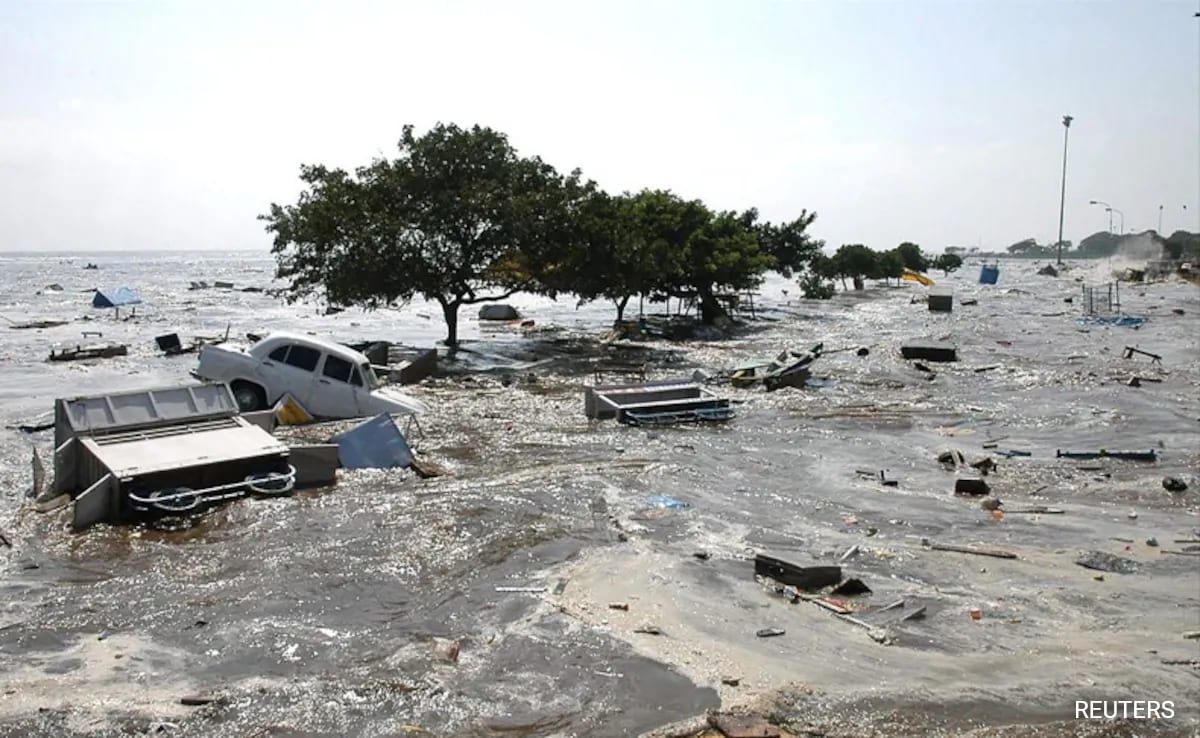
The challenge of the tsunami is its persistence. A storm surge from a hurricane hits and eventually recedes. A tsunami is a series of waves, often called a "wave train." The first wave is rarely the largest. People often make the fatal mistake of returning to the "flats" after the first surge retreats, thinking the danger has passed. But the second or third wave may be twice the size, arriving thirty minutes later, carrying the debris of the first—shattered houses, cars, and toxic sludge—turning the water into a grinding slurry of destruction.
We have built sophisticated systems to track this. Deep-ocean Assessment and Reporting of Tsunamis (DART) buoys sit in the middle of the Pacific, sensing the minute pressure changes of a passing wave. They relay data to satellites, which beam it to warning centers. In seconds, algorithms calculate the estimated arrival time.
But technology has a limit. If the earthquake happens ten miles off your coast, the math doesn't matter as much as your legs do. You have ten minutes. Maybe less.
The Architecture of Survival
Japan has spent billions on sea walls. In some cities, massive concrete barriers stand thirty feet high, separating the people from the horizon. But these walls are built based on historical data—the "expected" disaster. Nature has a way of rewriting the record books.
In 2011, the Tōhoku tsunami simply overtopped the walls. The water didn't break them at first; it poured over the top, eroding the foundations from the inside until the concrete crumbled. The lesson was brutal: you cannot out-engineer the Pacific. You can only outrun it.
This realization has shifted the focus from "defense" to "mitigation." Modern coastal planning now emphasizes vertical evacuation. These are reinforced concrete buildings, often libraries or community centers, designed with open ground floors that allow water to flow through without toppling the structure. The goal is to get people above the thirty-foot mark in under five minutes.
The Weight of the Water
It is difficult to conceptualize the power of moving water until you see it toss a twenty-ton fishing boat onto the roof of a three-story building.
Water weighs about 62 pounds per cubic foot. A wave that is ten feet high and a mile wide represents millions of tons of pressure. It doesn't just hit a house; it pushes the house off its foundation and carries it inland, using that house as a battering ram to destroy the next one. This is why "tsunami-proof" is a term rarely used by honest engineers. You don't "proof" against a tsunami; you endure it.
The stakes are invisible until they are absolute. We live in a world where we have mapped the stars and decoded the genome, yet we still live at the mercy of a sudden lurch in the dark, cold mud miles beneath the waves.
The sea is a heavy thing. It is a silent neighbor that occasionally forgets its manners. When the earth beneath it moves, the ocean is simply trying to find its level again. It doesn't care about the villages, the cars, or the porcelain cups. It only cares about the law of gravity.
The siren stops. The birds go quiet. The tide disappears, leaving the seafloor naked and shivering. In that moment, the history of the world doesn't matter. Only the hill matters. Only the height matters.
Run.