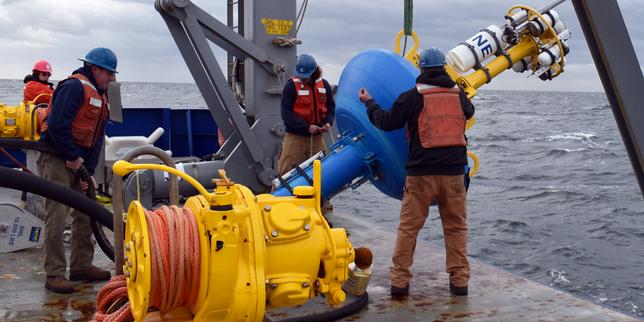
A quiet execution is taking place in the deep waters of the Atlantic and Pacific oceans. Over the next 15 months, scientific research vessels will systematically pull more than 900 highly advanced data-collecting instruments from the ocean floor. This rapid decommissioning of the Ocean Observatories Initiative, funded by the National Science Foundation, effectively blinds the international scientific community. It creates an immediate gap in real-time tracking of marine heatwaves, coastal flooding, and the weakening of global ocean currents. By shutting down this American-funded infrastructure, the global ocean observing system loses its most sophisticated cornerstone, leaving industries from commercial shipping to commercial agriculture vulnerable to unmonitored environmental volatility.
The decision is not a gradual retirement of aging hardware. It is a abrupt policy-driven termination. The network was engineered to operate for at least 25 to 30 years, establishing a multi-decade baseline required to isolate long-term climate signals from seasonal noise. Instead, it is being dismantled after just a decade.
The Hidden Anatomy of the Network
The public often views marine observation as a collection of simple weather buoys bobbing on the surface. The real machinery is far more complex. The system features heavily hardened deep-sea moorings fixed up to 2,800 meters below the surface, underwater gliders that traverse vast oceanic stretches, and remote robotic vehicles.
[Surface Buoy] ---> Beams real-time data to satellites
       |
       | (Sub-surface cables & instruments)
       v
[Deep-Sea Moorings] ---> Tracks temperature, salinity, and oxygen
       |
       v
[Abyssal Floor Sensors] -> Monitors extreme pressure & currents
These instruments do not just measure if the water is warm or cold. They track subsurface salinity, dissolved oxygen zones, and carbon dioxide absorption. This data is transmitted in real time directly to onshore laboratories and global databases.
Satellite observation cannot replace this infrastructure. While space-based sensors provide exceptional coverage of the ocean skin, they cannot penetrate the deep water column. The critical thermodynamic and chemical signals that dictate long-term weather patterns and marine ecosystem collapses occur hundreds or thousands of meters down.
Why the Shutdown Matters to Commerce
The removal of these sensors directly affects the global economy. The immediate financial consequences will hit industries reliant on highly accurate, medium-range environmental forecasting.
- Commercial Fisheries: Subsurface sensors along the Pacific Northwest coast track low-oxygen zones and rapid acidification events. Without this early-warning system, commercial fleets cannot predict the migration or sudden die-offs of high-value shellfish and finfish populations.
- Agriculture: Global food supply chains rely heavily on seasonal monsoon and drought predictions. The data generated by these deep-sea networks feeds directly into coupled ocean-atmosphere models that determine rainfall forecasts months in advance.
- Maritime Shipping and Energy: Ocean currents act as underwater highways or obstacles for massive cargo vessels. Real-time data on current velocity and structural shifts allows for optimal fuel routing and early warnings for offshore infrastructure exposed to extreme underwater pressure.
The operation of this network required $48 million annually. Compared to the trillions of dollars in economic asset value tied to accurate climate and weather data, the operational cost is a statistical rounding error. The National Science Foundation characterized the move as a "descoping" aligned with a "nimbler approach to prioritize support for evolving scientific priorities." However, decades of oceanographic consensus show that halting continuous data collection introduces irreversible gaps into long-term scientific models.
The Collapse of the Atlantic Conveyor Belt
The most urgent risk sits in the North Atlantic. The Irminger Sea array, located between Greenland and Iceland, was explicitly positioned to monitor the Atlantic Meridional Overturning Circulation, known as the AMOC. This system of deep, cold, and salty currents acts as the Earth's primary heat conveyor belt, bringing warm water northward and keeping Europe's climate habitable.
Scientists have spent years tracking signs that the AMOC is weakening due to freshwater influx from melting ice sheets. If the AMOC reaches a tipping point and shuts down, regional temperatures will shift violently, resulting in extreme cold in northern latitudes and intense heat accumulation near the equator. The Irminger Sea sensors provided the precise, continuous measurements of deep-ocean water density required to detect this threshold. Removing these sensors means navigating an increasingly volatile climate system while turning off the dashboard lights.
A Fragmented Global System
Ocean research has historically operated through international cooperation. The American network did not exist in a vacuum; it integrated into the Global Ocean Observing System, alongside European, Japanese, and international arrays like the Argo float program. When one major contributor abruptly pulls its core infrastructure, the global mathematical models degrade for everyone.
The physical removal of these systems highlights a deeper structural shift in global scientific leadership. Building deep-sea hardware capable of withstanding corrosive seawater and crushing abyssal pressure requires immense institutional knowledge and specialized engineering pipelines. Once the engineering teams are disbanded, the research vessels reallocated, and the data baselines broken, restarting the project becomes prohibitively expensive.
The data accumulated by the network will remain accessible via its data center, but a historical archive cannot forecast a live marine heatwave. The loss of real-time visibility beneath the surface leaves logistics networks, food producers, and coastal municipalities exposed to shifts they will only detect after they arrive on shore.