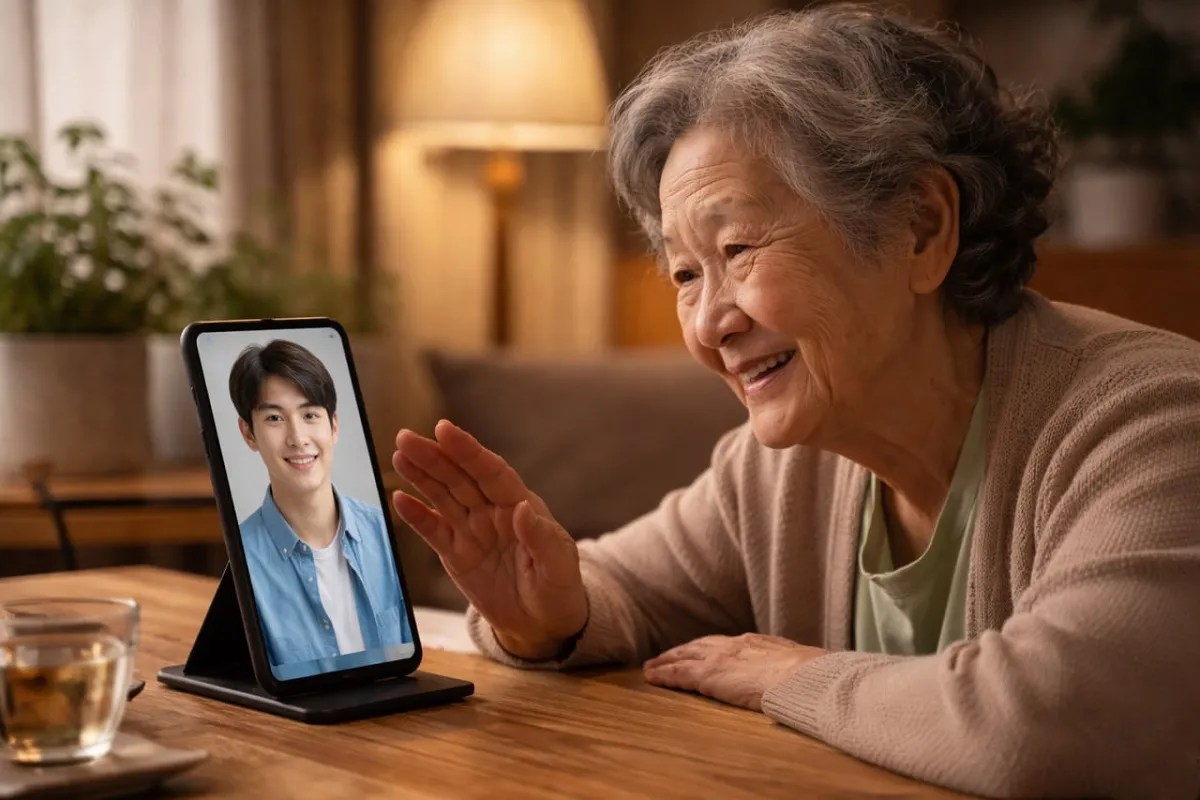
A grieving family in China recently made headlines for "reanimating" their deceased son through artificial intelligence. They used voice snippets, old videos, and photos to train a chatbot that mimics his personality, speech patterns, and physical likeness. The goal was simple: to keep his presence alive and shield an elderly grandmother from the crushing reality of his death. This is no longer a plot point from a dystopian television series. It is a booming, unregulated industry where software developers trade in the currency of loss.
While the immediate emotional relief for the family is tangible, the long-term psychological and ethical implications are terrifying. This practice, often called "ghostbotting" or digital resurrection, creates a simulated loop of interaction that prevents the natural progression of mourning. By replacing a memory with a responsive algorithm, we are entering a period where death itself becomes a negotiable status.
The Mechanics of a Digital Haunting
The process of creating a digital clone is remarkably straightforward with current tools. It begins with data ingestion. An AI model requires a "training set" composed of text messages, social media posts, and voice memos. The more data the family provides, the more accurate the imitation becomes. Large Language Models (LLMs) are then fine-tuned to adopt the specific syntax and vocabulary of the deceased.
For the visual component, deepfake technology maps the late individual's facial features onto a digital avatar. This avatar can "speak" in real-time during video calls. To the human brain, which is wired to recognize familiar faces and voices, the illusion is potent. It triggers a dopamine response that provides instant comfort. However, this is a biological hack. The brain is being told that a person who is gone is actually responding to new stimuli.
The Ethical Vacuum of Grief Tech
Companies offering these services operate in a legal gray area. There is no global consensus on who owns the digital soul of a dead person. Can a person give "post-mortem consent" to be used as a chatbot? Currently, the decision rests entirely with the living. This creates a massive power imbalance. A person may have spent their entire life being private, only for their survivors to feed their private correspondences into a third-party server to satisfy their own emotional needs.
We also have to consider the risk of data permanence. Once a person’s likeness and voice are digitized and hosted on a company’s server, that data is subject to breaches, sales, or repurposing. Imagine a deceased son being used to sell insurance or political ideologies because his digital likeness was leaked in a database hack. The commercialization of the dead is a slippery slope that we have already begun to slide down.
Psychology of the Infinite Loop
Traditional grief follows a path toward integration. You learn to live with the absence. Digital clones disrupt this. Instead of moving through the stages of mourning, the user remains stuck in a perpetual "present" with a digital ghost. Psychologists are increasingly concerned that this could lead to prolonged grief disorder, a condition where the bereaved cannot function because they are tethered to the past.
The simulation can never truly evolve. A son who died at twenty-five will stay twenty-five in the machine forever. He will never have new experiences, never change his mind, and never grow old. The family is not interacting with their child; they are interacting with a static snapshot that has been animated by statistics. It is a mirror, not a window.
The Business of False Hope
The companies behind these "grief bots" are not charities. They are startups looking for recurring revenue. By positioning their product as a tool for "healing," they bypass the scrutiny usually applied to invasive technology. They rely on the vulnerability of people at their lowest points. When a subscription fee is the only thing keeping a "son" or "daughter" "alive" on a screen, the pressure to pay becomes a form of emotional extortion.
If the company goes bankrupt or the servers go dark, the family experiences the death all over again. This "second death" can be even more traumatic because it is sudden and final in a way the first death was not allowed to be. We are seeing a shift where the grieving process is being outsourced to proprietary code, making our most intimate human experiences dependent on a corporate terms-of-service agreement.
A Legacy of Shadows
We must ask ourselves what we lose when we refuse to let go. Human memory is imperfect for a reason. It softens over time, allowing us to heal and continue living. When we replace that softening with a high-definition, 4K digital puppet, we are trading the sanctity of the human experience for a temporary sedative.
The technology will only get more convincing. In five years, these clones will be indistinguishable from the real people in a video chat. They will be integrated into smart home devices, allowing the dead to "remind" you to turn off the oven or wish you a happy birthday from a speaker in the kitchen. This is not a tribute to the dead. It is a monument to our own inability to face the finite nature of life.
The real danger is not that the AI will become sentient, but that we will become so comfortable with the simulation that we stop valuing the authentic, messy, and inevitably ending reality of being human. If you can replicate a person with a few gigabytes of data, you have effectively stripped them of their uniqueness. True honor for the dead lies in the silence they leave behind, not in a manufactured voice box that says what we want to hear.
The family in China believes they are protecting a grandmother. In reality, they are building a prison of pixels. Every time she speaks to that screen, the gap between the truth and the lie widens. When that gap finally collapses, the fall will be catastrophic. We are currently building a world where no one ever truly leaves, and in doing so, we are making it impossible for anyone to truly live. Stop trying to code a way out of sadness. Death is the one thing that should never be automated.