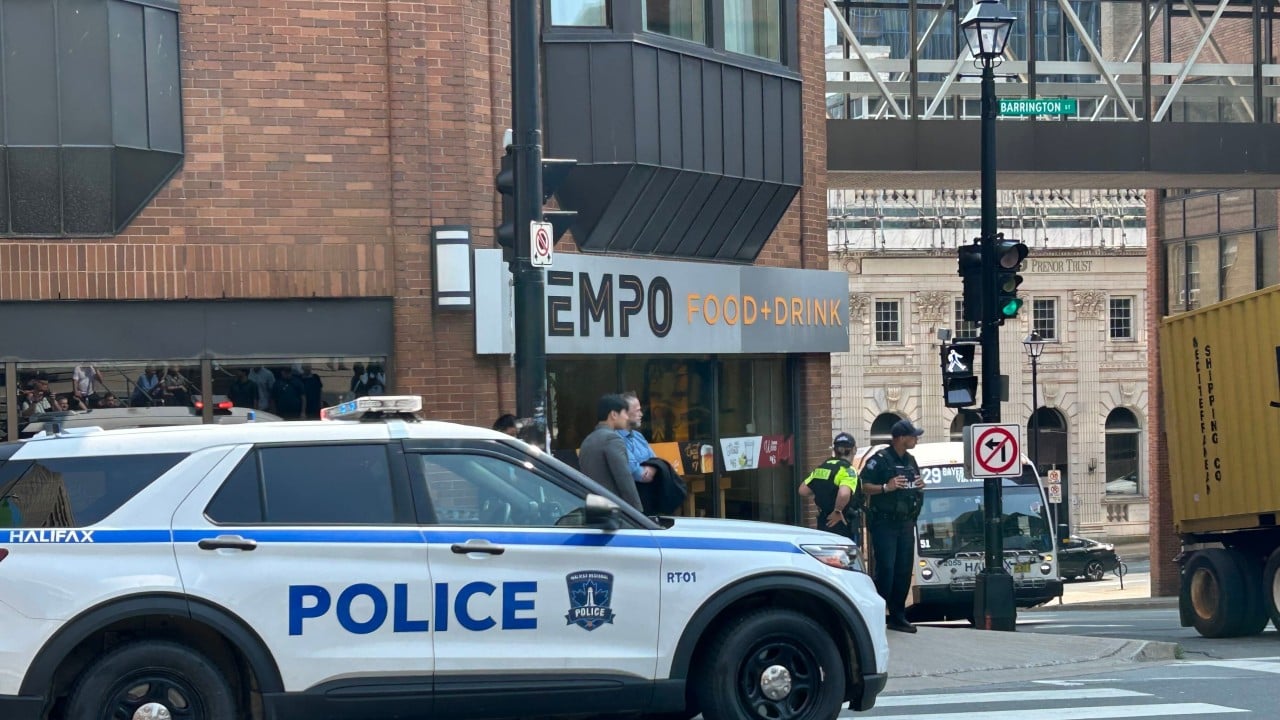
The arrest of 54-year-old Ali Assakereh following a bomb threat directed at the United States Consulate in Halifax exposes structural vulnerabilities in physical perimeter defense and municipal crisis response protocols. Rather than viewing this event as an isolated criminal aberration, security analysts must evaluate it through the lens of threat topology, resource allocation trade-offs, and the compounding risks facing foreign missions across Canada.
The Anatomy of Urban Diplomatic Targeting
Consulates operate in dense metropolitan environments that inherently conflict with high-security hardening principles. Unlike fortified embassies located in sprawling diplomatic compounds, urban consulates share real estate with commercial enterprises, public parking facilities, and high-pedestrian corridors.
In the Halifax incident, the suspect parked a vehicle containing a propane tank and containers of flammable liquid inside the parkade of Purdy's Wharf, a multi-use commercial complex housing the American post. This vector exploits an unavoidable operational paradox: missions must remain accessible to the public and local commerce while simultaneously defending against asymmetric threats.
The mechanism of disruption relies less on actual kinetic yield and more on economic and psychological leverage. By utilizing ubiquitous materials—such as pressurized gas cylinders and accelerants—an individual can trigger a disproportionate municipal response without acquiring restricted military-grade ordnance. The cost function heavily favors the perpetrator; minimal material investment yields maximum municipal friction, including downtown street closures, transit halts, and mass evacuations.
Assessing the Macro Threat Environment
To understand the Halifax event, it must be indexed against preceding security failures at other Canadian diplomatic posts. Earlier in the year, the U.S. Consulate in Toronto experienced two distinct armed attacks:
- In March, multiple rounds were fired into the downtown Toronto building, prompting the Royal Canadian Mounted Police to classify the event as a national security incident.
- On July 27, another shot was fired at the facility, with subsequent investigations pointing toward organized criminal networks rather than conventional ideological terrorism.
While Canadian authorities have stated there is no direct operational link between the Toronto firearms incidents and the Halifax bomb threat, the aggregate pattern signals a normalization of hostility toward American state symbols. Each incident lowers the threshold for copycat behavior, altering the risk calculus for local law enforcement agencies tasked with protecting foreign dignitaries.
The Economic and Operational Toll of False Positives
When Halifax Regional Police received notification of the threat on a Sunday evening, a standardized algorithmic response sequence was initiated. The discovery of the vehicle mandated the deployment of specialized Explosive Disposal Units, the establishment of a multi-block security perimeter, and the evacuation of commercial spaces.
Subsequent analysis by explosives experts confirmed that the materials inside the vehicle posed no actual detonation hazard. However, security efficacy cannot be measured solely by post-hoc explosive validation. The systemic cost includes:
- Resource Saturation: Pulling specialized tactical and investigative units away from routine municipal policing to manage a localized perimeter.
- Commercial Downtime: Halting business operations across several core downtown blocks for hours.
- Intelligence Deficit: The suspect's ability to travel approximately ten kilometers away from the primary containment zone before being apprehended near the Canada Games Centre highlights gaps in real-time tracking during active threat windows.
Strategic Realignment for Mission Defense
Defending urban diplomatic installations requires shifting from reactive perimeter hardening to predictive threat mitigation. Consulates embedded in commercial structures must decouple their security infrastructure from civilian infrastructure.
Intelligence sharing between municipal police services, federal agencies, and diplomatic security details must transition from retrospective notification to predictive pattern analysis. The convergence of domestic grievances, mental health crises, and easily accessible tactical vectors means that physical hardening alone will fail to deter disruption. Law enforcement must integrate continuous behavioral monitoring of surrounding access points to intercept threat actors before vehicles reach vulnerable subterranean parkades.