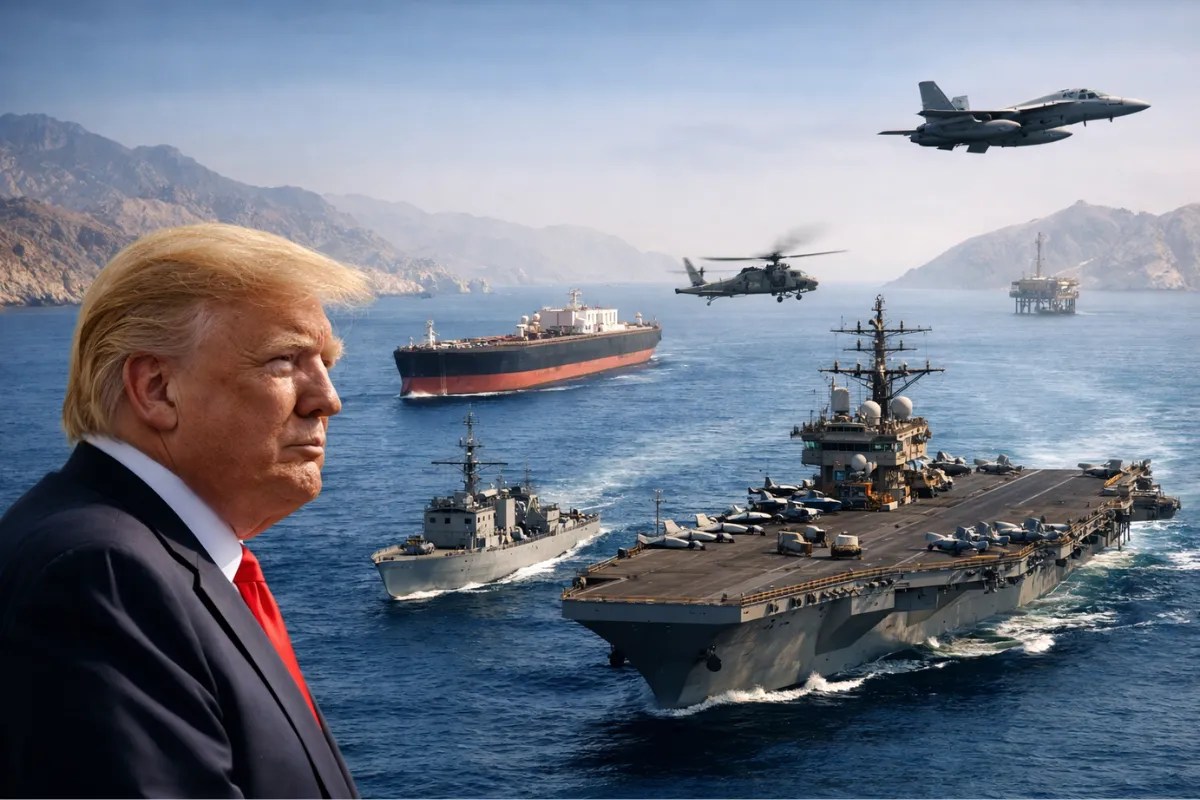
Iran is threatening to choke the global economy, and Donald Trump isn't having it. The Iranian regime recently declared they won't let a single ship pass through the Strait of Hormuz without their explicit permission. It's a massive escalation. Trump fired back instantly, making it clear that the United States must open the strait, by force if necessary.
This isn't just political posturing. It's a battle over the world's most critical maritime chokepoint. If you look at a map, the Strait of Hormuz is a narrow strip of water separating Iran from Oman and the United Arab Emirates. It connects the Persian Gulf with the Gulf of Oman and the Arabian Sea. At its narrowest point, the shipping lane is only two miles wide in either direction. Yet, about 20% of the world's total petroleum liquids pass right through this tiny corridor.
Iran knows this. They use it as a geopolitical gun to the world's head. Trump knows it too, and his latest response signals a dramatic shift in how the US intends to handle Tehran's naval bullying.
The Massive Scale of the Hormuz Chokepoint
Let's look at the numbers because they show exactly why everyone is panicking. We're talking about roughly 20 million barrels of oil moving through that strait every single day. That is more than the daily consumption of the entire United States. It's not just crude oil either. Massive quantities of liquefied natural gas, or LNG, from Qatar rely entirely on this route to reach markets in Asia and Europe.
If Iran blocks the strait, global energy supply drops instantly. Oil prices would skyrocket overnight. I'm talking $150 or even $200 a barrel within days. Gas prices at your local pump would soar. Inflation, which global economies have been fighting desperately to control, would spiral completely out of hand.
Iran claims they have the right to control these waters. They don't. The 1982 United Nations Convention on the Law of the Sea establishes the right of transit passage for international shipping through straits used for international navigation. Iran signed this treaty, though they never ratified it. They argue they only owe transit rights to countries that also ratified the treaty. The US hasn't ratified it either, but Washington views the transit rules as customary international law that applies to everyone. It's a legal mess with explosive real-world consequences.
Trump Strategy vs Previous Administrations
Washington usually responds to Iranian threats with slow, bureaucratic diplomacy. They build international coalitions. They issue strongly worded statements at the UN. Trump doesn't operate that way. He sees this as a direct threat to American economic security and global stability. His immediate declaration that the US must open the strait shows a preference for overwhelming deterrence over diplomatic hand-wringing.
During his first term, Trump implemented a maximum pressure campaign against Iran. He pulled out of the 2015 nuclear deal and slammed Tehran with devastating economic sanctions. Iran responded then, as they are now, by harassing commercial tankers and seizing foreign ships. Trump countered by launching Operation Sentinel, a maritime security initiative designed to escort commercial vessels through the Gulf.
His current stance is even more aggressive. By stating flatly that the US will ensure the strait stays open, he's drawing a hard red line. He's telling Tehran that any attempt to enforce a "permission slip" system for international shipping will be met with American military power. The US Navy's Fifth Fleet, based nearby in Bahrain, is designed exactly for this type of conflict.
How Iran Actually Tries to Close the Strait
Iran can't actually seal off the Strait of Hormuz permanently with conventional warships. The US Navy would wipe their surface fleet off the water in forty-eight hours. The Iranian military knows this, so they rely on asymmetric warfare instead.
They use thousands of fast-attack sea boats. These are small, highly maneuverable craft armed with missiles, machine guns, and mines. They swarm large, slow-moving commercial tankers. They can drop naval mines stealthily throughout the narrow shipping lanes. They also possess an extensive arsenal of anti-ship ballistic and cruise missiles hidden along their rugged coastline.
Even if Iran doesn't stop every ship, just the threat of an attack causes insurance rates for shipping companies to rise astronomically. Commercial fleets simply refuse to enter the Persian Gulf when insurance premiums double or triple. Iran doesn't need a total physical blockade to cause global economic chaos. They just need to make the route too risky to insure.
Real Economic Fallout of a Blockade
Think this doesn't affect you? Think again. The global economy runs on just-in-time supply chains. A disruption in Hormuz immediately hits manufacturing hubs across Asia, particularly China, Japan, and South Korea, which import the vast majority of their energy from the Gulf.
When Asian factories face power shortages or massive fuel costs, the price of everything they export goes up. Electronics, car parts, clothing, and consumer goods become more expensive everywhere. Europe, already struggling with energy security issues over the last few years, would face a brutal winter energy crisis.
The US is more energy independent now than it used to be, thanks to domestic shale production. But oil is a globally traded commodity. If the global price spikes, American oil prices spike too. No one escapes the economic fallout of a closed Strait of Hormuz. That's why Trump is treating this as an absolute emergency.
Military Reality of Opening the Shipping Lanes
If Trump executes his plan to force the strait open, it will require a massive military campaign. It's not just about sailing an aircraft carrier through the gap.
The US military would need to conduct extensive minesweeping operations. This is slow, dangerous work. Navy mine countermeasures ships and specialized helicopters would have to clear the waters while under constant threat of coastal missile strikes. To protect those minesweepers, the US would likely have to neutralize Iranian missile sites and drone bases along the coastline.
That means airstrikes. It means an immediate escalation into a broader regional conflict. Allies like the UK, France, and regional partners like Saudi Arabia and the UAE would be dragged into the operations. It's a high-stakes gamble, but letting Iran dictate who enters and leaves the Persian Gulf is a concession the US simply cannot afford to make.
Navigating the Geopolitical Fallout
Keep a close eye on oil market volatility and shipping insurance indices over the coming weeks. The tension in the Middle East is reaching a boiling point, and the Strait of Hormuz remains the ultimate flashpoint.
Governments and major corporations are already drawing up contingency plans, rerouting whatever supplies they can through pipelines across Saudi Arabia to the Red Sea, though these pipelines don't have nearly enough capacity to handle the full volume of Hormuz. Expect the US Navy to increase its visible presence in the region immediately to reassure markets and deter further Iranian aggression. Diversify your energy sector investments now to prepare for potential supply shocks. Keep your eyes on the daily shipping data coming out of the Persian Gulf, because what happens in that two-mile-wide lane dictates the economic future of the planet.