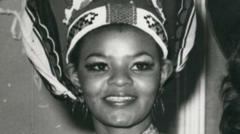
The 1970 Miss World pageant served as a critical inflection point where the internal racial hierarchies of the South African apartheid state collided with the burgeoning pressure of international diplomatic isolation. The death of Pearl Gladys Jansen at age 76 necessitates a forensic examination of the "Two-Entry System," a unique structural anomaly in pageant history that attempted to solve a geopolitical legitimacy crisis through a bifurcated representation of a single nation. This system was not a gesture of inclusion but a calculated tactical maneuver designed to retain South Africa’s membership in the Miss World Organization while adhering to the domestic mandate of the Group Areas Act and the Population Registration Act of 1950.
The Structural Architecture of Segregated Representation
In 1970, South Africa faced imminent expulsion from international sporting and cultural bodies. To preempt a total ban from the Miss World stage, the South African organizers, in coordination with pageant director Eric Morley, engineered a dual-representative framework. This framework operated on two distinct tracks:
- The Miss South Africa Track (White): Represented by Jillian Jessup. This track held the official state-sanctioned title and enjoyed the full financial and institutional backing of the South African pageant establishment.
- The Miss Africa South Track (Black): Represented by Pearl Gladys Jansen. This designation—specifically the inversion of the country name—was a linguistic and legal partition. It functioned as a "separate but equal" proxy to satisfy international observers without challenging the internal racial caste system.
This duality created a unique friction. For the first time, the Miss World stage hosted two contestants from the same sovereign entity, each representing a different legal and social reality within that entity.
The Socio-Economic Displacement of Pearl Jansen
While the competition resulted in a historic second-place finish for Pearl Jansen—the highest ranking for any South African contestant up to that point—the outcome was decoupled from the economic and social mobility typically associated with the title. In a standard pageant trajectory, a runner-up finish functions as a catalyst for high-yield modeling contracts, brand endorsements, and media careers. For Jansen, the apartheid regime’s domestic policies acted as a ceiling that nullified the "Miss World Effect."
The Multiplier Gap
The discrepancy in the professional outcomes of Jessup and Jansen highlights the "Multiplier Gap" in segregated markets. In a unified market, a Miss World runner-up title carries a predictable valuation based on audience reach and brand alignment. In the 1970 South African context, Jansen’s valuation was restricted to the "Non-White" market, which was systematically impoverished by job reservation laws and the Lack of capital access.
- Contractual Barriers: International brands feared domestic boycotts from the White minority government if they signed Black representatives for national campaigns.
- Geographic Restrictions: The Group Areas Act confined Jansen to specific residential and commercial zones, preventing the physical mobility required for a high-profile media career.
- Media Blackouts: The state-controlled South African Broadcasting Corporation (SABC) prioritized White cultural narratives, effectively erasing Jansen’s achievement from the national visual record for decades.
Geopolitical Optics and the 1970 Protests
The 1970 pageant was a flashpoint for the Anti-Apartheid Movement (AAM). Protesters, including the Women’s Liberation Movement, targeted the event not only for its perceived objectification of women but specifically for its complicity in the South African racial charade. The presence of two South African contestants provided a visible, undeniable metric of the state's internal divisions.
From a strategic communications perspective, the South African government’s "Two-Entry" strategy backfired. Instead of demonstrating a move toward reform, it highlighted the absurdity of the apartheid logic. The international press focused on the irony: a Black woman, officially designated as an inferior citizen in her home country, was judged as one of the most beautiful women in the world on a global stage. This cognitive dissonance accelerated the call for a total cultural boycott, which was eventually realized when South Africa was banned from Miss World in 1977.
The Mechanics of Erasure and Late-Stage Recognition
The transition from the apartheid era to the democratic era (post-1994) required a massive recalibration of South African national identity. In this process, the stories of pioneer figures like Pearl Jansen faced a secondary risk: historical flattening. Because Jansen’s 1970 achievement was an artifact of a segregated system, it sat uncomfortably within both the "old" and "new" South African narratives.
- The Old Narrative: Jansen was a temporary concession to international pressure, to be ignored once the cameras stopped rolling.
- The New Narrative: The focus shifted to "firsts" within the democratic era, such as Basetsana Kumalo (1994) or Zozibini Tunzi (2019), sometimes overlooking the survival and agency of those who competed under the "Africa South" banner.
Jansen’s later life, marked by financial hardship and a late-career return to music and public speaking, illustrates the long-term cost of being a "representative" without being a "citizen." The lack of a pension or structured support for these early icons is a failure of the cultural transition strategy.
Analytical Conclusion: The Legacy of Controlled Inclusion
The death of Pearl Jansen marks the end of a living link to one of the most complex psychological operations in 20th-century cultural history. The 1970 Miss World pageant was not an isolated entertainment event; it was a laboratory for "Grand Apartheid" to test its ability to manipulate global perception.
The primary lesson for contemporary analysts lies in the fragility of "symbolic inclusion." When a minority representative is granted access to a high-status platform without a corresponding change in the underlying legal and economic infrastructure, the result is a temporary optical win followed by long-term systemic neglect.
Future cultural diplomacy and DEI (Diversity, Equity, and Inclusion) frameworks must account for the "Jansen Variable": the delta between global visibility and local agency. For brands and nations alike, representation is a liability rather than an asset if it is not supported by a unified legal status and equitable access to the capital generated by that representation. The strategic play for South Africa—and by extension, any nation navigating a fractured identity—is the aggressive integration of historical figures into the current national brand equity. This involves more than retrospective awards; it requires the institutionalization of their stories into the national curriculum and the establishment of heritage funds to ensure that those who served as the nation's "diplomatic shields" do not perish in the shadows of the systems they once helped to navigate.