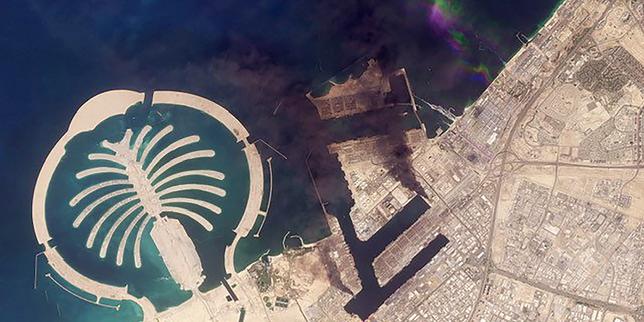
The skyscraper-studded horizon of Dubai has long functioned as a geopolitical Switzerland with better weather and deeper pockets. For decades, the emirate’s value proposition was simple. It was the place where everyone could do business with everyone else, regardless of the fires burning in the neighbors' yards. But that frictionless reality is hitting a wall of hard power. As regional conflicts move from proxy skirmishes to direct confrontations, the "city of the future" is finding that you cannot build a global hub on a fault line without eventually feeling the tremors.
Dubai’s success rests on its ability to remain agnostic. It welcomed Russian capital when the West slammed the door. It became a vital conduit for Iranian trade under the shadow of sanctions. It signed the Abraham Accords with Israel while maintaining its status as a playground for the Arab elite. This balancing act was not just clever diplomacy; it was the core business model. However, the current escalation across the Middle East—from the Red Sea to the Levant—has turned Dubai’s greatest strength into its most acute vulnerability. The world is no longer content to let Dubai sit on the fence, and the fence itself is starting to splinter.
The End of the Frictionless Hub
Money flows to where it feels safe, but safety is a relative term. In the 1990s and 2000s, Dubai was the safe haven because it was the only adult in the room during regional tantrums. Today, the risks are no longer contained. The Houthi attacks on maritime shipping in the Red Sea have done more than just delay Amazon packages; they have challenged the very idea of the Gulf as a secure logistics artery. If the ships cannot pass through the Bab al-Mandab Strait reliably, the massive Jebel Ali Port loses its luster as the undisputed gateway to the world.
Logistics is a game of pennies and predictability. When insurance premiums for tankers spike because of drone threats, the "Dubai discount" evaporates. We are seeing a shift where global firms are beginning to calculate the cost of "geopolitical overhead." It is a tax that Dubai never used to charge. While the cranes are still moving and the malls remain full, the boardroom conversations in London, New York, and Tokyo have changed. They are no longer asking how much they can grow in Dubai, but how much exposure they have if the Strait of Hormuz ever sees a serious blockade.
The Sanctions Squeeze
For years, the UAE has perfected the art of "strategic autonomy." This is a polite way of saying they talk to everyone. But the U.S. Treasury Department is losing its patience with the emirate’s role as a clearinghouse for sanctioned goods and "gray market" capital. The pressure is no longer subtle. We have seen a steady drumbeat of visits from high-ranking American officials, all carrying the same message: pick a side.
The influx of Russian wealth following the invasion of Ukraine was a massive boon for the local real estate market. Penthouses in the Marina and villas on the Palm were snapped up with record-breaking speed. But this windfall came with a target. The West views this capital flight as a leak in their economic pressure cooker. As a result, Dubai’s banking sector is under a microscope. Opening a business account in the UAE, once a relatively straightforward process, has become a gauntlet of compliance and "Know Your Customer" (KYC) hurdles. The friction has returned, and for a city built on the promise of speed, friction is a slow-acting poison.
The Competition from Within
While Dubai stares down global threats, it also has to look over its shoulder at its neighbor. Riyadh is no longer content to let Dubai be the region's only headquarters. Saudi Arabia’s "Program Regional Headquarters" is a direct shot across the bow. By telling multinational companies that they won't get government contracts unless their main regional office is in the Kingdom, Saudi is forcing a choice that most CEOs would rather avoid.
Dubai’s response has been to double down on the "lifestyle" angle. It remains the most liberal, livable, and cosmopolitan city in the region. But business isn't always driven by where the executives want to party; it's driven by where the capital is deployed. Saudi Arabia has the sovereign wealth and the massive domestic market that Dubai lacks. If Dubai is a shopfront for the world, Saudi is a construction site the size of a continent. You can ignore a shopfront; you cannot ignore the world's largest customer.
The Talent Trap
The emirate’s demographic makeup is its most fragile component. With an expatriate population hovering around 90%, the city is a collection of guests. These guests stay as long as the economic weather is good. The moment the risk-to-reward ratio tips, the exodus begins. We saw it in 2008 during the financial crash, and we saw a version of it during the early days of the pandemic.
The difference now is the nature of the talent. Dubai is trying to pivot from a service-and-construction economy to a tech-and-innovation hub. Coders, AI researchers, and fintech founders are more mobile than civil engineers. They don't need to be in Dubai to build their products. If the region becomes too "hot" from a military perspective, or if the regulatory environment becomes too stifling due to international pressure, this high-value talent will move to Singapore, Lisbon, or Miami. The UAE’s introduction of "Golden Visas" was a smart move to anchor these people, but a residency permit is not a shield against a regional war.
A City Without a Hinterland
Every other global city has a buffer. London has Europe (geographically, if not politically). New York has the vast American interior. Singapore has the manufacturing engines of Southeast Asia. Dubai has the desert and a neighborhood that is increasingly on fire. It is an island of extreme prosperity in a sea of volatility.
This lack of a stable hinterland means Dubai must over-perform constantly. It cannot afford a "down" decade. The infrastructure is world-class, but the maintenance of that infrastructure requires a constant, aggressive inflow of foreign cash. The city is a perpetual motion machine; if it slows down, it doesn't just stagnate—it risks a structural collapse. The "city-state" model is brilliant during periods of globalization and peace, but we are entering an era of fragmentation and "friend-shoring." In a world of blocs, being friends with everyone makes you a person of interest to everyone.
The Hard Reality of Soft Power
Dubai has spent billions on soft power. The Expo, the world-class airlines, the sporting events—these are all designed to make the city indispensable. The logic is that if the world is invested in Dubai, the world will protect Dubai. It is a form of security through integration.
But soft power is useless against a ballistic missile or a cyber-attack on a power grid. The recent reality is that regional actors are increasingly willing to use hard power to settle scores. When drones targeted fuel trucks in Abu Dhabi a couple of years ago, the psychological shock was more significant than the physical damage. It proved that the "Gulf Bubble" is permeable. Since then, the UAE has significantly ramped up its own defense capabilities, but every battery of Patriot missiles installed is a quiet admission that the era of "purely commercial" growth is over.
The Trade-Offs Ahead
The path forward for Dubai involves some of the most difficult choices in its short history. To stay in the West's good graces and maintain its position as a global financial node, it may have to sacrifice the "gray money" that has fueled its recent booms. This would cause a cooling of the property market, which is the bedrock of the local economy.
Conversely, if it ignores the pressure and continues to act as a bridge for the East and sanctioned states, it risks being cut off from the dollar-clearing system. There is no middle ground in a Cold War, and the current global climate is starting to feel very chilly. The leadership in Dubai is pragmatic, perhaps the most pragmatic in the world. They will try to navigate this by making small concessions to everyone, but the room for maneuver is shrinking every month.
The Infrastructure of Illusion
Walking through the Dubai International Financial Centre (DIFC), you could be in Canary Wharf or Hudson Yards. That is by design. The legal system in the DIFC is based on English Common Law, specifically to make Western investors feel at home. This "legal oasis" was a masterstroke. It allowed Dubai to bypass the perceived risks of local courts.
But a legal system is only as strong as the sovereignty that guarantees it. As the UAE navigates its relationship with the BRICS bloc—having officially joined recently—it is attempting to create a new kind of sovereignty. One that doesn't rely on the American security umbrella. This is a massive gamble. The UAE is betting that the world is moving toward a multi-polar reality where they can play both sides indefinitely. If they are right, Dubai becomes the capital of the "Non-Aligned 2.0." If they are wrong, they are an outpost that the West will eventually stop defending.
The Next Phase of the Gamble
We are witnessing the end of Dubai's "easy" growth phase. The years of building a taller tower or a bigger mall and watching the world flock to it are over. The competition is smarter, the regional risks are higher, and the global tolerance for "neutral" hubs is at an all-time low. Dubai must now prove it can be more than just a place to park money and change planes.
The city is currently attempting to rebrand itself as a global leader in specialized industries like green hydrogen and synthetic biology. These are high-stakes, capital-intensive bets. They require a level of long-term stability that the region hasn't seen in a century. The cranes are still moving, yes, but the people operating them are looking at the news more often than they used to. The spectacle remains, but the audience is starting to check where the exits are located.
Would you like me to analyze the specific sectors within the UAE economy that are most vulnerable to these shifting geopolitical alliances?